Flames have turned Aldea del Fresno into a ghost town for the past six days. Its 3,500-odd residents were evacuated last Saturday as fires raced through the western Madrid mountains, and since then, the place has remained eerily silent, with a layer of ash carpeting balconies, gas stations and vehicles that were abandoned in haste. Although there is no damage within the urban perimeter, the local police are patrolling the deserted streets and warning: “If anyone remains here, they are thieves.” On Tuesday at 5.00 pm officials announced that residents could return to their homes, but the village is still empty. The persistent smell of smoke proves the nightmare is not over.
Barely a kilometer from the village, several people are working to extinguish the constant flare-ups devouring the hills. “I’ve been here for 17 hours putting out hotspots, but they keep coming back,” says José Luis, the guard of a 1,200-hectare rural estate that now looks like an ocean of charred holm oaks and columns of smoke. “We ran out on Thursday because the fire was extremely fast, the fastest I’ve seen; tongues of fire were passing through. Everything burned down in two or three hours,” he recalls.
Firefighters and aerial units intervened to put it out, but the flames were still burning the next day. José Luis drives a pick-up as he crosses the estate to locate hotspots, and a herd of fallow deer crosses the dirt track, looking disoriented. “The workers were able to flee, and the fences have been opened so the wild animals can escape, but everything is burned, they have nowhere to run to,” he explains. He saw the fire jump from one side of the Picada water reservoir to the other, from hill to hill. He returned on Saturday and everything was already razed.
It is still too early to calculate the affected area, but the guard estimates it will not be less than 400 hectares (988 acres). He has worked here for seven years, and now, in addition to spending hours walking the winding trails looking for new fires, he monitors the estate’s webcams on his phone. He says he wasn’t afraid at the worst moment of the fire, but he winces remembering himself watching the screen as the flames devoured everything in the middle of the night.
Hilario Ruiz-Labourdette is an agricultural engineer and the manager of the estate. He praises the fast work by the Military Emergency Unit (UME), which protected workers and residents, but he says more is needed to save the land. “You can’t leave everything to the firefighters because they are overwhelmed and there aren’t enough people or resources in these circumstances,” he explains. “It’s important to protect lives, but if you evacuate the estates there’s no one left to protect them and to assist in fighting the fire; local people who know the access points, the tracks, the most dangerous spots that are of great importance in extinguishing the blaze,” he adds. He has requested permits to help control fires on the estate, but calls for more help: “We have been working day and night since Saturday, because although the fire may seem to have passed, the danger persists for several days.”
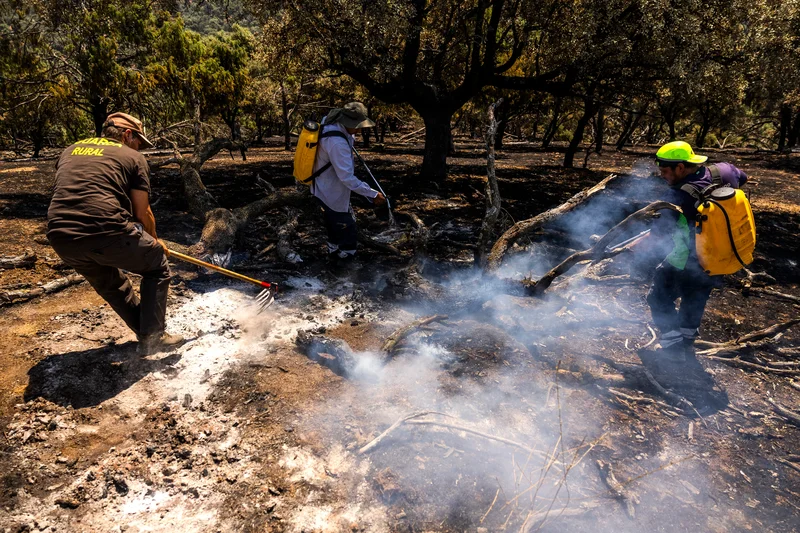
That is why, in addition to José Luis, they have hired two more people, Carlos and Santi, to continue putting out the constant hotspots and to cool the ground. Tomorrow nine professional firefighters will arrive because the flare-ups continue. “Just last night there were three new hotspots,” Hilario explains.
At this stage, the work involves returning again and again to places that have already burned, because even when the flames seem to disappear, they are still there in the subsurface. “That’s the most dangerous part; on the surface it looks like pouring water and raking the embers finishes the job, but no, it’s still under there,” says José Luis, stamping on the blackened soil that raises a cloud of ash and dust. Carlos carries huge water drums on his back with which he sprays the same spot again and again as he did last night and the night before. This time it gets out of control, and the flames rise several meters off the ground. “It’s even under the rocks,” says Carlos, wiping sweat from his brow after yet another intervention. He has three years’ experience in firefighting and swears he has never seen anything like this fire: neither so fast nor so large. In addition, they face another difficulty: they only have water from a nearby well, because the conduits of Madrid’s water distribution system, the Canal de Isabel II, have been destroyed by the fire. This means that they must climb up and down the ridge to refill the drums.
According to José Luis, the firebreaks have done little—at least those created by human hands. “What has worked as a natural firebreak here are the deer, which by grazing the lower parts of the holm oaks have prevented the fire from climbing into the crowns of the trees, because the wind drove it very fast at ground level,” he explains. The landscape, depending on the slope, is clearly divided: on one side there are huge expanses of holm oaks scorched at the trunk but still with green remnants in the crowns; on the other a charred desert, speckled with the white ash of what once were holm oaks and junipers. There is no trace left of the underbrush; all the broom shrubs have either burned or are still burning. The pine forest has not been spared either. “This will take at least two years to recover,” says José Luis, shaking his head. When they discover another hotspot on one of the estate’s highest parts, he stops for a moment to contemplate the blackened desert: “Look, from here we could see all the fires on Friday—the one in Burgohondo (Ávila), the one in Navas...” he says, pointing to a hill visible on the horizon shrouded by a gray haze. The estate spans several municipalities, all still with active fronts. The smell of smoke curls in his throat, but he says he no longer smells anything. He insists that more hands and more eyes are needed: today there are three of them and tomorrow there will be 12, and José Luis sighs when asked if that will be enough. “It’s impossible to know which hotspot we think we’ve put out but is still there, accumulating heat,” he explains. “The worst part is at night,” adds Carlos, “because that’s when you see it burning; you can’t just look for smoke.” He relentlessly sprays water from the yellow drum and mutters: “I put out this branch yesterday already.” And today it is burning again.
The church bell of Aldea del Fresno tolls, but it rings for no one. Its inhabitants remain sheltered in nearby Villamanta, housed in sports centers safe from the flames. They believe they will be able to return this afternoon. In their village, the fire has passed, but it is only a pause. The flare-ups remain.