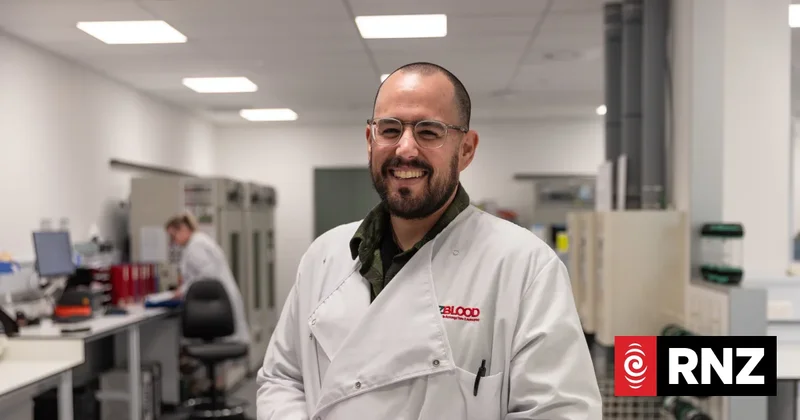
The New Zealand Blood Service says the capital's new blood bank - officially opened by the Health Minister on Wednesday - couldn't come soon enough.
The service at Wellington Regional Hospital plays a critical role in delivering life-saving donor blood to patients and according to staff, the new facility is a major upgrade.
NZ Blood Service chief executive Sam Cliffe said the almost 50-year-old former laboratory was "hopelessly not fit-for-purpose".
"The light fittings were so old we couldn't get new bulbs ... it was virtually impossible to clean. The staff did an amazing job of continuing to operate a very safe and reliable service."
She said the new space had been a long time coming and a couple of years ago things reached a crisis point.
"It could have been quite a dangerous situation in that we could have had our accreditation removed and we wouldn't have been able to provide a full service blood bank," she said.
That didn't happen. Health New Zealand found a solution, Cliffe said and the team was "utterly delighted" with it.
She said the facility was built for under $2 million "on time and on budget".
Wellington blood bank team leader Dan Gyles said he felt a mixture of relief and excitement at Wednesday's opening after pushing for a new lab for close to 16 years.
"It means everything. We now have space to do the job that we should have been doing all along. We have, despite the previous conditions, managed to maintain a safe service, but that was all it was."
He said they now had the space to implement laboratory practices around wearing gowns and protective gear, where required. "Rather than having tea breaks on our knees in the corner."
The laboratory, which includes pneumatic tubes that send and receive blood to and from the wards, multiple blood fridges, freezers storing plasma at minus 35 degrees, and room-temperature storage cabinets that keep platelets "jiggling," is three times the size of the old lab - built to meet expected future demand.
Gyles said the extra space also meant a second blood grouping and screening machine, which was a game changer for the dozen staff that keep the service running around the clock.
"These do our grunt work, so this is where the patient samples are loaded up and we determine their blood group ... and then we do a red cell antibody screen."
The process ensured the blood was compatible with the patient who received it, he said.
Gyles said the blood bank was the behind-the-scenes critical step between people donating blood and patients receiving a transfusion - the majority of which were cancer patients, like Mel Homer.
Homer has received multiple blood transfusions over the past year while undergoing treatment for acute myeloid leukaemia, a blood cancer.
"They basically nuke your whole system, it's like scorched earth and you have no immune system and the idea is that they also kill off the cancer cells, and hopefully they don't grow back."
She said the treatment saw her haemoglobin and white blood cell count drop and her platelets - the clotting component - tank.
"You can't function properly so you need blood transfusions to top you up to a level so you can start healing."
In addition to red blood transfusions, Homer also needed platelets to reduce the risk of brain bleeds - but there were only two donors whose platelets were compatible, she said.
"It was life-saving." She said every time she used it - which was multiple times - she would think, "I'm so grateful".
The blood bank also had to be ready for emergencies, Gyles said. Plasma was most often used for bleeding patients, patients in theatre, or trauma patients, he said.
It took about 15 minutes for the frozen blood product to thaw in a jiggling bath at 37C, he said.
"A bleeding patient - they need it quickly. So we've got some pre-thawed ahead of time."
Two years ago, Megan Piercy became a bleeding patient when she suffered a post-partum haemorrhage following the birth of her son.
"It was all kinds of bells and whistles from there. I had lost ... just over two litres at once."
She said given the emergency situation, she received blood from the universal donor type, however, samples of her blood were also sent off for testing in case she needed something more specific.
Piercy said the transfusion was crucial.
As a passionate blood donor herself, she knew the importance of it, she said. "I just never expected to be on the receiving end of it."
Michelle Sutherland, interim group director of operations for Capital, Coast and Hutt Valley, said the new blood bank was an important investment in the region's health services.
"Having this purpose-built facility on site strengthens our ability to deliver timely, safe and high-quality care for patients who need blood transfusions and other specialist services," she said.
Cliffe said patients, however, shouldn't notice the difference between Wellington's new blood bank and its predecessor.
"We've continued to maintain the same level of service delivery under incredibly trying conditions. [For] the people of Wellington this should be seamless."
She said the new facility - in addition to future-proofing the service - provided the space for it to resume practical laboratory training for pathology professionals in the Pacific.
"We had to stop ... because it required us to have students in the lab that we would actually train hands-on. We just didn't have the space or capacity to do that. We now do."