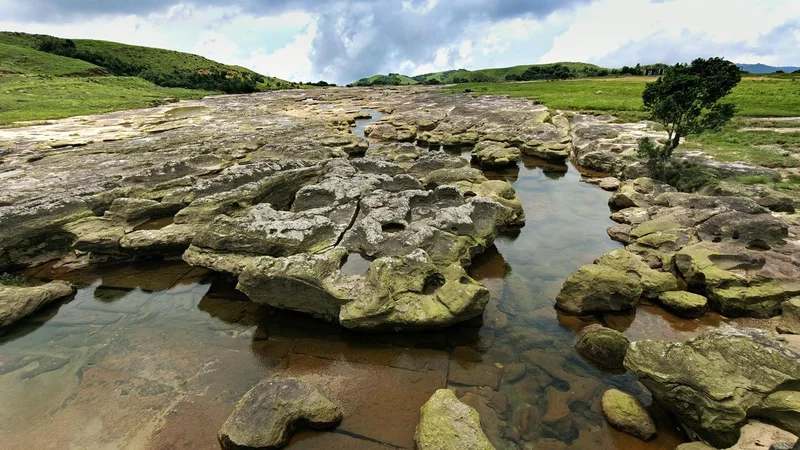
By November, the streams around Sohra begin to fall silent. The rivers that roared through the monsoon thin to a trickle and then to nothing, and the springs that families have drawn from for generations turn seasonal. By deep winter, in a town that holds two world records for rainfall, people are buying water by the bucket.
A bucket carted up from the plains costs anywhere between ₹20 and ₹50, depending on the month. Some households pay close to a thousand rupees for 500 litres. The residents of Sohra, the town the world still calls Cherrapunji, describe the shortage plainly: from November to March, water is something you purchase. What was once perennial is now seasonal. What was once shared is now sold.
It is a contradiction that ought to be impossible. Sohra and neighbouring Mawsynram are among the wettest inhabited places on earth, drenched by an average of over 11,000 mm of rainfall a year — figures that dwarf almost anywhere else on the planet. Yet in the winter dry months, at least 40% of residents in the Sohra constituency face an acute shortage of potable water, buying it from private contractors at prices that rise with scarcity. Ahead of successive Assembly elections, drinking water has become a campaign promise made to more than 25,000 voters, and broken with equal regularity.
The paradox of Meghalaya is not that the rain has stopped. It is that abundance has never guaranteed access — and that the State built almost nothing to hold on to what the sky gives it.
The rain is changing
The first pressure is the rain itself. The monsoon that once blotted out the sun for months now arrives in shorter, sharper bursts. Older residents remember a childhood when the rain was so relentless that a clear sky was a novelty; today, they watch their rivers sit at record lows.
The trend is measurable. A study by researchers at the Indian Institute of Technology, Kharagpur, and the Indian Institute of Tropical Meteorology, Pune — drawing on rain-gauge records across Northeast India from 1901 to 2019 — found a clear long-term decline in rainfall across the region. Sohra has been losing an estimated 27.15 mm of rainfall a year over roughly the past four decades. The slide has already cost the town its title as the wettest place on earth, a distinction that has passed to Mawsynram, barely 15 km away. Even Mawsynram is now recording a decrease.
The researchers trace the reduction in part to rising sea-surface temperatures in the tropical Indian Ocean and the Arabian Sea, which are altering the moisture carried inland during the crucial pre-monsoon window. Satellite records point to a second, more local driver: the loss of vegetation cover across the Northeast over the past two decades. As forests give way to croplands, both the rainfall and the land’s ability to absorb it decline together.
Rain is not the same as water
Meghalaya’s second problem is geology and slope. Sohra sits atop a high limestone plateau, and rain that falls on it drains away almost at once, sheeting down the hillsides and eventually reaching the plains of Bangladesh far below. Very little is retained on the way down. Deforestation has stripped the soil of what capacity it had to hold water, so that the rain the town does receive rolls off the hills largely unharvested.
This is the heart of the matter. The defining question in Meghalaya is no longer how much rain falls, but how little of it is captured, stored and managed. The State was configured, over centuries, around the assumption of endless water — its economy, its agriculture, its settlements. It was never built to keep water for a dry season, because a dry season was never supposed to come. Unlike arid regions that invest heavily in storage precisely because they expect scarcity, Meghalaya’s steep terrain means that when the rain fails, water simply runs off and the hillsides go dry.
That vulnerability was laid bare recently when the State recorded a rainfall deficit of about 80% in June — normally the peak of the monsoon — under the influence of El Niño. Chief Minister Conrad K. Sangma called it an “existential crisis” and warned officials that climate change was “no longer a future challenge” but a “present reality”. For a State whose entire socio-economic fabric is built on water, a shortfall of that scale in a single monsoon month is genuinely destabilising. The Mawphlang dam, a key reservoir supplying drinking water to the capital Shillong, has been reported drying up during such spells — its catchment further degraded by stone quarrying.
Who carries the buckets?
A water crisis is never distributed evenly, and Meghalaya’s is no exception. In many localities, water trickles from communal taps for only a short window each day. Those who miss it walk several kilometres to natural springs, a burden that falls overwhelmingly on women and children, who spend a large part of the day hauling buckets uphill by cart, bicycle and bamboo pole. Those who can afford to, buy from private contractors; those who cannot, walk.
The State’s formal water infrastructure has not filled the gap. Under the Jal Jeevan Mission, launched in 2019 to bring a functional tap connection to every rural household, Meghalaya has lagged the rest of the country — rural tap-water coverage stood at around 43.57% in 2023, against a national average of roughly 55.32%. In the Garo Hills, reports have described taps installed with no water behind them, and taps left unconnected to any pipe at all. The shortfall reaches into schools: of roughly 14,600 schools in the State, only about 6,720 were recorded as having functional drinking water — a gap that grows more serious as climate-driven heatwaves raise the risk of dehydration among children.
A crisis of management, not just weather
It would be easy to file Meghalaya’s predicament under climate change and leave it there. The declining rainfall is real, and the fingerprints of a warming Indian Ocean are on it. But the more uncomfortable truth is that the crisis is as much about governance as about weather. Rain that runs off unharvested, catchments degraded by quarrying, tap schemes that exist only on paper, and a decade of election promises that dissolve after polling day — none of these are meteorological failures.
The State’s own institutions have begun to acknowledge this. The Meghalaya Water Foundation has argued that people, as the users of water, must be placed at the centre of any solution rather than treated as passive recipients of pipes. The draft Integrated State Water Policy, prepared by the Department of Water Resources, is built around sustainable management and community participation — and if it delivers, it could offer a template for other water-stressed States and cities from Chennai to Bengaluru now confronting their own contradictions of flood and drought.
The practical priorities are not mysterious: harvest the rain that currently runs to Bangladesh, protect and reforest critical catchments such as Mawphlang, rein in quarrying and unplanned land-use change, and invest in the storage and distribution that the State never built. What has been missing is not knowledge but political follow-through.
The rain still falls on Meghalaya’s hills, if less reliably than before. The failure lies in how little of it reaches the people who live beneath them. If the wettest place on earth can leave its residents queuing for water, the lesson for the rest of India — where water is far scarcer — is difficult to ignore.
Adarsh Ashok is a public policy professional working in government advisory. Reporting draws on field testimony and data from the India Water Portal, The Federal, ENewsTime, UNI and Highland Post; the 1901-2019 rainfall study by IIT Kharagpur and IITM Pune; and government figures from the Central Ground Water Board, UDISE and the Press Information Bureau.
Published - July 30, 2026 12:40 am IST