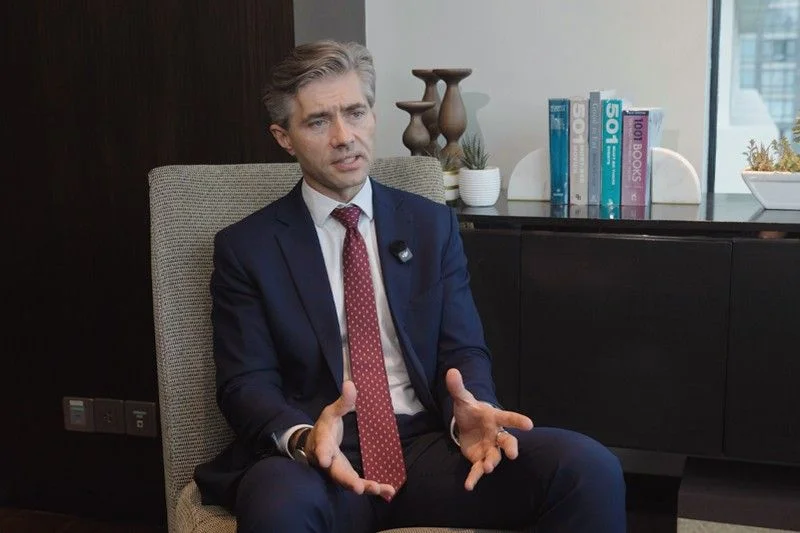
Interview with Lithuanian Foreign Minister Kestutis Budrys
**An Interview with Lithuanian Foreign Minister Kestutis Budrys **
*Cristina Chi
Philstar.com Senior Reporter *
--
We've seen Lithuania and the Philippines in recent years have a spike in terms of relations, in areas of cooperation. Lithuania has rapidly become one of our most active supporters in Europe. How would you describe where Philippine-Lithuanian relations stand today?
They are at the very beginning, [and there are] huge opportunities [at this] time. I see those in many areas for cooperation, be it political security cooperation or very practical economic cooperation, exchanges in our expertise in the development of certain technologies, and also promoting our trade.
So, from this visit, I will definitely bring back a huge list of homework where we should proceed further from our capital, but also with big expectations to advance further from Manila side.
So, what concerns the security situation? We share the same strategic assessment of where we are in this current world. We see how some revisionist powers, global actors in the world, try to redraw the rules of how we peacefully coexist with each other, how we cooperate, and how we trade. So, we have to prevent this from happening.
We have to assist each other in countering different hybrid threats that I see the Philippines also targeted by, be it at the sea, or be it in the informational field with disinformation and misinformation, also interfering into the political affairs, or be it at the sea with the different capabilities also. So, this is in the security area where we have a lot of experience as being constantly targeted by one of our, by actually two of our neighbors, Russia, Belarus. So, we learn a lot, we adapt, and this know-how is something that we share with those who want to be resilient.
And you have to be resilient in order to be secure and prosperous. In the economic field, we are looking forward to the European Union and the Philippines finally signing the free trade agreement. It will open new possibilities for us to trade in different goods.
For us, we are looking forward to high-value-added products and also electronics and other areas. And also what concerns the governmental functioning and governmental sector. And what I was talking a lot about today, that's the cyber security, that's our expertise from institutions and also from cooperation with our businesses and know-how that business collected that we can apply here and cooperate together. I mean the governmental technologies, not only the pure tools, but also how to defend ourselves, how to be more effective and efficient in our e-services that we provide both countries to our own citizens.
There are so many areas and tools that are accessible to us, and that's why in each meeting I mention the European Union and their instruments. So, those related to Global Gateway, to different development programt, but not only. That just promotes the trade context.
This is how it begins. It starts from one small project. People expand their relations and contacts and then it grows up to to big endeavors. So this is where we are right now.
Minister, today you met with the Philippine Coast Guard. Can you tell us about this meeting and what is your impression of the capacity of the Philippine Coast Guard right now?
Of course, I read and heard about the brave men and women in Philippines Coast Guard before coming here.
We were following the incidents that were happening in the West Philippine Sea with the vessels that were acting under different covers of the civilian vessels coming from China. Those developments were really disturbing and really that all international community has to have its position up on. Because those are breaches of international law, breaches of UNCLOS, of the law of the sea.
And that is the interest of all of us that respect international laws to preserve. We have different situations, but also related to manipulations and with international law and acting against its regulations in the Baltic Sea.
We have the coast, there we have Russia and Russia's related shadow fleet vessels causing threats to our environmental security, to the security of our infrastructure.
We are suffering from damaged undersea infrastructure. Those acts or incidents are conducted also by the vessels that are not following international regulations. So, those affected countries have to share their experience and the way how to protect ourselves within the international law. Even understanding that the other side is not respecting it. So, I really appreciate all the efforts that are done with the huge, robust and strong position from Philippines coast guard side in protecting the very principles that we also respect so much. That's sovereignty, that's territorial integrity, and that's being equal under international law. All of us.
That's why Lithuania also joined in the support of the 10th year of the arbitral decision in the case against China. Seeing it as one of the principles and as part of one of the principles and also seeing it as not only symbolic but very uniting as an element. What concerns preserving the law of the sea.
If we are falling in one of the areas, if we are making compromises because of someone has more power and is more agile and provocative, it means that it will collapse in all the other areas. So, if we cannot apply it here, so why does it have to be applied somewhere else? For example, in the Strait of Hormuz, from which blockade we are all suffering, our economies are suffering.
That's why I see it as the natural space for us — meaning the European Union, not only Lithuania — to cooperate. We are the continent, and we are the organization that is based on values and those values are very clear. We respect what we pledged and what we committed to and what we signed to.
So, this is where my country stands.
You mentioned the need for us to collaborate on cybersecurity. Our defense department has already considered a lot of hybrid threats threatening its position on the West Philippine Sea, its capacity. What lessons do you think the Philippines can draw from Lithuania when it comes to dealing with hybrid threats?
There are many of them. Our experience is is collected in decades countering different operations that we now call as as the hybrid ones. So, in the political field, be it political interference, be it political corruption coming from the other countries, we had a couple of decades ago, also these cases of economic coercion and manipulation with dependencies in the energy field, also financial manipulations. Overall activities, hostile activities in our strategic sectors, and of course, disinformation, misinformation, and then these sort of the things.
So we gathered a lot of experience how to organize in the most effective way the work of the government and institutions. It has to be whole of government approach, meaning that everyone is responsible but you cannot share it around and everyone is doing everything. Then it will be at the end, too many people in the kitchen.
We concentrated these efforts within certain institutions that are responsible for defense and for counter-strategic communication. We also engaged a lot of NGOs into this work and I think that was one of those highest added value experiences that we have. Not everything has to come from governmental institutions.
Civil society is very important and their activity. So, we were fighting trolls with elves that were within the informational area, within the social media that was organized in the way as NGOs. We also have a lot of experience how to bring the overall awareness in the society higher, how to engage with the civil society because it's also about the resilience, it's about the critical thinking, it's about questioning with whom you are dealing and of course it also is related to trust, to trust to traditional media outlet outlets trust to certain commentators and opinion makers within the society. So, this is the complex, this is the ecosystem and it's one part.
Another part, of course, is related to understanding who your enemy is and who is acting against you. So, whether there are state institutions or whether there are state institutions enabled, some hostile actors like organized crime or others, state media institutions. So, we also need to share this knowledge and we have this knowledge.
We know who is doing what and how the responsibilities are divided among different subjects within, for example, Russia. Of course, we are targeted a lot also by China and by other hostile actors. So, this is also experience and understanding this you can then see how to counter it.
And tools. At the tools level, within this huge flow of information on social media and in media elsewhere. We have to be very specific and distinguish where the noise is, where this is just something happening and distracting your attention, and where the core narratives are that are attacking the things that you want to protect. Meaning that the very principles of sovereignty, for example, or the political autonomy of certain decisions, how you define national interests and so forth. So, we have also companies that are working in this field and that are ready to share their experiences with the different AI-enabled tools on how to better protect.
So, the better we are within the field of resilience, the better the world will be. There will be less tension, there will be less preparation or less possibilities for the conflict. Because we understand each conflict, be it the war or be it in the other form, starts with shaping the environment, shaping the battlefield. And this is the cognitive warfare. If you are strong in this one, it means that you are lowering the probability of something hot that can start.
Would we be seeing a bigger presence from Lithuania in terms of counter-disinformation tools and programs? Can we expect more Lithuanian companies to kind of enter here and to for their tools to be made available here?
That's one of the subjects of my conversations here. Of course, that part, is within the governmental institutions and also within my institution, the Ministry of Foreign Affairs, because we also are very active in countering cyber activities. But involving the companies. So there are some good examples already of the projects that were implemented here.
I want to see those spots where I can facilitate to promote them better but generally, yes, there is the area for us to cooperate and for our companies to be here. So, there will be more presence of the ones that are dealing with cyber tools and also that are dealing with countering different propaganda narratives.
You mentioned the joint statement and Lithuania is one of the signatories. Lithuania is the only EU signatory that has actively resisted Beijing's economic bullying to the point of a diplomatic freeze. How does Lithuania's experience with Chinese economic coercion shape its partnership with the Philippines?
Yes, Lithuania was targeted by China's coercive measures. One of our strengths then in that situation, that was back in 2021, 2022, was assistance from our partners. We are not left alone there.
So, I'm really thankful to other member states of the European Union, to our allies within NATO and other countries that saw us as being absolutely, unfairly treated, treated absolutely against the commitments of China, what concerns World Trade Organization, what concerns the regulation of international economic relations in general.
This is lesson number one. We are ready to assist any country that is also targeted by those economic coercion instruments.
Number two, you cannot leave yourself unprepared, and just with the political solidarity, thinking about the position of other countries, you need tools, and those tools have to be very targeted and very sharp in how you react in these situations.
Because of the Lithuania's experience, EU introduced counter anti-coercion instrument, meaning that European Union as an organization can immediately react and review the trade agreements with the countries that are targeting one of our member states. These sorts of instruments can be created and expanding plurilaterally in the broader formats, understanding that not everyone will agree with this, because there are some nations that love to exploit different economic dependencies, but still there is some space for it. Third lesson learned, you cannot allow yourself being dependent on the countries that are leaning to use these dependencies for political purposes.
We learned this lesson the hard way with Russia when our economic dependency on the trade of natural gas and the imports of oil cost us a lot. We learned this, and we diversified our imports, with the big investments, what concerns natural gas, we turned from pipelines to the LNG imports with the oil. We also built the oil terminal and are now importing oil from all over the world. With the electricity, we disconnected from the country. That's Russia first of all that was manipulating with the conditions or with the amount of prices or with with everything that they can, for political purposes, just to punish, to prevent and you know just to send the signal and whatever.
So we learned this with Russia. With China, that's the same lesson that everyone has to learn. We’ve already seen how China was manipulating exports of some raw materials that we all need in our supply chains. Same with the with other dependencies. Diversification, de-risking and if it is too sensitive, decoupling. So what concerns dual-use technologies?What concerns those technologies that are really important for our defense and for the future of our defense? Lithuania spends the most on defense investment. What concerns other NATO allies? We have to be very clear on it. We have to be active looking into the result. That would diminish those risks.
These are, as a minimum, the three lessons of ours. Just to finish, as the fourth, you need time, and to rebalance those exports, or to compensate those with other countries.
And maybe for the fifth, and I will stop with the fifth lesson. There are so many good partners here in the Southeast Asia and that was for us the opportunity to look for new partnerships and also to diversify and open the new markets. That's why I'm here. That is the continuation of this engagement that is very genuine, that goes both ways, that is also useful for the countries and Philippines to have partners in Lithuania.
We are not offering all the 360 degrees of the products, goods and services. No, we are very technology oriented, high added value oriented, niche capabilities countries but sharp, smart, fast. So, I think this is the very good area for us to cooperate.
And each of those experiences from my almost 25 years in the security field, when we were attacked by something, when there was some damage caused in economy and be it in the political field, each of these cases brought for us more thick skin and more lessons learned and at the end of the day, we are more resilient. So, we are the strong hedgehog there.
You mentioned your visit here has been super productive and that you have a long list of homework when you get home. Can you tell us which aspect of our area of cooperation would the Philippines be seeing Lithuania more?
Those technologies and solutions in different areas. We already mentioned cybersecurity. Be it the very practical organization of the security operation centers, for example, or be it the policy on legislation level. Lithuania ranks number 5 now globally, what concerns all the organization and structural arrangement of cyber security, for example. So, we are ready to share this as the best practice on how to organize it.
And of course, what concerns the development of new tools and also dual use technology. So, I had a really good exchange with the Philippines Coast Guard also on some technologies that would make your work — so important work for the international community — easier. So, these areas.
And we will measure them soon, I think, with more of Lithuania's presence here.
Can you share more details about the tools that you discussed with the Philippine Coast Guard?
We are talking about some technologies that are driving the trends now, what concerns the protection of the sea routes. Those are technologies that are [being] developed now. As we understand, now, war is the biggest driving force of the things that are happening within the defense industry or dual-use technologies.
We have to use everything that we see is developing so fast in Ukraine and their brave efforts to defend themselves, and also turn those technologies and the usable ones in peacetime for our own good. So, we are talking about the protection of our maritime environment.
- Latest
- Trending