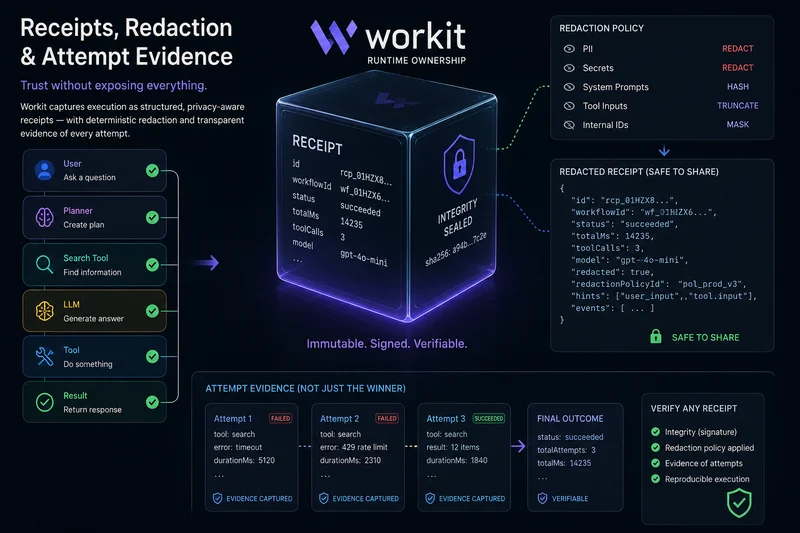
An async operation can return successfully while leaving an awkward question behind: what actually happened inside it?
For a small function, the return value may be enough. For a provider call with retries, cancellation and cleanup, it is not. Operators need to know which attempts ran, why the operation stopped, whether cleanup timed out and whether owned work remained pending.
WorkIt receipts preserve those lifecycle facts as data.
import { run } from "@workit/core";
import { createReceiptRecorder } from "@workit/core/replay";
// Application-owned provider boundary.
declare function callProvider(ctx: {
  signal: AbortSignal;
}): Promise<{ answer: string }>;
let observedScope;
let recorder;
await run.scope(async (scope) => {
  observedScope = scope;
  recorder = createReceiptRecorder(scope, {
    receiptId: "answer:request-42",
  });
  await scope.spawn(run.retry(callProvider, {
    times: 3,
    initialDelay: "100ms",
  }), {
    name: "provider.answer",
    kind: "llm",
  });
});
const receipt = recorder.build(observedScope.status());
recorder.unsubscribe();
The receipt includes the terminal outcome, normalized lifecycle events, a final scope snapshot and a summary of cleanup or leaked-task evidence. In WorkIt 0.5.0 it can also derive one record for every retry attempt admitted by the outer task boundary.
Evidence, not deterministic replay
The word “replay” is overloaded. Deterministic replay records enough scheduling and nondeterministic input to execute a program again with the same decisions.
That requires control over clocks, random values, I/O, scheduling and usually the runtime itself.
WorkIt does something narrower. It records what the scope observed:
typed task and scope events
final scope snapshot
terminal outcome
cancellation reason
cleanup failures and timeouts
retry attempt outcomes
telemetry drop and truncation counts
You can store and inspect that evidence later. You cannot use it to rerun an arbitrary JavaScript program. The distinction is useful because it keeps the receipt contract small enough to verify.
Attempts belong to the task lifecycle
Before 0.5.0, receipts could include retrying events. Those events explained that another attempt was planned, but they did not provide a terminal outcome for every invocation.
The task:attemptevent closes that gap:
scope.onEvent((event) => {
  if (event.type !== "task:attempt") return;
  process.stdout.write(JSON.stringify({
    taskId: event.taskId,
    attempt: event.attempt,
    outcome: event.outcome,
    durationMs: event.durationMs,
  }) + "\n");
});
An attempt ends as succeeded, failed or cancelled. Nested retry wrappers do not produce competing generic histories for the same task. The outer retry boundary owns the task-level attempt sequence, while an application can add more specific provider or activity evidence when it needs it.
That ownership rule prevents a receipt from presenting two incompatible
answers to “how many task attempts ran?”
Add metadata at the boundary that knows it
The runtime knows the task id, attempt number, timing and outcome. It does not know whether a particular invocation targeted a primary provider, a regional replica or a billing-sensitive activity.
createAttemptRecorder()lets the caller add that context explicitly:
import { createAttemptRecorder } from "@workit/core/replay";
const attemptRecorder = createAttemptRecorder({
  maxAttempts: 20,
  maxMetadataBytes: 1_024,
});
// `callProvider` is the application-owned provider function from the previous
// example.
const callPrimary = attemptRecorder.wrap(callProvider, {
  metadata: {
    provider: "primary",
    operation: "answer",
  },
  reasonCode: (error) =>
    error instanceof TypeError ? "transport_error" : "provider_error",
});
const operation = run.retry(callPrimary, {
  times: 3,
  initialDelay: "100ms",
});
Reason codes must be bounded slugs. Metadata must be a JSON object and must fit the configured byte limit. Common secret fields are redacted before the record is retained.
This is deliberately caller-owned enrichment. Inferring provider policy from an arbitrary error object would turn a lifecycle recorder into a second routing engine.
Redaction belongs before storage
Progress data is often valuable during an incident, although it may contain fields that should never reach a durable ledger.
Receipt redaction has conservative defaults for common secret names, and the caller can add its own policy:
import { redactReceipt } from "@workit/core/replay";
const publicReceipt = redactReceipt(receipt, {
  removeFields: ["privateNote"],
  redactFields: ["authorization", "tenantToken"],
});
Redaction is not a substitute for data minimization. The safest private payload is still the one that was never attached to an event. It does, however, provide a clear boundary between local lifecycle evidence and a receipt intended for storage or publication.
What a receipt can establish
A captured receipt can support claims about the WorkIt lifecycle it observed:
- the scope reached a terminal state;
- no owned tasks were pending in the final snapshot;
- cancellation carried a typed reason;
- cleanup failure or timeout events were present;
- admitted retry invocations had terminal outcomes;
- event truncation or telemetry drops were counted.
It cannot establish that a remote provider stopped billing, that an external transaction was semantically correct or that an uncaptured event occurred.
Those limitations are not footnotes. They define where runtime evidence ends and application or provider evidence begins.
Executable evidence
The relevant release proofs are:
LIFE-004 completed scope receipt
LIFE-005 typed cancellation reason
LIFE-012 admitted attempt evidence and default secret redaction
They run through:
npm run test:evidence
npm run test:coverage
npm run verify
The tests cover completed and cancelled receipts, cleanup evidence, bounded event windows, redaction, attempt outcomes, metadata limits and installed package consumers.
The practical result is modest but important: when WorkIt owns an async
lifecycle, it can leave behind a typed account of what it observed.
Sources
- GitHub: https://github.com/WorkRuntime/workit/releases/tag/v0.5.0
- npm: https://www.npmjs.com/package/@workit/core