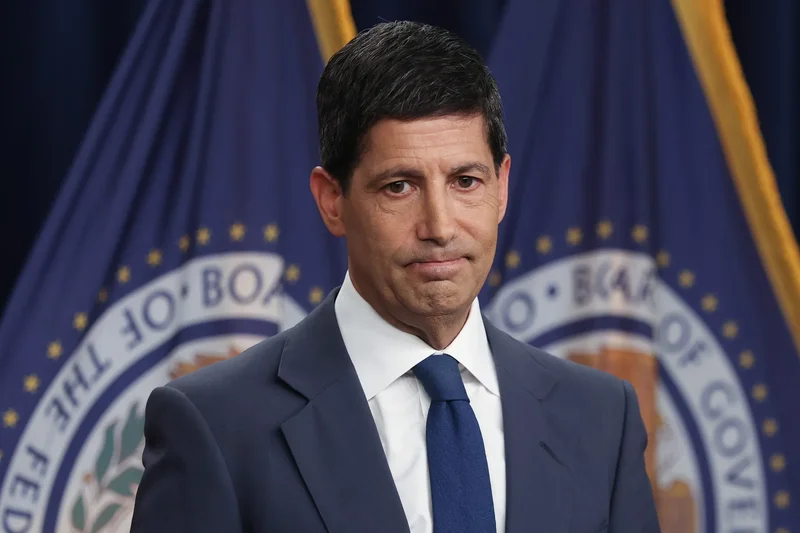
- In today’s CEO Daily:A ‘family fight’ at the Fed.
- The big leadership story:Inside Ikea’s big bet on humans
- The markets:Mixed globally as investors digest major earnings.
- Plus:All the news and watercooler chat from- Fortune.
Good morning. How are you feeling about the U.S. economy? Federal Reserve Chairman Kevin Warsh said yesterday that the Fed wants to see an annual U.S. inflation rate of 2%. It’s now running at 3.5%. And yet the Fed left interest rates unchanged, a decision that prompted dissenting votes from three regional presidents who want to raise rates. “It was a real family fight,” he said. “That’s the way to get policy right.” The trajectory of that policy is unclear as Warsh, unlike his predecessor, isn’t one to give forward guidance. Some takeaways:
Rates are more likely to go up than down. Energy prices are high. Housing prices are high. Tariffs added about $1,000 in costs to the average U.S. household last year and could add almost as much this year. There’s a mix of trends in this economy. If lowering the inflation rate to 2% is a priority, though, raising rates is a time-tested way to do it. The question is why wait?
The markets are skittish. The Fed controls short-term rates. Long-term rates are determined by the bond market. And that’s certainly pricing for inflation. While Warsh left rates untouched, the 30-year bond yield rose to its highest level since 2007, and the 10-year Treasury yield rose more than 7 basis points. Over in the equity markets, the Dow fell 2.2%, or 1,100 points, its worst decline since April 2025. Other indices are down, too. Investors are worried about inflation.
Consumers are hurting. A pound of ground beef costs $6.82. The national debt is more than 100% of GDP, with the government owing the equivalent of $113,000 per person. Inflation, much like interest, is compounding, and the cumulative effect of years of high inflation has taken a toll. The federal minimum wage is at a 70-year low, and inflation is even curbing the desire to date. The biggest beneficiaries of lower rates are arguably not consumers, but companies with big capital expenditure plans.
CapEx is getting expensive. Interest rates are pushing up borrowing costs, but they’re not the only reason. Rising raw material costs, geopolitical risk, compute, wages and multiple other factors are impacting the bottom line, too. Invest in AI transformation but keep an eye on your customers and your costs.Contact CEO Daily via Diane Brady at diane.brady@fortune.com
Top leadership news
**Ikea’s big bet on humans **
When Ikea’s AI bot Billie took over routine customer service questions, the furniture giant retrained roughly 8,500 workers, many as design consultants, instead of laying them off. The remote-sales centers where the reskilled employees work have since become the retailer's fastest-growing sales channel. "Companies have for so long been in a mode where they're using people to satisfy things that customers need," Wharton professor Prasanna Tambe said. "The question is, is there an opportunity to move these people into providing things that customers want?"
Microsoft's Azure engine
Microsoft shares jumped more than 8% in after-hours trading after Azure surpassed $100 billion in annual revenue for the first time, up 33% from last year, even as a broader market selloff sent the Dow plunging over 1,100 points on Fed rate worries. CEO Satya Nadella attributed the growth to customer demand for AI.
**Meta shares tumble **
Meta shares fell as much as 10% as capex nearly doubled to $31.1 billion in the last quarter. CEO Mark Zuckerberg hinted that Meta would follow rivals into the cloud-rental business but framed it as secondary to selling AI "intelligence," saying "it would be foolish to basically just sell all of the compute and take a short-term profit."
The markets
S&P 500 futures are up 0.38% this morning. The last session closed down 1.52%. The STOXX Europe 600 was up 0.57% in early trading. The U.K.’s FTSE 100 was up 0.56% in early trading. Japan’s Nikkei 225 was up 0.71%. South Korea’s KOSPI was down 1.23%. China’s CSI 300 was down 1.10%. Hong Kong’s Hang Seng was up 0.20%. India’s NIFTY 50 was up 0.08%. Bitcoin was at $64K.
Around the watercooler
Robinhood CFO details surging prediction market business as firm posts record revenue in Q2 by Jeff John Roberts
Dr. Fauci, the Lockdown Czar, just won’t go away by Steve H. Hanke
Inside China’s two-speed economy: Why goods consumption is slumping even as exports and services boom by Nicholas Gordon
Hugging Face drops in-depth hack report, while OpenAI gives us 7 bullets. Here’s what we know now, and what remains a mystery by Emily Forlini
CEO Daily is curated and edited by Joseph Abrams, Jason Ma, Claire Zillman, and Lee Clifford.