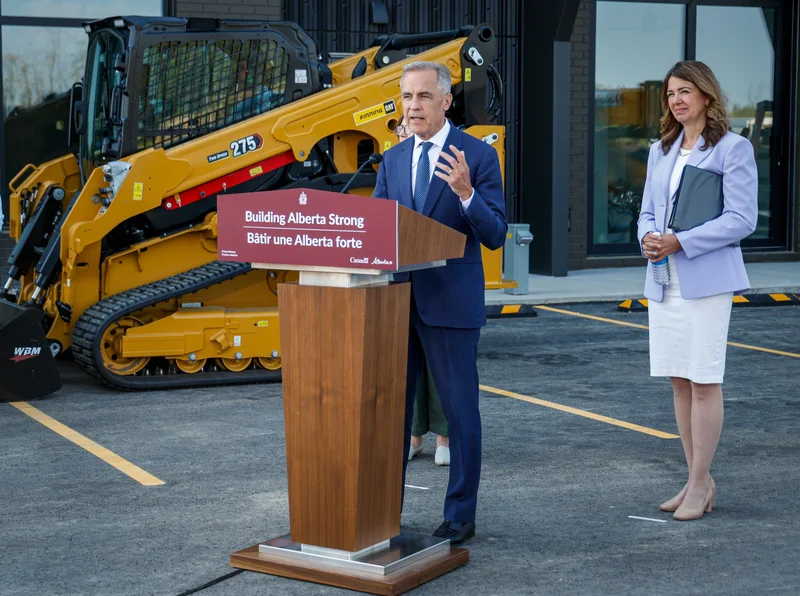
Good morning. Prime Minister Mark Carney says Canada won’t use energy exports as a bargaining chip in U.S. trade talks. More on that below, along with U.S. wildfires and why Canadians don’t want to get prenups.
TOP STORIES
Carney’s new line on energy
Prime Minister Mark Carney ruled out restricting Canada’s energy supply to the U.S. as a bargaining chip in trade talks. It’s a reversal from last week, when he said “everything is on the table” as Ottawa decides how to respond to U.S. tariffs set to take effect on Aug. 19.
The new tariffs: The levies would impose 50-per-cent duties on roughly US$20-billion of Canadian goods, from alcohol to electronics equipment. They would be on top of tariffs on steel, autos and aluminum and a general duty on anything not traded under the United States-Mexico-Canada Agreement.
Energy as leverage: Curbing Canadian energy exports to gain leverage has come up as an idea since U.S. President Trump returned to office. The U.S. depends heavily on Canadian oil and gas, and Trump has so far exempted them from tariffs. Last year, Ontario Premier Doug Ford announced a 25-per-cent surcharge on electricity exports, but backed down after the President threatened steel and aluminum tariffs. (Trump later imposed those tariffs anyway.)
Carney’s view: The Prime Minister said it was a matter of trust in Canada. “When you’re a supplier of a key commodity ... you’ve got to think really hard about not supplying.” But he insisted that he would only sign a trade deal if he can get a good one – and left open the possibility that there will be no agreement.
Fauci pleads the Fifth
Anthony Fauci refused to answer questions from a U.S. Senate committee yesterday related to his involvement in research at a Chinese lab and the origins of the COVID-19 pandemic, citing his constitutional right not to be compelled to self-incriminate.
The context: As the director of the U.S. National Institute of Allergy and Infectious Diseases until 2022, Fauci was a key figure in the U.S. pandemic response. Republicans have accused him of causing pandemic confusion, undermining trust in institutions and, in some cases, causing the pandemic itself. Before leaving office, former U.S. president Joe Biden issued Fauci a pre-emptive pardon for the work he had done.
What he did (and didn’t) say: Fauci made a brief opening statement that said Rand Paul, a Republican senator who chairs the Senate Committee on Homeland Security and Governmental Affairs, was harbouring an “unhinged obsession with me.” Otherwise, he responded to dozens of questions with the same 21-word answer invoking the Fifth Amendment.
Wildfires rage in the U.S.
For weeks, fires in Ontario and B.C. have filled skies with smoke, prompting threats of retaliation from Trump. But increasingly large parts of the U.S. Pacific Northwest are now on fire: more than 235,000 acres have burned in Utah and Colorado, and the total is at 1.8 million acres in Oregon and Washington state.
Flammable conditions: More fires may be in store, after a winter without much moisture and a summer of scorching heat. Forecasts show some regions are becoming a tinderbox beyond anything measured in recent memory, particularly in Oregon.
Meanwhile in Europe: As firefighters battle Spain’s worst wildfires on record, volunteers have mobilized to give a helping hand to people displaced from their communities.
A NATO spy investigation
The RCMP says it will support Belgian authorities investigating a Canadian intern of Chinese origin alleged to have engaged in espionage at NATO’s operational headquarters in Belgium.
The allegations: The intern had been working at NATO’s operational base, Supreme Headquarters Allied Powers Europe (SHAPE), near the French border. She was arrested last week on suspicion of espionage and is being held in pre-trial custody in Belgium. Sources said earlier that the intern had been vetted in Canada and that the RCMP had carried out a formal law enforcement record check.
Murder convictions in Dominica
A jury found two Americans guilty of murdering Montreal entrepreneur Daniel Langlois and his partner, Dominque Marchand, on the small island nation of Dominica. Sentencing for Jonathan Lehrer and Robert Snyder Jr. has been scheduled for September, though an appeal is expected.
The case: The couple’s burned remains were discovered on a remote road in late 2023, kicking off an extensive investigation. Langlois and Lehrer had been entangled in a legal battle over a road that went through Lehrer’s cocoa farm and provided access to Langlois’s luxury eco-resort on the island. Prosecutors said two witnesses placed the Americans around the crime scene, and forensic ballistics linked the bullets to Lehrer’s gun.
The Take
It is much harder to take territory than to defend it. That is to our advantage, too: We are fighting for our economic lives, the Americans are not.
As Ukraine and Iran confront much larger powers, Canada can learn some lessons from asymmetric warfare, Andrew Coyne writes.
The Chart
Prenuptial agreements, more commonly known as prenups, are meant to bring clarity and certainty in the event a marriage breaks down. Yet most Canadians still avoid them – often because of the cost and emotional toll.
The Wrap
What else we’re following
At home: U.S. tariffs on Canadian dairy powder could worsen a global shortage of the products already at the centre of a fitness craze.
Abroad: A Ukrainian strike on an Iranian cargo ship blurred the line between the world’s two big wars, The Globe’s Mark MacKinnon writes.
Middle East: An Iranian strike hit northern Kuwait, and Jordan shot down five missiles launched from Iran, hours after the U.S. attacked targets belonging to Iran’s Revolutionary Guard Corps.
On ice: Macklin Celebrini became the NHL’s highest-paid player when he signed a US$18.8-million, five-year contract extension with the San Jose Sharks.
On foot: Theatre actors have embraced shoe shining as a side hustle in Toronto’s financial district.
Yes, chef: The new Anthony Bourdain biopic Tony is a movable feast, critic Barry Hertz writes.