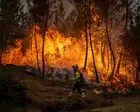
Are we understanding it yet? As Europe burns in the west, the south and the north, are we grasping the fact that our economies, food systems, political stability and even our ability to plan for the future, will all be charred in a world on fire?
Paris got a taste of what is in store for us Europeans when, weeks ago, fire ripped through Fontainebleau forest, a bouldering paradise and one of the world’s first natural reserves. But the wildfires currently threatening Bordeaux and Madrid, which experts are calling the most extreme seen in Europe, are apocalyptic in comparison. In the Gironde region around Bordeaux, tens of thousands of hectares have burned, creating an unpredictable “thunderstorm of fire” as the region’s chief administrator called it. More than 200,000 people have been displaced in the largest peacetime evacuations in France’s history. Only the bravery of firefighters, dozens of whom have been injured, is keeping the fires within mere kilometres of Bordeaux and its more than a million inhabitants.
In Spain, multiple fires have merged on the outskirts of Madrid, creating “the largest fire in Spain’s history”, burning more than triple the hectares of an average July as yet another heatwave menaces the country. Scientists blame “weather whiplash” due to the accelerating climate crisis for bringing the fires this close to the ancient streets and squares of Madrid and Bordeaux. As far south as Sicily, as far north as Norway, the story is much the same: a summer of almost unendurable heat has erupted into tempests of flame.
Across the Atlantic, thick smoke drifting southwards from fires across Canada’s 270m hectares of boreal forest obscured, once again, the skies in cities in the United States. Certain Maga-affiliated politicians reacted not with offers of firefighting assistance, as Canada has so consistently sent to US states in need, but by proposing sanctions on Canada, or tariffs. As if the problem, to minds obscured long before the skies ever were, is insufficient raking.
A catastrophe of this scale will necessarily be politicised. The Spanish prime minister, Pedro Sánchez, condemned disinformation and conspiracy theories around the fires; French opposition figures have criticised the government for delaying the acquisition of two additional Canadair firefighting planes, and the government is accusing the opposition of using tragedy for political point-scoring. But why should the blame game stop at borders, when the carbon that we have collectively emitted is drifting in our shared atmosphere?
To adapt a phrase from Animal Farm, we are all responsible, but some are more responsible than others. In this case, the US is the beast more responsible than all the rest: it has emitted more than one-fifth of all historical emissions, and remains by far the highest per-capita major emitter alongside Saudi Arabia. To be fair, Canada is not far behind, and the smaller Gulf states like Qatar deserve a special mention of shame too.
It would be one thing if the US was guilty of historic emissions while making a concerted effort to change. China, for all its own problematic emissions, is at least fostering breathtaking growth in renewables and now dominates the world’s green industries as a result. Instead, the US has almost always been recalcitrant – or worse – about the crisis. US fossil fuel, energy and auto companies hid evidence and blocked action for decades, while the US government undermined and withdrew from the Kyoto protocol under George W Bush, promoted a fracking boom under Barack Obama, and withdrew from the Paris agreement during Donald Trump’s first presidential term.
The US has flipped so far beyond recalcitrance during Trump’s second stint in the White House that it can only be described as waging ecological warfare. The phallic mantra of “drill, baby, drill” is guiding an administration for which the faintest speck of care for the Earth is already too woke. Green policies are not merely dismantled, but increased fossil fuel use is being pursued with heinous glee. Such a conflict effectively pits the US against the rest of the world. So let’s take the US’s Maga senators and congresspeople seriously: as the skies fill with smoke and forests turn to ash, shouldn’t the United States, the guiltiest of guilty parties, be made to pay?
As the Guardian recently reported, countries individually responsible for less than 2% of global emissions are nevertheless the largest plurality, collectively responsible for 33% of the world’s emissions. There is no individual country that can address the catastrophe under way on its own; but there is no collective solution without each individual country making cuts.
And when it comes to Europe, there is something additional of consequence that we can do: use the power of the single market to make the world’s worst ecological actor change course, or at least make it pay to fund the global effort to adapt to the climate crisis.
For most of the past year, European industry and Europe’s rightwing parties have been pushing to roll back or slow walk regulation, thinking that the way to remain economically competitive is to race Trump’s America to the bottom. It is not. It is economic doom to race to a future where nothing is insurable, where crops fail en masse, where hundreds of thousands of evacuees have become millions of internally displaced climate refugees and where the combination of these calamities has pushed public finances to breaking point.
To safeguard its political and economic future, Europe needs to accept that the US’s environmental war must be met with an economic response – coordinated with other actors, including China. Let’s extend the EU’s emissions trading system (ETS) carbon market to all sectors, beef up the “carbon border tax” to protect against retaliation, slap tariffs on finished goods and services from the US that have easy substitutes and place export taxes on materials and intermediate components used in US-located production. All that cash could then be pooled, shared and earmarked for decarbonisation and adaptation.
This might sound ludicrous. But what is truly ludicrous is that this is only the beginning. This is what three decades of inaction and insufficient action have produced. Ludicrous would be allowing the US, under the grasp of a handful of villainous, ecocide billionaires and ideologues, to drag us all into the abyss of even more years of catastrophic inaction.
- Alexander Hurst writes for Guardian Europe from Paris. His memoir Generation Desperation is out now