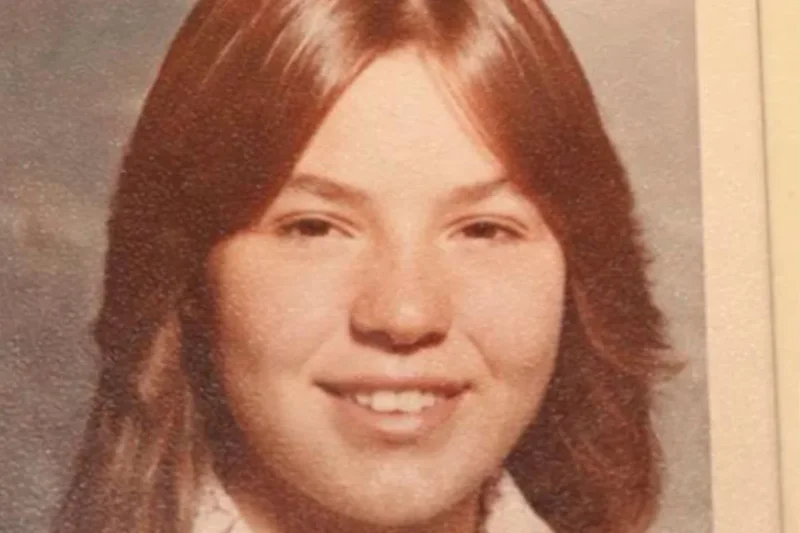
A teenager whose body was dug out from a California vineyard nearly 50 years ago has finally been identified.
The body of Michelle Louise Collier was unearthed in a shallow grave in June 1978 – but was labelled as a “Jane Doe” and remained unidentified until recently.
A tractor driver made the grim discovery while cultivating land in city of Arvin, not knowing that the remains were of a girl who had vanished in February that same year.
The Kern County Sheriff’s Department named the victim in the unsolved murder as the 15-year-old Fresno girl, describing it as "a significant milestone" in the investigation.
Her older sister, Cynthia Dunbar, said during a press conference on Tuesday that her family finally has “some closure”.
“(Michelle) disappeared 48 years ago, and it was only recently that we knew where she was,” she added.
She also had a message for her sister’s killer, saying: “Your cowardice act affected our entire family, but make no mistake, law enforcement will find you and hold you accountable.
“Whether you are already incarcerated or dead, you will be found.”
Michelle’s identification only became possible thanks to the latest advances in DNA technology, but the circumstances surrounding her death remain unknown.
“When the unidentified remains were recovered in 1978, DNA technology did not exist,” the sheriff’s office said. “Identification depended primarily on fingerprints, and dental records.”
When her remains were found, the teenager appeared to have been dead for several months.
She was "found wearing two white metal necklaces around her neck (one with a round religious medallion),” according to the sheriff's office.
An autopsy ruled her death as a homicide. Fingerprints and dental records were also collected, but police could not find a match.
After months without answers, Michelle was buried as a Jane Doe at Arvin Cemetery in November 1978.
The remains were exhumed in August 2007 in the hopes of identifying the victim through DNA testing.
Over the next 18 years, authorities continued their attempts to identify her, even sharing a reconstruction photo of what she may have looked like, but to no avail.
Finally, investigators made a major breakthrough last year, with the help of forensic investigative genetic genealogy, a method which combines DNA profiling with family tree research. It came to wider public attention over the Golden State Killer case in 2018.
Potential families of the Jane Doe were identified and her mother submitted DNA for testing.
Michelle’s body was returned to her surviving siblings earlier this month. The investigation into her killing continues.