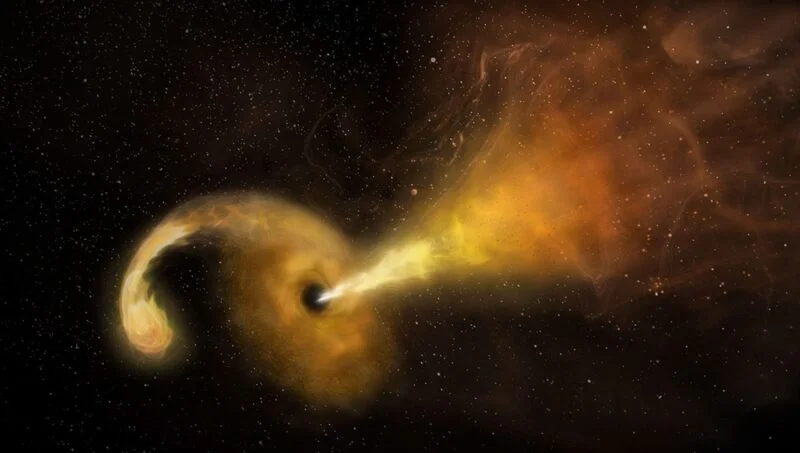
Wandering black hole spotted shredding a star
When we think of supermassive black holes, we usually think of the enormous beasts that lie at the center of galaxies like the Milky Way. But on July 27, 2026, NASA said its Neil Gehrels Swift Observatory spotted a supermassive black hole wandering on the outskirts of a galaxy.
How did scientists spot it? The black hole was ripping apart a star that had drifted too close. And this is the first time scientists have seen a supermassive black hole feasting on a star that far from the center of a galaxy.
Lead author Robert Stein of the University of Maryland and NASA’s Goddard Space Flight Center in Greenbelt, Maryland, said:
We were looking for these star-shredding events as a way to find otherwise invisible supermassive black holes wandering away from the galactic cores where they usually reside. With this discovery, which is one of just a couple that have been confirmed so far, we’ve validated a new technique and can use it to hunt for more.
The researchers published their peer-reviewed paper in The Astrophysical Journal Letters on July 27, 2026.
And yes, Swift is the same observatory that’s falling back to Earth. It’s in the midst of a rescue mission that will boost it to a higher altitude.
A bright flare on the outskirts of a galaxy
An extremely bright flare revealed the location of the otherwise hidden supermassive black hole. The flare was the result of a star getting ripped to shreds by the intense gravitational pull of the black hole. Astronomers call this violent breakup of a star a tidal disruption event.
The Zwicky Transient Facility at Palomar Observatory in California first spotted the bright eruption in November 2025. The flare was happening at the outer edge of a galaxy some 750 million light-years away. Stein said:
Out of the half million flashes the Zwicky Transient Facility detects each night, our new artificial intelligence algorithm automatically recognized a flare that looked a lot like a tidal disruption event, despite its unusual location in the outskirts of a galaxy.
Confirmation of a tidal disruption event
The bright flaring lasted for months, allowing other observatories to have a look at the event. The supermassive black hole, about a million times the mass of our sun, created the tidal disruption event. It shone in ultraviolet light as it temporarily radiated with the light of about 10 billion suns.
The Swift telescope was able to estimate the temperature of the tidal disruption event. It registered a temperature of 54,000 degrees Fahrenheit (30,000 degrees Celsius). Plus, the Southern Astrophysical Research telescope in Chile looked at the spectrum to confirm that it was a tidal disruption event. Co-author Jonathan Carney of the University of North Carolina at Chapel Hill said:
The combination of all this data helped us rule out other explanations and confidently say it’s a tidal disruption event, despite its strange location.
A wandering black hole
Astronomers believe most galaxies have a supermassive black hole at their cores. They usually form from the gravitational collapse of all the material packed into the galaxy’s center. So tidal disruption events – when the supermassive black hole rips apart and eats a star – are something astronomers have spotted before at the centers of galaxies.
And in 2024, scientists spotted the first tidal disruption event that wasn’t at the center of a galaxy. That one occurred about 2,600 light-years from the center. And now they’ve spotted one 30,000 light-years away from a galaxy’s core.
How did the supermassive black hole get there?
So this black hole not being at the center of a galaxy isn’t new, but it’s still odd. Stein said:
It must have originated in a galaxy’s center, but not the one it’s in the outskirts of now. We think the host galaxy’s supermassive black hole is still at its core, but the one eating the star could have started off in a small galaxy that merged with the big one we see today.
The researchers came up with two scenarios as to how the supermassive black hole got to where it is:
- Three or more galaxies may have merged. The gravitational interactions could have flung the lightest black hole out to the galaxy’s edge.
- A dwarf galaxy could be in the midst of merging. The dwarf galaxy’s stars – too dim to see individually – might be falling into the larger galaxy, and one passed too close to the dwarf’s supermassive black hole.
How common are wandering black holes?
Stein said:
Further discoveries could reveal the origin of this apparent ‘orphan’ black hole. The key science question we want to answer is: How common are wandering black holes?
We may know soon.
If you’ll recall, the Swift mission is falling back to Earth. But NASA has a plan to boost it, so that it can resume operations. The mission to boost it launched on July 3, and the Swift capture should happen in the coming weeks.
Co-author S. Bradley Cenko, Swift’s principal investigator at NASA Goddard, said:
Pointed science observations with Swift’s UVOT and XRT (X-Ray Telescope) instruments are temporarily suspended as the mission awaits an orbit boost. Once it resumes normal operations, Swift could continue searching for more examples of out-of-place black holes.
The Vera C. Rubin Observatory and upcoming Nancy Grace Roman Space Telescope can also join in the hunt.
Carney said:
Rubin’s wide, deep surveys will reveal a much larger sample of tidal disruption events than current observatories are capable of collecting, including ones that are off-center. And Roman’s space-based surveys will extend the current search zone by seeing ones that are farther away, looking back through 9 billion years of cosmic history.
Bottom line: Astronomers have spotted a wandering black hole shredding a star. The supermassive black hole, normally found at the center of a galaxy, is instead roaming the outskirts of a galaxy.