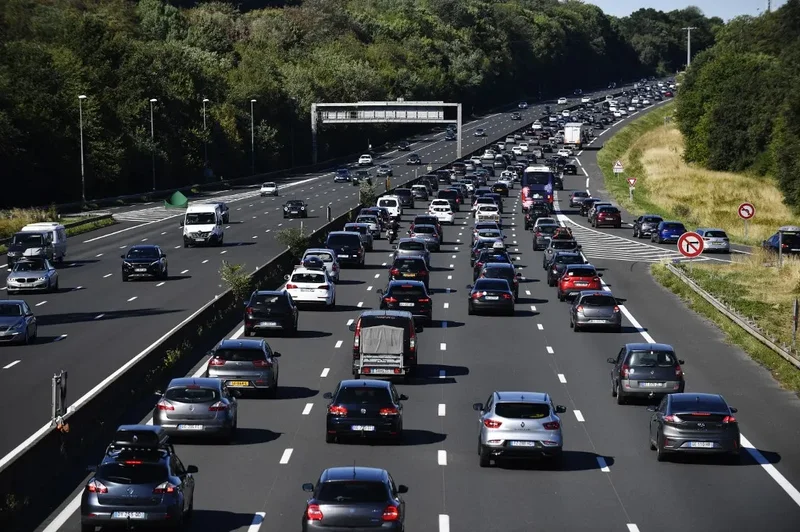
Thousands of people are escaping the heat of Italy’s big cities and heading to cooler places near the sea or in the mountains for the August holidays. But the annual exodus is expected to bring traffic jams and potentially hazardous driving conditions.
Polizia di Stato (Italy’s state police) has released a calendar with information about traffic conditions each day in August to help travellers choose when to leave for their holidays and avoid peak traffic.
The calendar is colour-coded, with a yellow marker indicating heavy traffic, red indicating heavy traffic with “possible critical conditions,” and black indicating “critical” traffic.
Fridays will also be consistently busy on Italy's roads, as yellow or red traffic warnings have been issued for every Friday of the month.
READ ALSO: Mythbuster: Is there any way you can drive without a licence in Italy?
Traffic conditions are expected to be more favourable on Tuesdays and Wednesdays throughout August.
Thursdays are also generally a good time to hit the road, apart from the first Thursday of August, when heavy or very heavy traffic is expected.
If you’d like to leave on Monday, the best days are Monday August 3rd and August 10th, as all subsequent Mondays are forecast to see heavy or very heavy traffic.
The calendar also shows the days when vehicles weighing more than 7.5 tonnes are not permitted on the road.
Which roads can I expect to be busiest?
Motorways and state roads connecting major cities to popular seaside holiday destinations or mountain resorts are more likely to see heavy traffic in the coming weeks.
Here’s a breakdown:
Motorways (autostrade):
- Motorway junctions RA13 and RA14 near Trieste, Friuli Venezia-Giulia
- Motorway A14, connecting Bologna, Emilia-Romagna, to Taranto, Puglia
- Motorway A1, connecting Milan to Naples
- Motorway A2, connecting Salerno, Campania, to Reggio Calabria, Calabria
- Motorway A30, connecting Caserta to Salerno, Campania
- Motorways A19 (Palermo-Catania) and A29 (Palermo-Mazara del Vallo), both in Sicily
State roads (strade statali):
- State Road 16, known as Statale Adriatica, connecting Padua, Veneto, to Otranto, Puglia
- State Road 309, known as Strada Romea, connecting Venice, Veneto, to Ravenna, Emilia-Romagna
- State Road 36, from Sesto San Giovanni, Lombardy, to Italy’s border with Switzerland
- State Road 18, known as Tirrenia Inferiore, connecting Naples to Reggio Calabria
- State Road 106, known as Statale Jonica, stretching from Reggio Calabria to Taranto, Puglia
- State Road 148, known as Statale Pontina, connecting Rome to Terracina, Lazio
- State Road 7, known as Statale Appia, going from Rome to Brindisi, Puglia
- State Road 1, known as Via Aurelia, connecting Rome to Ventimiglia, Liguria
- State Roads 675 (from Terni, Umbria, to Monte Romano, Lazio) and 3-bis (from Terni to Ravenna, Emilia-Romagna)
If you’re planning on using one of the above roads to reach your holiday destination, you may want to consider an alternative route.
The Italian State Police offers guidance on alternative itineraries at the following links: north, centre and south.
READ ALSO: The rail travel disruption to expect in Italy this summer
How can I keep up with the latest developments?
Rai-Isoradio broadcasts and Onda Verde news on the three Radio-Rai networks share frequent traffic updates.
Motorway company Autostrade per l’Italia also provides real-time maps and information about traffic, road closures, weather conditions and roadworks. Drivers can enter their starting point and destination and calculate the best route on the website.
Italy’s motorway construction and maintenance company ANAS also features live traffic updates, available both on their website and the mobile app VAI.
If you’d like to speak directly to an operator while on the road, you can contact ANAS’s customer service at toll-free number 800 841 148 or by using their live chat, or call the road safety information coordination centre at 1518.