AI is not magic, but consensus building is. Notes on Wikimedia’s next 25 years, after Wikimania 2026.
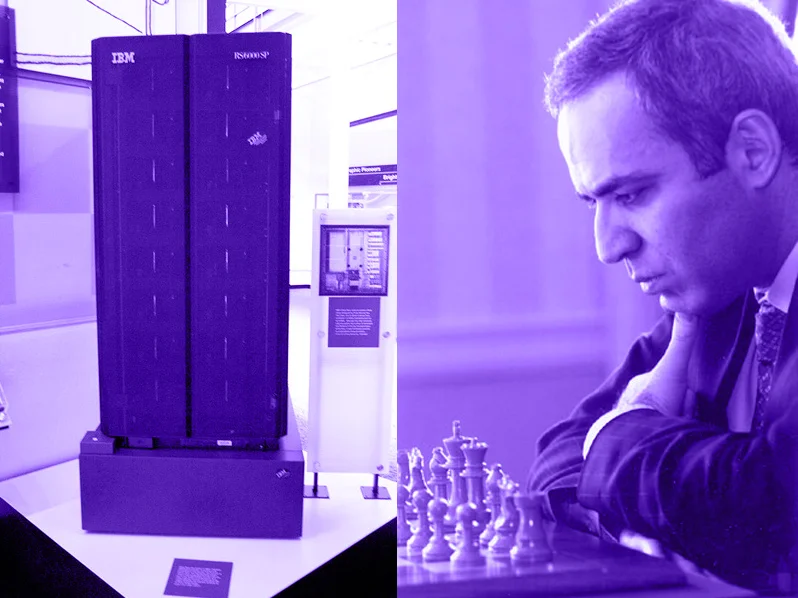
In 1997 Garry Kasparov lost a chess match against Deep Blue, a chess computer built by IBM. It was the first time a reigning world chess champion lost to a computer.
In the media it was framed as ‘man versus machine’. But Feng-hsiung Hsu, the main designer of Deep Blue, later wrote that this assumption was wrong. He saw the match as one type of human versus another. Human as performer (Kasparov) versus human as toolmaker (the Deep Blue team).
I’ve been thinking a lot about that match since I’ve returned last week from Paris where I attended Wikimania: the world’s largest gathering of Wikimedians (people who write Wikipedia and its siblings). With 1,250 people attending in person and over 2,000 online we celebrated Wikipedia having its 25th birthday this year with five intense days of talks, workshops and of course many, many meetings and conversations with Wikimedians from all around the world.
One question was woven throughout virtually every session and conversation: in a world where AI is reshaping both the digital and physical world, how do we as a community deal with it? As Christophe Henner wrote earlier this year, AI is not a tool but a paradigm shift. How do we make sure we continue being relevant in the next 25 years?
I’ve been a Wikimedian for 21 years and a developer. The last few years I’ve used AI in many of my projects. So I have some thoughts about this.
Earlier this year I hosted two workshops during the Wikimedia Hackathon in Milan about this question which resulted in this blogpost. At Wikimania I repeated this workshop during the Wiki AI Preconference.
After the three workshops i organized and five days of Wikimania one thing for me is clear: just as Kasparov was playing against other humans and not a machine we’re competing against other humans who have figured out how to be better at some of the things we do.
What this means? We should become better toolmakers as well.
Unsure of what all the terms in this article mean? Click here to read a glossary of terms.
- The projectsrefer to the Wikimedia projects (Wikipedia, Wikidata, Wikimedia Commons, etc.).
- The community,- movementor- Wikimediansare the people who work on those projects, both in a hired capacity (e.g. from the Wikimedia Foundation or affiliates) or as volunteers.
- The foundationor- the WMFrefers to the Wikimedia Foundation, the supporting organization which provides the hosting and technical infrastructure for the Wikimedia projects.
- The affiliatesrefer to the local Wikimedia- chapters(e.g. Wikimedia Netherlands) and- user groups(e.g. LGBT+ User Group).
- LLMs are ‘large language models’, so ChatGPT, Claude, Gemini, etc.
- Frontier modelsare the AI models that power the most well-known LLM chatbots listed above.
- Local modelsare models that run on your own computer instead of in the cloud. These are usually less capable than frontier models, but can be good enough for specific tasks. More capable local models need a lot of RAM; 16GB is usually the bare minimum.
- Open weight modelscan be downloaded for free and can run on your own computer (compared to many frontier models which are closed). However, some of the more capable models can require so much RAM that they still run in the cloud (e.g. DeepSeek V4 Pro needs 862GB of RAM).
- Inferenceis generating content using an LLM, e.g. writing code using an LLM chatbot.
- Tokensare the basic unit an LLM takes as input and produces as output. Most models are priced based on tokens, and better models tend to cost more per token.
- Open licensesare the conditions under which the content on the Wikimedia projects is available. Creative Commons BY-SA and Zero are the most popular ones. An open license means you can reuse the content for most purposes for free, even commercially.
- Markdownis an important input/output format for LLMs. It’s a plain text format that provides a simple syntax that translates to HTML. E.g. text-
*between asterisks*is rendered in italics.
Three challenges
As a movement we face three major challenges:
1. Fewer humans
Our community is dependent on people visiting our projects. Because we need new editors, who start out as readers. And we need donations. The projects are funded mostly by small donations of readers who pass by and donate a small amount. If that source dries up because people consume Wikipedia content via an LLM or Google’s ‘AI Overview’ we have a problem.
Declining readership is a real trend that has been noted by the Wikimedia Foundation. It’s interesting that some comparable projects, like OpenStreetMap, are not so dependent on readership and have always focused more on being a data source instead of a destination. So maybe this is less of an issue than we think. But for now, I would say that we should err on the side of caution and see declining readership as a serious issue.
One other consequence of less humans on our projects is that the distance between consumers of our content and the people who produce it will get even bigger. It has always been an issue to explain to people that there are actual, breathing humans writing those articles together. LLMs might condition people into thinking that Wikipedia is just a bunch of AI bots writing articles. Another reason why they might be hesitant to donate or become an editor.
2. More robots
While humans are visiting our projects less and less, more and more robots appear. Many of those robots are scrapers, harvesting our data at unsustainable speeds. This has put a giant strain on our infrastructure. It feels like a lose-lose situation. Wikimedia provides one of the most important data sources for LLMs, in return we get a barrage of scraping bots, and we need to invest more in our infrastructure.
3. More slop
AI-generated articles are an issue as well. Apart from the regular vandalism that we have always had, now we need to deal with seemingly well-written articles that turn out to be generated by LLMs.
We have always included machine generated content (some Wikipedias are even written almost entirely with it), the question is where to draw the line in including AI-generated content.
This is not just an internal problem. Wikipedia is reliant on references to write verifiable articles. If the internet turns into a cesspool of AI slop it becomes harder and harder to find reliable sources.
Internal struggles
There are also internal issues that might weaken our position.
One important reason for organizing my Milan workshop was that not all voices in the movement were heard. Should we even use AI, or maybe ban the use of LLMs and coding agents altogether? Especially young people can have a very negative opinion on any usage of AI at all. If parts of our community feel left out of this discussion it might lead to internal polarization.
There are more than enough reasons to be skeptical of or opposed to the use of AI. The earlier mentioned lack of reciprocity from the companies who’ve been using our data, energy consumption, the atrocious working conditions in which some models have been ‘finetuned’, jobs getting lost, AI powering military ‘killer drones’, questionable government ties and many many more.
However, there was surprisingly little discussion in Paris about this subject. Maybe people have simply accepted that we’ll have a future where AI is an essential technology? Or maybe they haven’t, but they didn’t speak up? I don’t know, but i would love to read or hear more from those folks.
Another issue is the delicate balance within the movement between volunteers, affiliates and the foundation. The relationship between those three factions is complicated and at times very tense. See for example the proposed new rules concerning board member eligibility, updates to the structure of funding affiliates and the actions (or rather lack thereof) from the Foundation in relation to the Wiki Workers United solidarity union. Important decisions could be delayed and hampered by internal debate and discussions.
Humans must stay responsible
Let’s get back to the ‘man as performer vs man as toolmaker’ narrative.
If we agree on the notion that the significant shift in the world is not ‘machines are taking over’, but ‘machines controlled by humans are taking over’, it also makes sense that humans must stay responsible for the actions of the machines they build and use.
That might seem obvious, but it’s not. People who used to depend on programmers can now suddenly do many things themselves. This might feel like magic. Suddenly they’re able to write a complicated Excel formula! Or vibecode a little app for the paperwork they previously had to hire a company for!
Of course, most developers and technically skilled people know that computers aren’t magic and are very aware of the shortcomings. When you write code (by hand or using a coding agent) that accidentally deletes the production database of your company, “it’s the machine that did it” isn’t an excuse your manager will accept. And even in the age of coding agents, maintaining complicated software infrastructure is still hard work.
However, right now all over the world companies are firing their development teams and replacing them with AI agents, expecting everything will be the same, but cheaper. Of course, it’s not.
It seems that for some people, it takes firing their developers to discover that machines are not the same as people, and code isn’t magic.
Leveraging our biggest strengths
Code and AI aren’t magic. And I think that we, as Wikimedians, are particularly well-placed to explain and show how the ‘magic’ works. Just as Wikipedia articles explain that things are usually a lot more complicated than you think.
And that isn’t the only strength that we have. Wikimedia may be the David to big tech’s Goliath, but we often underestimate our own strengths.
Even though the big tech companies that make the major LLMs have a seemingly limitless supply of money, they lack one thing that our community has in spades: trust and reliability. Wikimedians are fervent nitpickers, making sure statements are properly referenced and factually accurate. Even though LLMs tend to get many things right (because they have been trained on sources like Wikipedia) they also get many things wrong. Even if Google’s “AI overview” is wrong “only” 10% of the time, that means millions of people get wrong answers every day.
Wikipedia is the critical data set used in most LLMs. We need to figure out how we can take advantage of that. Our open licenses are both one of our biggest strengths and weaknesses. It’s very hard to make big tech pony up for our data in a capitalist world because they already got it for free. However, Wikimedia data is valuable because it’s one of the few high quality human-generated data sets (and probably less destructive than AI companies destroying print books to train their models).
Another strength is that we are non-personalized. Folks using social media to get their news stay in their bubble, fed only the things that suit their taste. But on Wikipedia everyone reads the same article. Us not providing a ‘personalized reading experience’ is a feature, not a bug.
We have the moral upper hand when we’re talking about big tech vs Wikimedia. Efforts like Grokipedia, which is fully AI-generated, fail because there are no humans to check on articles. Grokipedia cited the Kremlin as a prominent source on the invasion of Ukraine because they’re using AI models. A Wikimedian would spot that immediately.
AI is not magic, but you know what is? Consensus building with humans.
Every Wikimedian should be a toolmaker
We have identified our strengths. Now, how should we use them?
It’s tempting to take a defensive stance against the big tech companies, and maybe even AI in general. But it’s better to play offense than defense. Big tech also doesn’t know what’s going to happen. It’s better if we try to invent the future ourselves instead of waiting around until something happens.
That means that right now we should focus on experiment over decisions. It’s better to do a lot of small experiments instead of making large-scale long-term bets. We should act deliberately, not emotionally, in the way Wikimedians do best: with nuance, knowledge and a scientific, objective look. And because of that we might be able to apply new technologies in a meaningful and useful way instead of jumping on the AI hype wagon and trying to cram AI into everything.
Another reason why we should experiment now is because the current situation is not going to last forever. Using LLMs today can be dirt cheap because of the influx of venture capital. If something like Claude Opus or Fable is too expensive, DeepSeek v4-flash is almost as capable and can generate millions of tokens for next to nothing. To put that into perspective: the total codebase of MediaWiki with all extensions is roughly 3 million lines of code. An amount of code like that could be generated by this model for about 11 dollars.
It’s very unlikely the situation will remain like this. The AI bubble will burst at some point in the near future, and then usage will suddenly be a lot more expensive. This also means that we need to prepare for that, and make sure that the tools we build don’t rely on AI models or can use simpler, self-hosted ones.
It also gives us a great opportunity. As mentioned, people who can’t code suddenly can code now. And people who used to code in the past may rediscover their joy of coding again. They should get accustomed to the best practices that are evolving right now.
Want to know what those best practices are? Click here to find out.
- Using a coding agent. Claude Code is the most well-known but there are many capable open source alternatives as well like pi.dev and Hermes.
- Be aware of the dangers. A coding agent can be run in ‘yolo mode‘, which means it has unrestricted access to your machine, up to and including deleting files by accident. You should either be careful in giving permissions or use a “harness” to restrict access to your system.
- Use skills. Skills are text files written in Markdown that instruct a LLM about a specific task like ‘connecting to the Wikidata API’ or ‘finding pageview metrics on Wikipedia articles’.
- Try out different models. Obviously everyone should try the frontier models, but it’s interesting, if only for the exercise, to try out a locally hosted or open weights model.
- Use best practices. One thing that has always been very hard in software development is making sure people follow best practices. This includes things like unit tests and documentation, but it also includes providing your app in different languages (internationalization or ‘i18n’) and making sure it’s accessible (‘a11y’). With coding agents this becomes much easier. They don’t complain about writing documentation!
The Wikimedia Foundation announced that they are experimenting with hosting some open weights models on their LiftWing infrastructure. Currently, this includes the relatively modest Qwen 3-14B and 3.6-27B models. Hopefully those models will be more capable in future.
Of course, the answer to “what should we do” is a little bit more nuanced than just “build lots of tools”. We already have over 4,000 tools, many of them unmaintained and/or broken. We don’t want to get an overload of new tools that are then unmaintained and no longer used. We might need to set expectations higher for the tools we use, or be more vigilant in deprecating and removing old ones.
Using AI for Wikimedia doesn’t mean writing articles
So if every Wikimedian builds tools, what do we build? When talking about generative AI the first thing that comes to mind is ‘writing articles’, but that’s probably one of the least useful applications. And just as Wikimedians are doing many more things apart from writing Wikipedia articles, AI can be used for many different applications as well.
I liked how Andrew Lih talked about a ‘friction matrix‘ for Wiki AI tools. Low/high burden on one axis (for humans) and low/high impact on the other. It’s interesting to look at tools that have high impact, but a low burden. This means the many, many tedious repetitive tasks done by Wikimedians that can be replaced or at least simplified by building new AI-assisted tools.
A great example of this was the PoliLoom tool showed by Ada Homolova and Johan Schuijt. It allows Wikipedia-sourced facts about politicians to be imported into their Wikidata items. This includes data points like place of birth and political position. Using AI, they analyzed Wikipedia articles to highlight sentences (e.g. ‘Jane Doe was born in Paris’) and prepare the appropriate Wikidata edit (e.g. Jane Doe -> Born in Paris). A human editor is always required to verify the proposed edit. A good example of a task humans can do, but AI accelerates.
Another obvious use case for AI-tools is helping smaller-language communities. There are almost 350 Wikipedia language editions. For many of them, Wikipedia is the only major reference work in that language. AI tools could help the limited number of volunteers who work on those editions to maintain their projects.
Teaming up
Of course, we as Wikimedians, are not alone in this journey. We’ve always had many friends who share our values about open access to data, verifiability and shepherding the open web. This includes parties like the Internet Archive, Creative Commons, OpenStreetMap and many others. It only makes sense to team up with those parties and collectively agree on what steps we should take to make sure the internet remains true to our vision.
Therefore it’s good to see initiatives like Mosaic, which brings together many different ‘commons’-related parties, not least because the possibilities for knowledge and cultural institutions like galleries, libraries, archives and museums (GLAMs) are tremendous. One can only imagine a future in which relevant data is shared easily by GLAMs to Wikimedia using new AI-powered tools.
One suggestion for a new tool I loved was Audrey Tang‘s idea about an ‘LLM edit button’. Every editor started by discovering the ‘edit’ button at some point at the top of every Wikipedia article. With the move from consuming Wikimedia content from the web to LLMs we lack that button. What would an ‘edit’ button look like in the age of AI?
Together we can create an alternative to the commercial closed web dominated by big tech. One where humans stay in control and build a world in which every single human being can freely share in the sum of all knowledge.
Happy birthday Wikipedia!
Notes and sources
In the interest of brevity and reading clarity I’m not sourcing every single statement and observation here. Many of the statements and sentiments were expressed multiple times by different people. I’m just trying to paraphrase.
I used the Claude Opus 5 and Gemma 4 12B models for spelling and grammar corrections, smoothing clunky sentences and general tips and feedback. 99% of the text you’ve read was written by a human.
Tools and experiments
- Wikipedia:WikiProject AI Tools
- AI Potluck – AI made and owned by the public
- Wayback Machine Labs
- Andrew Lih’s Wikimedia AI skills
- Open-weight LLMs hosted on Wikimedia’s infrastructure (LiftWing)
- What is an AI harness?
Documentation
- Wiki AI Preconference Etherpad
- Wiki AI Preconference conference site
- Wikimedia Futures Lab: conversations about Wikimedia’s future
- The AI-Bridges initiative
- Wikimedia, the commons, and the new AI knowledge loop paper, by OpenFuture
- Wikimedia Foundation elections/2027/Proposed eligibility criteria – Meta-Wiki
- Updating the ecosystem of Wikimedia organizations/Recognition and Funding for Movement Organizations – Meta-Wiki
- Andrew Lih’s slides for the Wiki AI Preconf
Baby Globe gif by the Wikimedia Foundation, licensed under CC-BY-SA 4.0.