Things would likely have turned out very differently had Faridoon Tofan not taken the bus to Italy. He had intended to go on a short trip to Rome. The 46-year-old — who had fled the Taliban to Germany just under four years ago and had since been working and learning the language — was detained during a border check in mid-April and taken directly to a deportation detention center in Munich.
The reason: Tofan did not have the legal right to leave Germany. His asylum application had been rejected; he held only a temporary residence permit, which does not protect against deportation. He could now be sent back to Kabul, even though he is neither a convicted criminal nor has he been classified as a security threat. His asylum application appeal was definitively rejected in July, and he is now to be deported.
Tofan's wife and six children are still living in Kabul. They were recently paid a visit by Taliban officials and say they've been living in constant fear ever since and the sons no longer dare attend school, Nina Alizadeh Marandi told DW. She is an asylum law expert at the human rights organization Amnesty International in Germany and in close contact with Tofan's lawyer.
The Taliban officials' interest in the Tofan family in Kabul came after Faridoon Tofan's meeting with Afghan consulate staff in Berlin. Both the embassy in the German capital and the Afghan Consulate General in Bonn are now under Taliban control — a state of affairs for which the German government has faced heavy criticism from the opposition and human rights organizations.
While the German government does not officially recognize the Taliban administration as the legitimate government of Afghanistan, it points to contacts maintained at a purely "technical level."
Deportation precedent
This week, another Afghan national with no criminal record was deported.
The flight — operated by Freebird Airlines using an Airbus A320-214 — departed Leipzig/Halle Airport in Eastern Germany at 1:43 a.m. on Tuesday, bound for Trabzon, Turkey, before continuing to Kabul, Afghanistan. The Afghan national with no criminal record was on the plane alongside 30 convicted offenders.
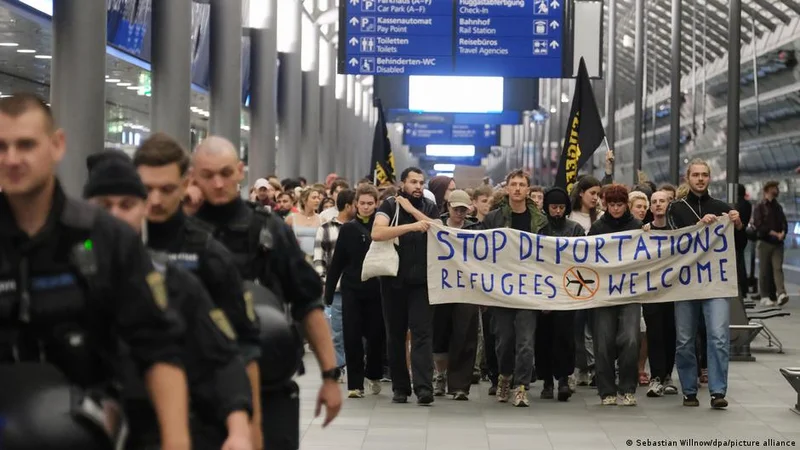
This set a precedent that sparked vociferous protests: 260 people heeded the call of an anti-racism alliance and came to demonstrate inside the airport's departure hall, accompanied by a police escort.
Luca Müller, spokesperson for the anti-racism group, also referenced the deadly terror attack on the Pride event in Berlin over the weekend: "While Islamist violence targeting Berlin's Pride celebration is being condemned from all sides, the federal government is supporting the Islamist Taliban through its deals," Müller said.
By "deals," Müller is referring to accusations leveled by many human rights organizations and the political opposition that the German government is de facto legitimizing the Taliban regime in Afghanistan in order to facilitate more deportations.
Interior Minister justifies the tough approach
What critics view as a breach of fundamental taboo, others see as nothing more than the swift enforcement of existing law. Interior Minister Alexander Dobrindt again told journalists this week, that anyone who has gone through an asylum process resulting in a rejection is therefore required to leave the country and must expect deportation if they do not depart voluntarily. Dobrindt, who is a member of Bavaria's conservative Christian Social Union (CSU), stated that the federal government is simply pursuing its goals in migration policy, driving forward this "shift in migration policy" with "control, a clear course, and a firm stance," Dobrindt added.
Improved security situation in Afghanistan?
Since the resumption of deportations to Afghanistan in 2024, Germany has returned more than 200 individuals. According to Amnesty International, at least one of them was killed following his arrival in Kabul.
However, the German government points to assessments by the UN migration agency (IOM), which considers the return of men to Afghanistan to be feasible again — in principle.
"The security situation in Afghanistan has improved significantly; that is simply an objective fact," Mihyung Park, the IOM's country chief in Kabul, told the media outlet Redaktionsnetzwerk Deutschland. Park added one caveat: "Under current circumstances, we would strongly advise women against returning to Afghanistan."
In general, however, UN agencies warn against involuntary returns, noting that the returnees heavily depend on support to settle again in their country of origin.
Amnesty International condemns the German government for increasingly toughening its deportation practices without regard for the catastrophic human rights situation in Afghanistan. Nina Alizadeh Marandi pointed out that the very day of this week's historical deportation happened to coincide with the 75th anniversary of the adoption of the Geneva Refugee Convention.
"Human rights standards must not be eroded simply because upholding them is politically inconvenient," Alizadeh Marandi said. "Amnesty calls on the federal government to refrain from further deportations and to monitor whether Afghans who have already been deported are able to live in Afghanistan without persecution or danger to life and limb," she added.
Opposition speaks of a 'dangerous wrong turn'
Germany's political opposition has also sharply criticized the first deportation of an Afghan national with no criminal record. "It is irresponsible that Alexander Dobrindt is now deporting people to Afghanistan who have done absolutely nothing wrong here," said Marcel Emmerich, the Green Party's parliamentary spokesperson on interior policy.
Emmerich said that Dobrindt's "dirty deal" regarding deportations strengthens the Taliban, "makes us vulnerable to blackmail, and undermines Germany's own security." He added that the federal government is taking a "dangerous wrong turn" with this Afghanistan policy.
Juliane Nagel, a lawmaker for the socialist Left Party in the parliament of the eastern state of Saxony, called the flight "shameful" and demanded that Saxony's Leipzig/Halle Airport — which is largely state-owned — no longer be used for deportations to Afghanistan.
This article was translated from German.