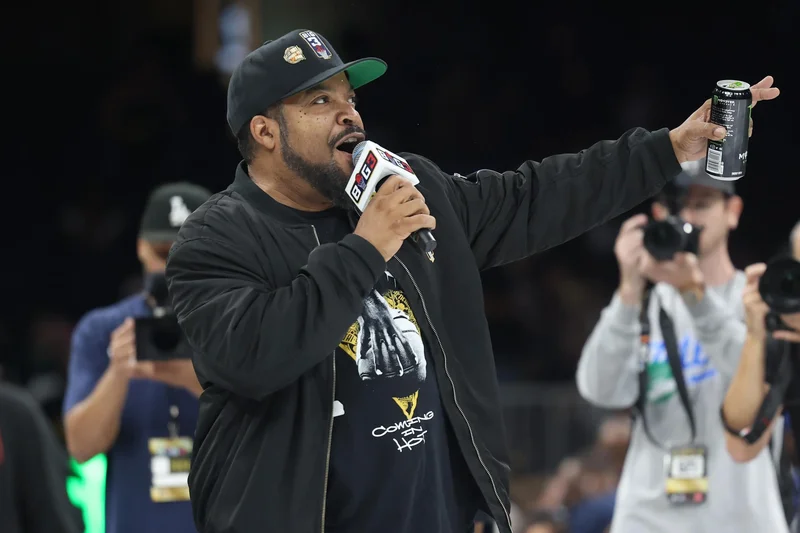
He sat in a private room reflecting on his success as a hip-hop mogul, a movie star and the BIG3 co-founder. Considering Ice Cube’s life-long ambitions, it seemed expected he would maintain a bold vision regarding his summer 3-on-3 basketball league.
“With the right capital injected in the right areas, we can do a lot more and be one of the biggest leagues in the world,” Ice Cube told me. “We’re not just looking at the U.S. We’re looking worldwide.”
About nine years after co-founding the BIG3 with entertainment executive Jeff Kwatinetz, Ice Cube has already witnessed the BIG3 extending its reach.
Each year, BIG3 has increased its representation. They have retired NBA stars (Dwight Howard) and former NBA role players (Mario Chalmers, Michael Beasley, Lance Stephenson, Montrezl Harrell, Jordan Crawford, Greg Monroe, Corey Brewer). They have former NBA/WNBA luminaries as their coaches (Julius Erving, Michael Cooper, Nancy Lieberman, Rick Mahorn, George Gervin, Gary Payton, Stephen Jackson, Nick Young). They have a former NBA star as its lead commissioner (Clyde Drexler).
The BIG3 is valued at $290 million after becoming the first publicly traded professional sports league in American history last month by partnering with a publicly traded special purpose acquisition company (Graf Global Corp.). In 2024, the BIG3 sold four of its eight franchises in Miami, Los Angeles, Detroit and Houston to various ownership groups for $10 million each. BIG3 has also partnered with the Prostate Cancer Foundation this year, which has included facilitating testing signups outside of venues and league-endorsed PSAs.
No wonder Ice Cube appeared in a pleasant mood before BIG3’s recent games at the University of Southern California’s Galen Center. Ice Cube, otherwise known as O’Shea Jackson Sr., still spoke in a serious tone with me in an arena conference room. Then, Ice Cube declined to bask in BIG3’s accomplishments and proclaim that “today was a good day” as he did in his heralded song. Instead, Ice Cube focused more on BIG3’s upcoming goals.
“We want to expand,” Ice Cube told me. “To really unlock what this league can do, we want to have more than eight teams, even more than 12. The traditional way is just to sell teams and grow like that, which is cool. But it makes you make deals that you need to make instead of deals that you should make.”
Some of those deals have already happened.
For the past seven years, CBS has broadcast BIG3’s games on its network in what a league spokesperson described as “a solid partnership.” BIG3 also remains optimistic it will maintain a long-term relationship with CBS. And why not? BIG3 reported that viewership has increased 26% this year and that per-game attendance has averaged around 8,000 fans. Those developments coincided with a crowded sports calendar that included FIFA World Cup, Major League Baseball and WNBA games.
“When we first started, it was ‘mom and pop,’” Lieberman, the Dallas Power’s head coach, told me. “Now we have more owners. We have run this thing like it’s a real, true business. I am so impressed with how they’re running it.”
That gives Ice Cube relative optimism on how much BIG3 can grow.
“We want to get to 24 [teams], maybe even 34,” Ice Cube told me. “We want to grow the league. We don’t want it to be irresponsible. But we want to grow the league at a pace where we feel that it’s going to get a bigger footprint in people’s minds when it comes to the BIG3. We want to make sure that we have a space in everybody’s minds when it comes to major sports.”
How soon can expansion happen?
“Who knows,” Ice Cube told me. “There is always an interest. We sold four teams. We have to sell four more. Once we sell those four, then 12 will be on the horizon. I can’t put a number on it because we want to do it in the smartest and most responsible way with the right team owners at the right price.”
What’s next for BIG3 expansion?
That explains why BIG3 went public. With this merger, fans can influence BIG3’s potential growth directly by purchasing league shares and becoming part owners. Traditionally, institutional investors and CEOS often only had such access. Under this arrangement, though, fans can use new or existing brokerage accounts to buy and sell BIG3 stock.
Instead of operating as a barn-storming league, BIG3 also travels weekly to markets that already host their city teams for its 10-week season. That includes the Boston Ball Hogs, Chicago Triplets, Dallas Power, Detroit Amps, DMV Trilogy (Washington D.C.), Houston Rig Hands, Miami 305 and LA Riot. Miami’s Amerant Bank Arena will host two games (Detroit-Dallas, Miami-Boston) on Friday (8 pm ET). Atlanta’s State Farm Arena will host two other games (LA – Houston, DMV-Chicago) on Sunday (1 pm ET).
“This is the way to grow the league on a global scale with the public,” Ice Cube told me. “It’s not just the public looking on the outside buying merch, going to games and cheering on players. But it’s also the public that is really benefitting from the upside of the league. We want the league to grow. We want to have them benefit in seeing the league’s growth and make them feel like they’re really a part of the league’s growth. They can take us from where we are to the next level.”
BIG3 has fielded some scrutiny amid its attempts to reach the next level.
As Front Office Sports first reported, BIG3 fielded accusations that it reneged a promise that NFT buyers would own stakes in teams and share a portion of the franchise sale’s profits. The proposed class action lawsuit, filed in California state court by Lou and Sally Sheward, asserted that BIG3 misrepresented the rights that buyers of team-specific NFTs would receive when they first sold beginning in 2022. It also outlines 12 causes of action, including fraudulent concealment and breach of contract.
“Sheward and the other plaintiffs represent holders of an asset class—namely NFTs—which lost all value due to the overall market collapse,” a BIG3 spokesperson said in a statement. “The plaintiffs are filing a public nuisance suit despite contractual obligations to resolve all such disputes through confidential arbitration. This is a classic nuisance suit for an asset class that has lost all value, brought in an effort to extort the BIG3.”
That hasn’t stopped BIG3’s future ambitions. Ice Cube told me that he and other BIG3 officials have talked with various international professional basketball leagues about possibly hosting a 3-on-3 league in their respective regions, including Australia’s National Basketball League, the East Asian Super League and various European and United Arab Emirates leagues.
With more funds and potential investors, Ice Cube expressed optimism that the BIG3 could host a league in global markets eventually.
“It’s all about having the capital to go after that, and not just depend on the owners that own teams in those leagues,” Ice Cube told me. “Without going public, you would have to wait for the team owners in those territories to become believers in 3-on-3, buy a team and support a league. With this, we can develop the league with people that may not necessarily be a big part of the basketball world that is already there. We could do something new. So we just want to have those options to do what is smartest for the league at the time, and not be pigeonholed into calling up the same rich guys that everybody calls up.”
Can BIG3 have any NBA and 2028 Olympics involvement?
Since its inception on Jan. 11, 2017, the BIG3 has also learned that it cannot rely on the NBA for any financial support, logistical help or any public endorsements.
Instead, Ice Cube leaned on his own credibility as an entertainer and businessman. He also maintained strong relationships with NBA luminaries after attending numerous Los Angeles Lakers’ home games. Incidentally, Ice Cube co-founded the league in honor of the late Kobe Bryant’s 60-point performance in the final game of his 20-year NBA career.
BIG3 couldn’t convince notable stars to join, including Bryant and Caitlin Clark. But the league became popular enough to attract other retired players, including Allen Iverson, Joe Johnson, Rashard Lewis and Chauncey Billups. The league’s coaches have included NBA and WNBA luminaries, including Charles Oakley, Rick Barry, Lisa Leslie, Reggie Theus and Gilbert Arenas. Jaylen Brown became the first active NBA player to play in a BIG3 game when he competed in the 2023 All-Star game at London’s O2 Arena.
“I didn’t know what to expect. It’s tough coming from the NBA and playing in the BIG3,” Young told me. “You feel a certain way. You feel like you get looked at a certain way. But now things are starting to change. I feel like more players are starting to come and be confident with playing it, as they should. If you’re not doing anything, this is one of the best leagues outside of the NBA.”
That success partly explains why the Naismith Basketball Hall of Fame honored Ice Cube in 2024 with the inaugural “Ice Cube Impact Award.” That honor “acknowledges individuals making substantial contributions to their community.” Former NBA player Jalen Rose later won the award in the 2025. With BIG3 garnering more popularity and credibility, has the NBA’s view on the BIG3 evolved?
“It hasn’t moved,” Ice Cube told me. “There’s one clause that we’re trying to get past, which is the ‘no-compete clause’ that they have on us where their owners cannot invest in the BIG3 as majority owners in any way, shape or form. It’s because of that clause. We think it’s ridiculous that they’re saying that we’re competing with them. But that’s [NBA Commissioner] Adam Silver and [Deputy Commissioner] Mark Tatum. That’s their stance.”
The BIG3 does not interfere with the NBA regular-season (October-April) or the NBA playoffs (April-June). The NBA has overseen Las Vegas Summer League in mid-July since 2007 after the league first worked independently in its first three years. The NBA also manages the California Classic, Salt Lake Summer League and Orlando Pro Summer League. It is not clear to what extent those overlapping summer-league schedules influence the NBA’s policy on the BIG3. An NBA spokesman did not return messages seeking comment on the league’s latest position on the BIG3, and if it will ever become interested in collaborating at any level.
“We’re trying to tell them to be reasonable. We could do a lot together,” Ice Cube told me. “Their athletes love us. Their coaches love us. Their owners love us. Their GMs love us. Everybody loves us, but those two guys at the top. It shouldn’t be like that.”
The BIG3 has also faced resistance on whether its players can represent USA Basketball in the Summer Olympics’ 3-on-3 tournament. Team USA did not qualify in the Summer Olympics’ inaugural 3-on-3 tournament in the 2021 Tokyo Games. In the 2024 Paris Olympics, Team USA finished with a 2-5 record and failed to advance out of pool play amid a key injury to former NBA player Jimmer Fredette. The team also featured two former college basketball players in Division I (Kareem Maddox) and Division II (Dylan Travis) as well as a former G League and overseas player (Canyon Berry). It doesn’t sit well with the BIG3 that any of their players might be excluded in the the 2028 Summer Olympics, which will take place in Ice Cube’s hometown (Los Angeles).
“They’re crazy not to use our athletes as the U.S. Olympic team in 3-on-3,” Ice Cube told me. “The last two Olympics have been a disaster for USA when it comes to what USA Basketball has been putting together to represent the US. I hope they have a ‘come-to-Jesus moment’ and realize that we have the best 3-on-3 players in the world. It’s not even close. They should use our athletes to represent the U.S., especially on U.S. soil. Will they do that or not? Egos may win and prevail, and the U.S. will suffer because of that.”
Technically, USA Basketball does not determine whether BIG3 players would be eligible for the Olympics. A USA Basketball spokesperson told me in a statement that “athletes are eligible to be considered based on the FIBA Qualification System.”
Per IOC and FIBA guidelines, players must participate in at least two FIBA 3-on-3 competitions, FIBA 3-on-3 recognized national team competitions or recognized qualifiers between Jan. 1 2026 and June 12, 2028. At least two players on the four-person team have to be among the top in FIBA’s 3-on-3 individual rankings by June 12, 2028. All players also meet nationality requirements. They have to hold legal nationality of their represented country. They have to present a passport of their represented country before Jan. 1, 2026. They cannot play for any other national team in any FIBA team competitions.
“These guys, what are they going to do? Live in Europe in the offseason and be away from their families?” Lieberman asked rhetorically. “It’s crazy. Why can’t we work with FIBA and let this be a part of our qualifying tournaments?”
The BIG3 boasts some quirks for entertainment purposes. They allow each team to challenge a call once a half called “Bring the Fire,” which then turns into a one-on-one matchup to determine who wins the possession. Referees award fouled players one free throw that counts as two or three points, something the NBA Summer League experimented after the G League implemented the rule in 2019-20 to improve game flow. Otherwise, BIG3 avoids gimmicks in favor of organic 3-on-3 basketball. In both the Summer Olympics and BIG3, the 3-on-3 competition entails a half-court game that requires each team to reach a target score and to clear the ball at halfcourt following a missed shot. The BIG3 makes an exception for airballs to mirror pickup games.
The Summer Olympics and the BIG3 have some subtle differences.
The BIG3 requires the winning team to score 50 points with at least a two-point margin-of-victory. In the Summer Olympics, the winning team has to score 21 points or hold a lead when the 10-minute clock expires. The BIG3 has a longer shot clock (14 seconds) than the Summer Olympics. (12). The BIG3 mirrors the NBA with how it awards points for baskets made inside the arc (two) and outside the arc (three). But the BIG3 also features a 4-point play for shots made at least 30 feet away from the basket. The Summer Olympics awards one point for baskets made inside the arc and two points for baskets made outside the arc. In both leagues, a player cannot foul out as they do in the NBA after collecting sixth fouls. Instead, the opposing teams are awarded the bonus after each team commits a fifth foul in each half (BIG3) or six fouls (Summer Olympics). The U.S. Men’s basketball team also adjusts to FIBA’s rules that include playing shorter quarters (10 minutes instead of 12). Although the NBA and FIBA balls are technically the same size (29.5 inches in circumference), Team USA officials have often said the ball feels smaller.
Since the 1992 Olympics, FIBA has allowed NBA players to participate partly because they represent the United States’ best 5-on-5 players. Meanwhile, BIG 3 officials, coaches and players contend their league boasts the country’s best 3-on-3 players considering their playing background in either the NBA, G League or overseas.
“They understand the game,” Cooper, Miami 305’s head coach, told me. “If you bring in former players and all they have done is play 5-on-5 and then they tried to get them to play 3-on-3, that’s difficult for some people. It’s kind of hard to force it to happen. So we got the best 3-on-3 players in the world, former players that know how to play this game and guys that are in very good basketball shape. They know how to play physical basketball and they understand the rules. I think our players should be included.”
BIG3’s focus on the game
Ice Cube did not sound surprised that “the sports world is not welcoming us to the party.”
“That’s nothing new,” Ice Cube told me. “I started with N.W.A. It was the same treatment from the music industry. When I started making movies, there were actors coming out and saying that rappers are taking all the jobs. So I’ve never been welcome. But that never stops me.”
Hence, the BIG3 will still work on landing more NBA stars.
Ice Cube challenged LaMelo, Lonzo and LiAngelo Ball publicly to play in the BIG3 All-Star game in Charlotte on August 22. Lonzo replied that he’s interested in appearing in “The Last Friday,” which would be third movie of the “Friday” movie series. Ice Cube responded, “No problem. You win, you in.”
Any answer?
“I haven’t heard from them. I just heard crickets,” Ice Cube told me. “I haven’t heard from them. So maybe they were bluffing.”
Regardless, the BIG3’s success has hinged on more than just NBA stars making cameos or on the league securing business deals. It has started and ended with the product. The final week of the regular season will take place at Houston’s Toyota Arena (LA – DMV, Houston-Miami) on August 6 (7 pm ET) and at Boston’s TD Garden (Dallas-Chicago, Boston-Detroit) on August 9 (1 pm ET). Dallas’ American Airlines Center will then host a celebrity game and two playoff games on August 15 (12 pm ET. Lastly, Charlotte’s Spectrum Center will showcase BIG3’s All-Star game and championship game on August 22 (1 pm ET).
“We want to make sure that we cap it off with a deserving champion with a great game,” Ice Cube told me. “From there, we’ll look at our opportunities. We’re in talks with a few different people about media deals and licensing deals. We just want to keep fanning those flames. Nothing helps more than a great season.”
It also helps that coaches and players have found the BIG3 to be credible. Before she joined the BIG3 3 in 2018, Lieberman relayed that Ice Cube followed up on his promise that she “will be the highest paid coach in the league” out of respect for her Hall-of-Fame credentials. Shortly into her second season, Lieberman and other coaches shared with Ice Cube and other BIG3 officials on a conference call that they need more than two officials to manage the game’s physicality. A week later, the league added a third official.
The BIG3 still oversees some chippy play. Earlier this season, Stephenson had a heated altercation with LA’s Devin Ebanks and Crawford, while Beasley also had a scuffle with Howard. The BIG3 doesn’t condone the behavior, though. Both Stephenson and Beasley were ejected. Drexler issued both players a one-game suspension and said in a statement that “fighting of any kind will not be tolerated.”
By striking that balance, Cooper said the BIG3 fosters a competitive environment that he found similar to the famed Lakers-Celtics rivalry that spawned 12 NBA Finals matchups. Cooper helped the Showtime Lakers win five NBA titles in eight NBA Finals, including three against the Celtics (two wins in 1985 and 1987, one loss in 1984).
“It is constantly physical. That’s why our players have to be in great shape,” Cooper told me. “The running has been taken out of it. But that physicality, as far as getting to the basket and moving around? The referees let you play a little bit more like in the '80s.”
Meanwhile, Chalmers represents one of many players that have viewed the BIG3 as a respectable league through word of mouth. Lewis, who played with Chalmers with the Heat, convinced Chalmers to join after playing overseas in Greece.
“I still wanted to play basketball and still wanted to be in shape,” Chalmers told me. “The biggest thing for me is being able to play in front of my kids. I had my youngest son, who’s seven. So I still want to show him the way of basketball. I want to show him that I can still compete and that I still can play. With the way people are showing up, this keeps getting better each and every year. Players are coming in shape. The basketball community is such a small community. Once you’ve played for so long, it’s good to play against your old friends and play with your old friends that you got a chance to play in the NBA.”
BIG3 participants hardly treat this as a recreational league, though. Lieberman showed me an app on her phone that outlines an extensive scouting report on each opponent, including player tendencies, statistical trends and film clips. Young, who coaches the LA Riot, laughed and conceded he doesn’t break down film with his players. But he shares observations with his players about opponent tendencies. Cooper hosts weekly conference calls to detail the scouting report, distributes game film and then watches it together the day before a game. All BIG3 teams practice at least once before each game.
“We’re very well prepared,” Cooper told me. “My job is not necessarily Xs and Os. We do run some plays. But it’s more about individual matchups, who we’re going to be playing and knowing what that player can and can’t do.”
Meanwhile, the BIG3 has received clarity on what it can and can’t do as a league. After noticing that most sports fans once viewed 3-on-3 basketball “as a step cousin,” Ice Cube seemed proud of the BIG3’s growth. He hardly remains satisfied, though.
“I’m not going to say that we’ve overcome anything,” Ice Cube told me. “I’m going to say that we’re proving every year that we have the best 3-on-3 players in the world. I’m not proclaiming we have the best 5-on-5 players in the world. But I’m claiming that we have the best 3-on-3 players in the world. We love to prove it on all levels.”