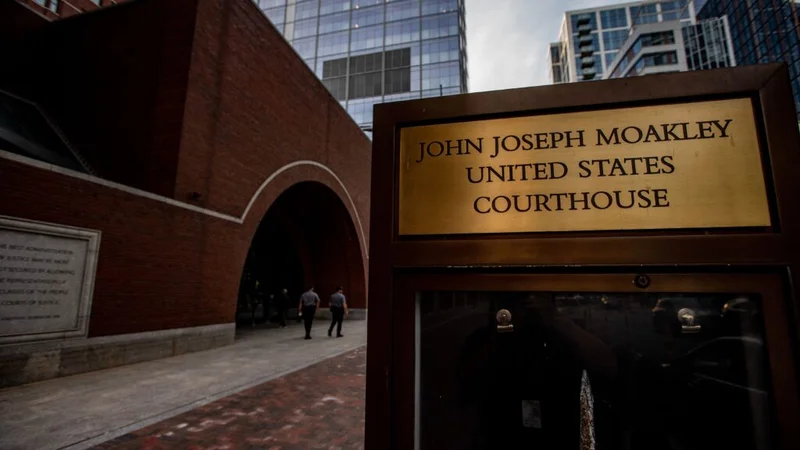
BOSTON — In an order issued Thursday, a federal judge denied 26 states’ request to postpone the implementation of Medicaid work requirements announced in June.
The case, which was filed by 26 states, seeks to alter a piece of one of President Trump’s biggest legislative priorities. The suit is focused on the implementation of a work requirement for people who receive Medicaid, the details of which were issued in June with the target of implementing the changes by Jan. 1. But states must also communicate with Medicaid recipients by Aug. 31 regarding how the changes may affect those enrollees.
In his order Thursday, U.S. District Judge Richard G. Stearns of Massachusetts ruled in an initial decision to deny the states’ request for a preliminary injunction to pause the implementation of the work requirement rules outlined in June. The states argued in a hearing Tuesday that they did not have the staff or capacity to roll out the work requirement as requested on the timeline put forth by the federal Centers for Medicare and Medicaid Services, writing that it would “cause harm and chaos.” They also argued that it violates the Administrative Procedures Act, which governs how agencies should implement changes in policy.
“Contrary to months of regular communications with CMS and preliminary guidance materials upon which Plaintiff States based their implementation plans, CMS adopted a rule that dramatically narrowed the Congressionally established categorical exclusions from the work requirement for some of the most vulnerable Medicaid members,” the states wrote in their suit.
In response, government attorneys argued in a filing before the hearing that Congress vested the power to issue the work requirement when it last year passed H.R. 1, commonly referred to as the One Big Beautiful Bill. They also stated that they did their due diligence in considering the ramifications to changes in the definition of being “medically frail.”
The judge, who was appointed by Bill Clinton, wrote that it was unclear how much of the responsibility for the tight timeline the states are under can be blamed on CMS. “It is not clear how much this harm can fairly be attributed to CMS. This timeline was set by Congress in H.R. 1, not by CMS in the challenged IFR,” he wrote. He added that he was unconvinced “that the States have shown that their expenditures are likely to be totally irrecoverable.”
The states, in the hearing Tuesday, argued that CMS is encroaching on Congress’s power of the purse in interpreting H.R. 1 in a more limited way than the letter of the law requires. While the judge denied the preliminary injunction, he wrote that “this case presents difficult issues regarding the scope of Congress’s delegation of interpretative authority to the Secretary and the faithfulness to Congressional intent with which the Secretary performed his task.”
The order on the preliminary injunction was filed without prejudice, meaning the suit will proceed to a more thorough hearing on the merits of the case. Stearns hopes to schedule those hearings before the work requirement needs to be implemented on Jan. 1. Should movement on the case stall, he wrote, states can renew their request for the court to offer relief.