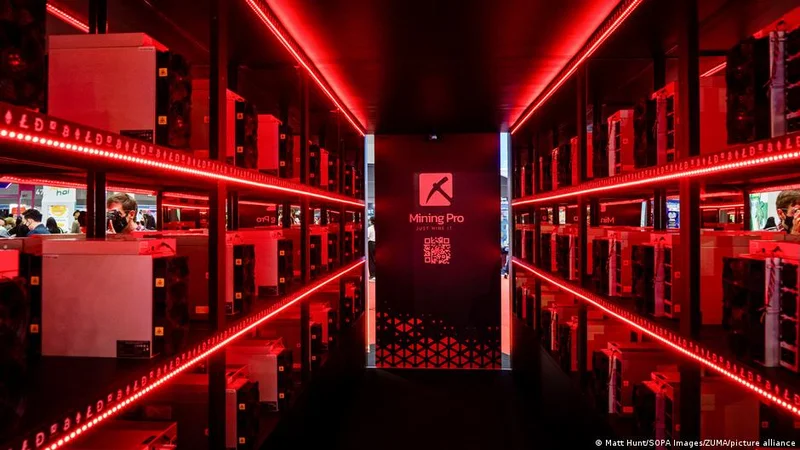
A raid in Malaysia last week exposed how cryptocurrency mining is becoming entangled with electricity theft and organized crime across Southeast Asia.
In Malaysia's southern state of Johor, 71 cryptocurrency-mining machines had been running around the clock across four rented premises for about a month before police moved in.
During the raids on July 22 and 23, officers arrested three suspects and seized computers, routers and vehicles alongside equipment used to illegally mine Bitcoin.
Johor police chief Ab Rahaman Arsad said the syndicate bypassed electricity meters, leading to an estimated €14,500 ($16,600) in losses in about a month, according to local media reports. The machines were thought to be generating between €17,200 and €21,500 in monthly revenue.
The case was relatively small by Malaysian standards. Between 2020 and 2025, national utility Tenaga Nasional Berhad (TNB) identified almost 14,000 premises linked to electricity theft for cryptocurrency mining. Its cumulative losses reached around €1.1 billion.
Detected cases increased from 610 in 2018 to 2,397 in 2024, according to Malaysia's Energy Ministry, which has described illegal mining as a serious threat to public safety, economic stability and the national electricity system.
"In Malaysia, thousands of incidents have triggered investigations into illegal mining for cryptocurrency purposes," said Sonny Zulhuda, an associate professor at the International Islamic University Malaysia.
"This poses a huge problem for the security of electricity resources, economic sustainability, competition and revenue loss," Zulhuda told DW.
"Enforcement has been lagging behind due to a lack of legislative preparedness and limited agency capability in enforcement and investigation. This is unfortunate because Malaysia is fast developing its digital infrastructure."
Where crypto mining meets organized crime
Cryptocurrency mining is not inherently criminal. However, authorities are increasingly finding links between illegal crypto mining, online gambling, money laundering and Southeast Asia's industrial-scale cyber scam networks.
Last October, the United States and the UK sanctioned Cambodia-based Prince Group and associated companies, alleging that the network operated forced-labor scam compounds and laundered proceeds through cryptocurrencies and other assets.
US authorities also seized Bitcoin worth around $15 billion at the time from wallets whose private keys were held by Prince Group chairman Chen Zhi, describing the cryptocurrency as proceeds and instruments of fraud and money laundering.
Thailand's Department of Special Investigation has made the clearest connection between stolen electricity and transnational crime.
In 2025, investigators dismantled three major illegal crypto mining networks, seized more than 6,390 machines and estimated losses to the Provincial Electricity Authority at more than €24.9 million.
In one operation, authorities found around 1,900 mining machines at warehouse sites. The electricity authority estimated that the network was consuming power worth around €575,000 each month while paying only a fraction of the amount due.
Indonesia has seen similar cases. In December 2023, police in the province of North Sumatra raided ten sites and seized more than 1,100 Bitcoin-mining machines. State utility PLN estimated losses over six months at around €700,000.
Governments have responded with raids, tougher penalties and cooperation between police, utilities, regulators and anti-corruption agencies. Malaysia has created a multi-agency committee and deployed smart meters at substations to identify abnormal consumption.
But enforcement remains difficult. Equipment can be moved quickly, premises can be rented through intermediaries and meter tampering may involve organized networks or insider assistance.
Saaidal Razalli Azzuhri, a telecommunications expert at the University of Malaya, told DW that raids should be supported by transformer-level monitoring, mandatory licensing, disclosure of companies' beneficial owners and investigations tracing bank transfers and cryptocurrency wallets.
"The objective should not be to prohibit blockchain technology, but to ensure that miners pay the full economic cost of their electricity and do not transfer their costs and infrastructure risks to the public," he said.
Zulhuda said that Southeast Asian governments need to deal with this issue properly so they don't send the wrong message to companies that want to invest in the region's growing digital sectors.
Malaysia has several laws to curb illegal cyber activities, including the Cyber Security Act 2024 to protect its National Critical Information Infrastructure and the recently enacted Cybercrimes Act 2026 to address digital system misuse and abuse, he added.
Laos pulls the plug
Laos shows that even legal, state-backed cryptocurrency mining can struggle to deliver the promised benefits.
In mid-2021, the government authorized six companies to mine and trade cryptocurrencies. The plan appeared suited to a country that had invested heavily in hydropower and sometimes produced more electricity than its economy could absorb. Mining offered a way to monetize surplus energy.
At its peak in 2021 and 2022, the industry consumed around 500 megawatts. But the surplus proved unreliable.
Some miners accumulated unpaid bills. More importantly, officials concluded that the industry created few jobs and little demand for domestic suppliers compared with manufacturing or other commercial activities.
Deputy Energy Minister Chanthaboun Soukaloun said last October that the government intended to end electricity supplies to miners.
Laos wants to redirect the power towards metals processing, electric-vehicle manufacturing and artificial-intelligence data centers, while increasing electricity exports to neighboring countries.
The experiment offered a broader warning. Cheap electricity can attract crypto miners, but it does not guarantee lasting investment or wider development. When operators steal power, or consume subsidized electricity without creating much value, the public is left carrying the cost.
Edited by: Keith Walker