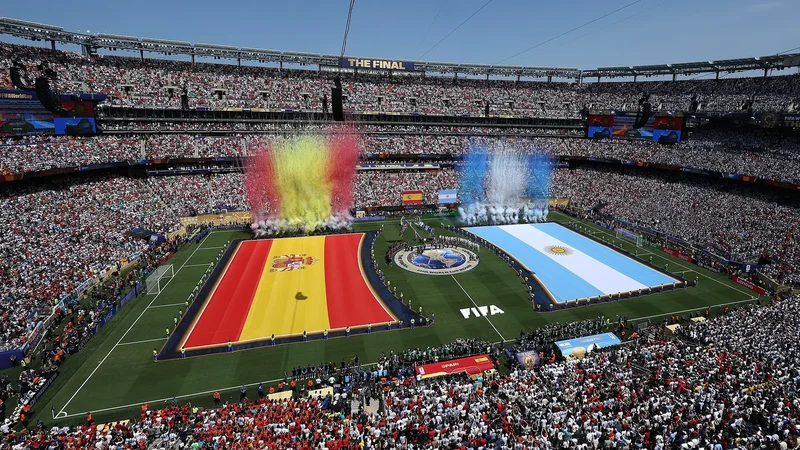
The recently concluded 2026 FIFA World Cup, co-hosted by the United States, Canada and Mexico, was billed as a celebration of football’s global reach. The first 48-team edition, a landmark expansion promising inclusivity and excitement. Instead, it stands as a stark warning. Football’s governing body, led by President Gianni Infantino, has prioritised commercial interests, political favouritism and logistical excess at the expense of the game’s integrity, sportsmanship and purity as the people’s sport. What was once a testament to human athleticism and national passion has increasingly become a vehicle for lucrative revenue streams, sponsor breaks and power plays that erode the very essence of “association football” as we know it.
FIFA’s relentless push for what’s being sold as growth – more teams, more matches and more hosts - has strained players, fans and the fabric of fair competition tremendously. The tournament’s expansion from 32 to 48 teams was just the beginning; discussions are already underway for a potential 64-team format in future editions, driven by Infantino’s vision of a “World Cup for the whole world.” While more nations participating sounds noble and democratic, it dilutes quality, inflates the schedule to grueling lengths and turns the event into an endurance test rather than a pinnacle of excellence. Players, already battered by club seasons, face even greater physical and mental tolls, while traveling supporters endure astronomical costs and fragmented logistics.
This multi-nation hosting model amplifies the problem. Spanning three countries across vast distances, it burdens national teams with excessive travel, jet lag and disrupted recovery. Fans hoping to follow their squads zigzag across borders, facing prohibitive ticket prices, finals reportedly reaching thousands of dollars and inconsistent infrastructure. The 2030 FIFA World Cup will be an even bigger beast, jointly hosted across six countries and three continents. Morocco, Portugal and Spain are the primary hosts, while Argentina, Paraguay and Uruguay will each host one opening commemorative match to celebrate the centenary of the inaugural tournament. The “beautiful game” risks becoming a logistical nightmare that alienates the very people it claims to serve.
In the 2026 edition, refereeing scandals, Video Assistant Referee (VAR) chaos and selective favouritism have further undermined trust. Inconsistencies plagued matches, with VAR interventions often appearing arbitrary and sometimes blatantly one-sided. Allegations of favouritism toward star-player Lionel Messi and his side Argentina echoed throughout, including controversial decisions in high-stakes games against Egypt and others where goals were disallowed and fouls overlooked in ways that seemed to protect star narratives. England fans, no strangers to heartbreak, voiced familiar grievances of being “robbed” by dubious calls, part of a broader pattern of officiating that fuels conspiracy theories rather than resolution.
The introduction and application of VAR, meant to enhance fairness, has instead fragmented the flow and invited eagle-eyed scrutiny over human interpretation. Referee scandals are nothing new in FIFA history but in 2026, they compounded perceptions of a system bending to commercial and narrative pressures, keeping big draw-cards like Messi in the spotlight longer.
In this 2026 tournament, hideous political interference reached new lows. The most glaring example involved US President Donald Trump influencing the rescinding of a red card to American striker Folarin Balogun. After a controversial sending-off, Trump publicly and privately engaged FIFA’s Infantino, leading to the suspension of the ban under Article 27, allowing Balogun to continue playing. This unprecedented intervention by a head of state drew widespread condemnation, with European bodies questioning the tournament’s integrity. Rules bent for the host nation’s star player? It reeks of favouritism that no fan of pure sportsmanship can accept.
Visa restrictions and geopolitical tensions exacerbated divisions. Iranian players and officials faced severe hurdles, with many support staff denied entry and the team forced to base in Tijuana, Mexico, shuttling across the border for matches rather than staying in the US. This disrupted preparation, recovery and fairness, turning participation into a thorny political obstacle course. Other officials and fans from various nations encountered similar barriers, contradicting FIFA’s “inclusive” rhetoric amid US immigration policies. South Africa´s Bafana Bafana dealt with spying incidents during preparations ahead of facing co-hosts Mexico, with leaked training footage raising questions about tactical integrity and fair play. This was another symptom of an environment where edges are seized through any means. Needless to say, South Africa lost 2-0.
Player welfare took a backseat to spectacle. Pitch conditions drew criticism, with reports of altered turfs potentially risking injuries in a bid to meet broadcast and sponsor standards. Hydration breaks, ostensibly for health in warmer climates, doubled as advertising opportunities, shattering match rhythm and reminding viewers that commerce dictates the clock. A total of 32 matches were played with the stadium roofs fully closed. This is unnatural and takes away from the unpredictability of the game! Matches are sometimes influenced by weather conditions such as humidity, wind, fog, rain and temperature.
In the final, half-time entertainment dragged on excessively, prioritising showbiz over the game’s natural cadence and testing even the most dedicated fans’ patience. These elements (commercial hydration pauses, prolonged entertainments, pitch tweaks and VAR) illustrate a deeper rot. The game is being engineered for TV rights, sponsorships and global branding rather than on-pitch purity. FIFA’s projected billions in revenue, estimated at $9 billion (R147.85 billion in July 2026) underscore the incentives but at what cost to authenticity?
The soul of soccer lies in its accessibility, unpredictability and embodiment of merit over money. It is the working-class passion of packed stadiums in Johannesburg’s Soccer City, Maracanã in Rio de Janeiro or Camp Nou in Barcelona, the underdog stories and the raw emotion unscripted by suits in Zurich. Yet 2026 felt like a corporatised production that included sky-high tickets which priced out ordinary fans, dynamic pricing scandals and a format that favors spectacle over substance.
Expansion to 64 teams looms as the next threat, promising more “inclusivity” while likely amplifying travel strains, fixture congestion and quality dilution. Multi-country hosting normalises player exhaustion and fan fragmentation. Combined with referee controversies, political meddling and commercial interruptions, this trajectory endangers what makes football transcendent. FIFA must reclaim the game’s essence: shorter, focused tournaments; consistent, transparent officiating free from influence; prioritisation of player health and fan experience over endless revenue streams. Without reform, the World Cup risks becoming just another plastic branded entertainment property. Profitable, yes, but hollowed of its magic.
Football belongs to the people, not the boardrooms. The 2026 edition exposed the fault lines. Fans, players and true stewards of the sport must demand better before the soul of the beautiful game is lost entirely, forever.