Despite growing backlash against Flock Safetyâs automated license plate readers, some local governments that have voted to remove them have faced issues getting the cameras deactivated and taken down. Now, there could be another reason for communities to want them gone.
The Guardian reports that road-safety advocates are warning that some Flock camera installations may pose a safety risk to drivers.
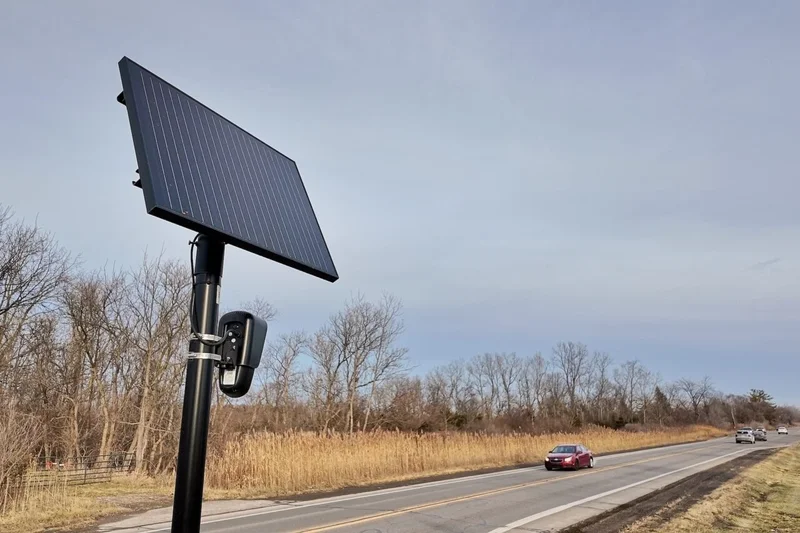
The report highlighted a camera installed beside a narrow, two-lane rural road in Greene County, Ohio. The camera sits atop a black metal pole about two feet from the edge of the pavement, making it difficult to see at night. It also had no obvious sticker showing that it had been inspected by safety authorities.
The Guardian pointed out that according to Ohio Department of Transportation guidance, license plate readers installed along roads without curbs should be at least eight feet from the road.
The pole also lacks a breakaway plate, a safety feature designed to allow a roadside pole to snap when struck by a vehicle, reducing the force of the impact.
Steve Eimers, known online as the Guardrail Guy, has recently been documenting Flock camera installations that he says fail to meet roadside-safety standards.
Eimersâs teenage daughter died a decade ago after she crashed into a guardrail. He has since advocated for safer roads and pushed authorities to follow their own safety requirements for guardrails and other roadside structures.
Eimers told The Guardian that he found only one Flock pole in Erie County, Ohio, with the required breakaway plate. Even then, he said, it was installed higher than permitted under federal standards.
âFlock is not a sophisticated user of roadside safety hardware,â Eimers told The Guardian. “They are nowhere near doing what they are supposed to be, what should be done.”
The new safety concerns come amid growing scrutiny of Flock and its sprawling surveillance network.
Flock sells automated license plate readers, or ALPRs, primarily to local law enforcement agencies. The cameras record the license plate, make, model, color, and other identifying details of passing vehicles, along with the time and location of each sighting. Law enforcement can then search that data during investigations.
According to Flock, its cameras supported more than 1 million criminal investigations and helped locate roughly 10,000 missing people last year.
But the cameras can also lead to serious mistakes.
Last year, a Colorado woman was wrongly accused of stealing a package after a Flock camera captured her vehicle driving in the neighborhood where the theft occurred. Fortunately, she had dash-cam video showing that she was innocent.
Privacy advocates also warn that the cameras collect location data on millions of people who are not suspected of crimes, often without a warrant, probable cause, or reasonable suspicion.
An open-source project called DeFlock maps the locations of license plate readers across the country and tracks communities considering or ending contracts with Flock.
Earlier this month, the Los Angeles Police Department stopped using Flock cameras and allowed its contract with the company to expire.
Even when communities reject the cameras, getting rid of them can be complicated. In Verona, Wisconsin, officials covered their Flock cameras with black trash bags after voting not to renew the cityâs contract. 404 Media reported that city officials were unsure whether they could remove the cameras themselves and whether Flock could remotely deactivate them.
Others have also taken matters into their own hands. Videos showing people knocking down or damaging Flock cameras have gone viral online.
For its part, Flock says it is taking the new road-safety concerns seriously.
âWe’ve recently heard concerns that some camera installations could be better positioned on public roadways to ensure a drivers’ safety,â a Flock Safety spokesperson told Gizmodo in an emailed statement. âOut of an abundance of caution, Flock will be conducting a review of camera pole installations across our network to ensure they meet engineering, permitting, and installation standards.â
The company said it will address any issues identified during the review.
Flock CEO Garrett Langley also said he spoke with Eimers after the safety advocate contacted him on X.
âIt was a really productive conversation,â Langley said. âWe spent about an hour with him walking us through road safety.â
Read More: How a Single Typo in a Username Cost an Innocent Man 18 Months of His Life