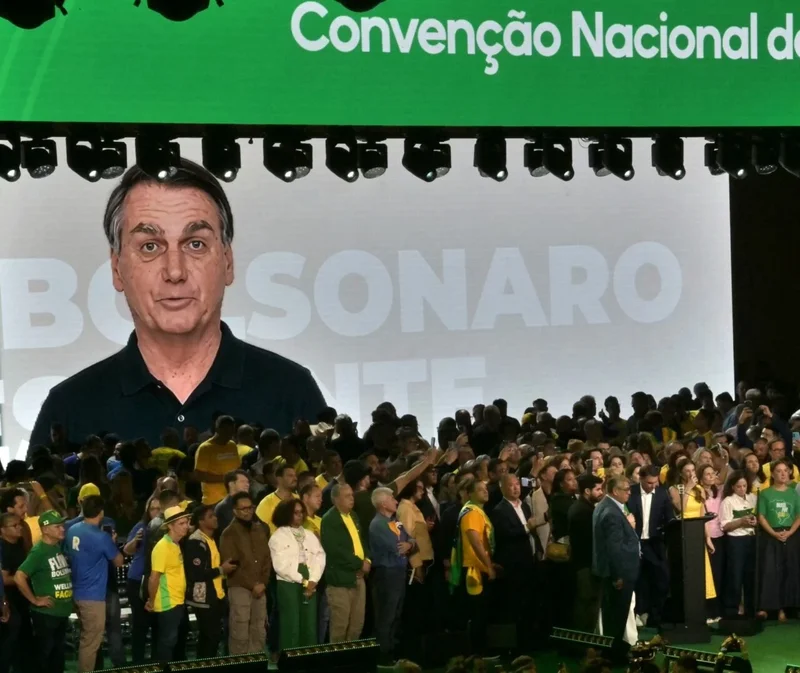
Brazilian ex-president Jair Bolsonaro has been in political exile since September, after he was convicted of plotting a military coup against the government. But thanks to the use of AI, the voice of the 71-year-old right-wing populist and former army captain is once again being heard by the masses.
On Saturday, a giant, AI-generated video recreation of Bolsonaro was projected in front of a crowd who had assembled for the presidential campaign launch of his son, the 45-year-old senator Flávio Bolsonaro. âAs everyone here knows, I am imprisoned and silenced by an unjust and arbitrary decision based on something I never did,â the Bolsonaro deepfake said in a copy of the video posted to YouTube. âBut I guarantee, no prison will silence the feeling of hope we have awakened.âÂ
The deepfake then implored the crowd to vote for the younger Bolsonaroââflesh of my fleshââin the upcoming Brazilian presidential election, which is scheduled for October 4th.
The Brazilian supreme court ruled in March that Bolsonaro, who had been defeated in the countryâs 2022 election by Luiz Inacio Lula da Silva, could continue serving his 27-year prison sentence under house arrest at his home in BrasÃlia due to his failing health. One of the conditions of the relocation was that he completely abstain from the use of social media or any other public communication.Â
Signing off on the AI-generated clone featured at the younger Bolsonaroâs campaign launch could potentially violate that condition. But one of the former presidentâs lawyers, Paulo Cunha Bueno, wrote in an X post on Wednesday that his client âdid not authorize the use of his image and voice for the production of the video created through artificial intelligenceâ and that, moreover, âhe could not have done so,â since heâs currently restricted from seeing visitors.
If the father never approved the use of the AI clone, the son could be liable for violating a Brazilian Higher Electoral Courtâthe Tribunal Superior Eleitoral, or TSEâban on the use of AI deepfakes for political purposes. Flávio Bolsonaroâs campaign team has told the court that the video was within the confines of the law since it began with a clear disclosure to viewers: âWhat you see here is not me,â the AI-generated Bolsonaro said in the video. âThis is a simulation of my image and my voice using artificial intelligence.”
The TSE could disqualify Flávio Bolsonaroâs presidential run if he violated the countryâs political deepfake regulations, according to the Financial Times.
The controversy is a stress test for the use of AI in the politics of Brazil, the largest economy in Brazil and the seventh most populous country in the world. Critics of deepfakes deployed in political campaigns argue that theyâre ushering in a dangerous new era of misinformation, one in which unscrupulous politicians can curate their image through digital means while at the same time claiming that any damning photos or videos of them can be conveniently brushed aside as AI slop.
Like the TSEâs law, the European Unionâs AI Act includes a provision mandating that deepfakes include a label disclosing that theyâve been digitally made or modified. No such disclosure requirement currently exists at the federal level in the US.