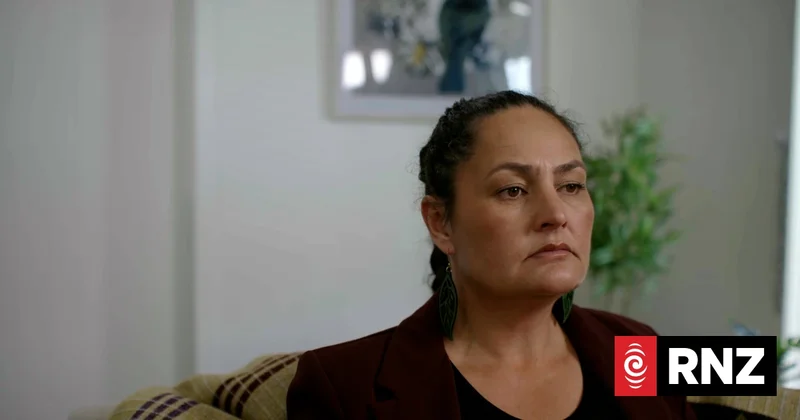
'He was a dictator': Mother of Marokopa children speaks out about her relationship with Tom Phillips
By Mihingarangi Forbes and Annabelle Lee-Mather for Mata Reports.
For most people, the Tom Phillips case began when he first disappeared with his children into the bush in 2021 and ended when he was shot dead by police last year.
But for the children's mother, Cat Christey, the saga stretches back many more years, through a volatile and sometimes violent relationship - and the nightmare she's experienced continues.
In her first interview since her children were recovered from the bush, Cat told Mata Reports: "I would like to see anybody else endure what I have endured for all these years.
"People think that this started … when Thomas abducted the children the first time. This started long before that. This has been going on for a long, long time."
'There was no room for compromise'
As she still deals with agency meetings and the fallout from the dramatic end to Phillips' time on the run, Cat has spoken out about the difficulties of her relationship with him and the toll it has taken.
"He was a good provider but very controlling. It was a very... imbalanced relationship. His views on what a marriage should be were different to my own. We should have been a team. But there was no room for compromise; it was his way or the highway.
"And he liked to be in control, he was a dictator."
Phillips first took the couple's three children into the bush near Marokopa in the western Waikato in September 2021 without telling Cat where he was going. They were separated at the time.
He returned several weeks later, but then, in December 2021, he went bush with the children again.
Phillips remained a fugitive until he was killed in a shoot-out with police following a ram-raid in Piopio.
Cat says that during their relationship, Phillips "wasn't extremely violent" although she described slaps and how he once strangled her.
But she was more concerned about his psychological abuse.
"He would control all the finances, he would take vehicle keys away from me … he would control who I saw and when I saw them."
A fascination with guns
She says Phillips had a fascination with guns and that at one point, she twice rang 111 to tell the police about it. However, she says, Phillips took the phone off her and hung up both times. "I truly believed police would show up because it was a 111 call … but police did not come."
Phillips ordered her out of the house after that incident. Although he later begged her to come back, Cat says she wouldn't.
A few days later, he began proceedings against her and the situation spiralled over the next few years.
Cat found out about the shooting and the discovery of her children after police had first told a Netflix documentary crew - a documentary she says she told the officer in charge, Detective Inspector Andrew Saunders, that she objected to.
"I was dead set against it when they first told me. It was very blunt and I said they do not have my permission.
"[Saunders] told me they didn't need my permission, that they were just letting me know."
Not a victim
It's one way in which she says she feels like she has been disregarded by police throughout the case.
For instance she says that she only found out through the media about the fact the police had decided not to charge anyone with assisting Phillips while he was on the run and that the case was no longer being actively investigated.
Also, she says, she was declined support for counselling because she was not considered a victim of crime.
"I had reached out to Victim Support … in the hopes that they might be able to assist with some sessions with my psychologist."
Cat says Victim Support spoke to the police about her situation but was told nothing could be done.
"Police refused to do a referral stating that we're not victims of crime." This was because what had happened to her was not considered domestic violence, a point disputed by Auckland University associate professor of law Carrie Leonetti.
"This abduction, I think, was an act of child abuse, but it was also an act of domestic violence against these children's mother," says Leonetti.
"Taking children and saying, 'You will not see them for three years, they will live or die depending on what I decide' is an act of domestic violence."
Even Police Minister Mark Mitchell, who would not comment specifically about police actions, said he personally believed Cat was a victim.
"Any right-minded person would say that a mother, regardless of the circumstances, when they're separated from their children, and they've through the tragedy that we all saw unfold in front of the country, a lot of people would probably consider her as much a victim in terms of what has happened," Mitchell told Mata.
"But I cannot talk to the police response other than saying, in my experience, police are very, very good at making sure they identify, communicate and support [victims] as much as they can."
Agencies respond
In response to questions from Mata Reports about Cat's treatment and allegations, Detective Inspector Ross McKay said: "A number of the matters you are asking about are subject to the government inquiry into the disappearance of the Phillips children, and it would therefore be inappropriate for us to comment at this time."
A spokesperson for Manaaki Tāngata Victim Support said the organisation could not comment on individual cases, but added: "The Victims Assistance Scheme, which Victim Support administers on behalf of the Ministry of Justice, has specific eligibility criteria.
"Our Support Workers carefully consider each person's circumstances and identify the support available to them."
A public inquiry into the disappearance of Phillips and his children has been delivered to Attorney-General Chris Bishop.
The inquiry, led by the Honourable Simon Moore KC, was set up under the orders of the previous Attorney-General, Judith Collins, and tasked with considering whether government agencies took all practicable steps to protect the welfare and safety of the children.
Bishop says the report will be presented to Parliament once the government has considered the recommendations and how to deal with suppression orders that are in place in the High Court and Family Court.
Made with the help of Te Māngai Pāho and NZ on Air.