New recommendations for solar power could speed up installations and lower household bills, the industry says.
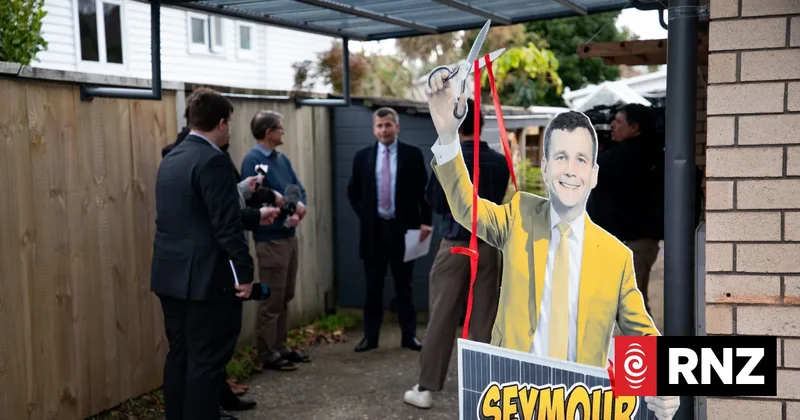
Minister for Regulation David Seymour laid out 15 recommendations to streamline solar uptake in a review published on Thursday.
He also advised legalising plug-in solar, which is currently illegal in the country due to concerns over electricity and fire risks.
"You may have heard people say in Australia you can go to Kmart, buy a plug-in solar panel, plug it in and be going just as though you'd bought a PS2 or a Sega Megastation, or any other device for that matter.
"However, this is much better for the environment and you actually make money instead of wasting your childhood," said Seymour.
Electrification advocates Rewiring Aotearoa welcomed the recommendations.
Its policy director Dave Karl said the suggestions addressed the challenges stopping households from taking up solar: delays and unnecessary added costs.
"I think absolutely solar's day has come in New Zealand and I think the commitments from almost every party around the finance through the ratepayers assistance scheme, will absolutely unlock the choice for more than 90 percent of households to get solar on board."
He said the review cut through red tape without sacrificing safety: accredited installers employing properly certified electricians would still be required.
"I do see it as a job creation opportunity in the medium to long run, and I really hope some parties come out with good policies around building that workforce domestically," he said.
He said legalising plug-in solar would make it very popular with renters.
"And I think more so than just plug-in solar, we'll be seeing lots of people also pairing that with plug-in batteries, enabling them to capture cheap electricity overnight and use that a little bit during the day as well.
"So I think it'll be, I mean, not as game-changing for power bills as rooftop solar can be, but shaving 50 bucks, 20 bucks - everything counts these days for a lot of families."
Future Energy co-founder Heath Coleman agreed this was a positive direction for the industry.
"I think we're all very supportive to see the removal, making solar easier and faster for homeowners to get solar, ultimately, at the end of the day," he said.
"What we're facing at the moment is that there's a long process to get registered and solar installers to have the micro credentials that they need in order to sign off and install a solar system."
He said apprentices in his team of 80 would have to wait an extended period of time after their qualifications before being allowed to install solar.
"We're really struggling to find people that have the right skill sets there because it's still a very new and emerging industry. So, we have to train people up constantly and that takes time and obviously a lot of cost in there as well."
He said he wanted to see the certification process speed up.
However, he said he thought the upfront costs would still be a major deterrent - even with rate payers assistance schemes announced by several political parties.
"I think financially all the numbers do tend to stack up'" he said.
'Significant savings'
But Consumer NZ's power switch manager Paul Fuge said solar installations typically took less than a decade to pay themselves back.
"The other way to look at it is in terms of the unit price.
"So currently the average price in New Zealand is around 35 cents to 40 cents a kWh, depending on where you live. And solar is coming in around 15 cents, including the cost of capital.
"So there's significant savings in terms of the cost of the electricity that's coming off a solar system compared to buying it from the grid."
The consumer champion said the perceived hassle and expense of solar deterred consumers.
"I mean, this review is really about removing unnecessary barriers. And if these reforms make solar quicker and easier to install without compromising safety, that's a win for consumers," he said.
He also welcomed legalising plug-in solar, as renters would be able to reap the benefits too.
"But what we'd say is installation is only half the story," he warned.
Fuge said he wanted to see more oversight of buy-back rates - the price of selling electricity back to the grid.
"Consumers also need to get fair pricing and fair returns from the electricity they generate from their solar systems."
James Scott from Electrify the Hutt, a community-led initiative to promote electrification, said allowing solar panel companies to sign off on an installation without an inspection would help speed up the process, but there was also a need for more installers to meet the demand.
The Ministry for Regulation said a small-scale solar system could involve up to six different sign-offs and five site visits from four different entities before it could be switched on.
Scott said his daughter and son-in-law had to wait around seven weeks due to the amount of red tape.
However, Scott added that he was able to be connected within 48 hours as his installer had done the preparatory work.
"I think that the regulatory review is one part of it, and taking away some of those things will help," he said.
"I think the other thing... is we need a good supply of trained and competent installers who know what they're doing."
Scott said some solar panel companies had more business than they could cope with.
"The demand is only going to grow, and if the current installers don't have the capacity, then we need to find ways as a community of growing that capacity."