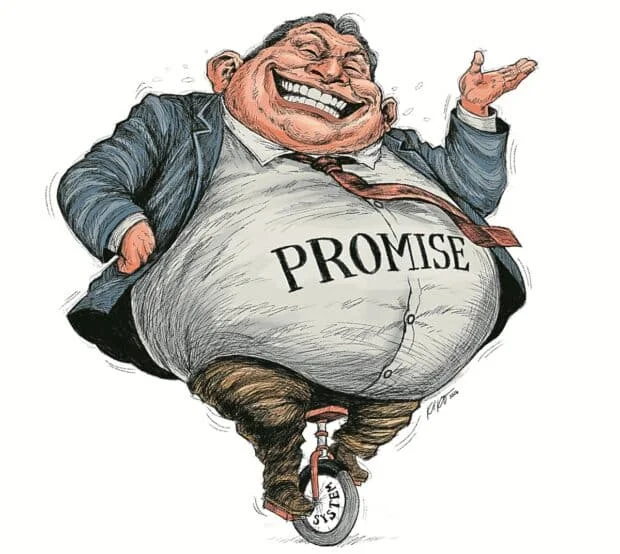
Why your promise fails at scale and how to fix it
Author’s note: This is an expanded version of last Friday’s article on the value proposition as a contract for relevance.
When companies fail to deliver on their value proposition, the usual explanation is poor execution.
Sales overpromised. Operations underdelivered. Customer service failed to manage expectations.
Article continues after this advertisement
Sometimes that is true. But when the same failures repeat across markets, teams and leadership cycles, something deeper is at work.
What looks like an execution problem is often an architecture problem. Most organizations treat a value proposition as a marketing promise. The strongest organizations treat it as a business system.
Customers buy the promise. Markets reward the system behind it. That system rests on four layers.
Layer 1: Strategic contract
What are we promising and what are we deliberately refusing to become?
Article continues after this advertisement
This is where most strategies quietly weaken. Companies are usually clear about what they want to do. They are less clear about what they are willing to stop doing.
Yet strategy is defined as much by exclusion as by ambition. When everything is important, nothing is.
Article continues after this advertisement
Apple’s reset
When Steve Jobs returned to Apple in 1997, the company was overwhelmed by complexity—too many products, too many directions, too many compromises. His response was not refinement. It was removal.
A simple 2×2 matrix defined the entire company: consumer versus professional, desktop versus portable.
Everything outside the grid was eliminated.
Profitable products were cut. Familiar lines disappeared. Internal resistance was high. But clarity returned.
Apple redefined its strategic contract.
A similar pattern: Southwest Airlines made a structurally identical choice when it rejected hub-and-spoke complexity, multiple aircraft types and premium service layers in favor of a single aircraft model and point-to-point routes.
Different industry. Same discipline.
Strategy became powerful because it became narrow.
The litmus test: Can your leadership team name three profitable opportunities deliberately rejected in the past year because they violated strategic boundaries?
If not, strategy is not guiding the organization. Accumulation is.
And accumulation does not scale.
Layer 2: Operating model
How does the promise become repeatable without heroics?
A strategy that depends on exceptional people is not a strategy. It is dependence.
Most organizations confuse performance with capability. Performance is episodic.
Capability is structural.
Toyota’s system advantage
Toyota built its advantage not on extraordinary people, but on extraordinary systems.
Its production model embedded quality into the process itself.
Any worker could stop the line when defects appeared. Problems were surfaced immediately. Fixes were built into the system, not left to management.
Excellence was not an outcome. It was engineered. Toyota removed variance instead of celebrating heroics.
A similar pattern: Tim Cook’s Apple reflects the same logic. While Steve Jobs defined strategic clarity, Cook built operational consistency—tight supply chains, disciplined procurement and predictable execution at global scale.
What once depended on genius became repeatable through operating design, scaling Apple from a roughly $350-billion company into a multitrillion-dollar enterprise.
The litmus test: If your top performers disappeared tomorrow, would your customer experience remain unchanged?
If not, the system is not the source of performance. People are. And that is fragile.
Layer 3: Governance
What prevents the promise from quietly eroding under pressure?
This is where most organizations drift without noticing.
Not through bad decisions, but through reasonable ones.
Sales team wants growth. Operations unit wants efficiency. Finance wants margin.
Each decision is logical in isolation.
But systems fail in accumulation.
And here is the uncomfortable truth: Most companies do not fail because they lack strategy. They fail because they refuse to enforce it.
What leaders call flexibility is often the slow erosion of discipline. The pressure to bend rarely starts internally; it is driven by the relentless, short-term demands of quarterly earnings and institutional investors. When the market demands immediate yield, governance is the only wall standing between temporary growth and permanent brand dilution.
Costco’s discipline
Costco’s promise is simple: deliver value to members. To protect it, it enforces strict limits on product markups.
Even when higher margins are possible, the rule does not usually bend across categories. This is not a constraint. It is protection.
It ensures that short-term financial logic does not overwrite long-term trust.
A similar pattern: Apple’s App Tracking Transparency policy reflects the same discipline. It limited cross-app tracking despite significant commercial pressure.
The cost was real. But so was the protection of trust.
Governance held the boundary.
The litmus test: When short-term revenue conflicts with customer trust, is there a mechanism that can stop the decision?
Or does the strongest financial argument always win?
If it always wins, governance does not exist. And drift is already underway.
Quiet. Incremental. Invisible, until it is not.
Layer 4: Incentive architecture
What does the system reward when no one is watching?
People do not optimize for intent. They optimize for incentives. This is where well-designed strategies quietly collapse. Not because people misunderstand the goal. But because they respond correctly to the wrong signals.
And ultimately, the real problem is not execution. It is the tolerance of inconsistency.
Apple retail
Apple removed commissions from retail employees.
Instead of rewarding sales volume, it rewarded customer experience.
The behavioral shift was immediate. Employees stopped pushing products.
They started solving problems. The result was alignment between behavior and brand promise.
A similar pattern: Southwest Airlines reinforces operational reliability and fast turnaround times through team-based incentives rather than individual sales targets.
No internal competition. No misaligned optimization. Only system performance.
The litmus test: If your top three key performance indicators are maximized, does your value proposition strengthen or weaken?
If it weakens, the system is not aligned. It is conflicted. And conflict always compounds.
The heaviest lift for any leadership team is not designing this new architecture; it is the political and financial cost of deconstructing the old one. Realigning incentives means breaking legacy empires, phasing out outdated metrics and enduring temporary friction while the organization transitions from individual heroics to systemic discipline.
The leadership imperative
Most organizations refine their value proposition. Very few build the system that sustains it.
But competitors can copy products.
They can copy pricing. They can even copy processes. What they cannot easily copy is alignment: a system where strategy, operations, governance and incentives reinforce each other under pressure.
Before your next leadership meeting, ask four questions:
• Is our promise defined by what we refuse to become?
• Can our operating model deliver it without heroics?
• Do our governance mechanisms protect it from short-term market and quarterly pressures?
• Do our incentives reinforce the promise and are we willing to endure the friction required to align them?
A value proposition is not what a company says. It is what survives pressure.
The promise attracts customers. The system keeps them. And over time, consistency becomes trust. Then trust becomes advantage. And advantage becomes difficult to dislodge.
Define the promise. Build the engine.
Protect the boundaries. Align the incentives.
Because customers never experience strategy. They experience systems. ** —CONTRIBUTED** INQ
Josiah Go is the co-creator of the six-step Logic Chain, part of the four-component PILA Reasoning Stack, which is embedded in the seven-part Trust Economy Flywheel framework. He is the bestselling author of 20 books and serves as an independent director of a universal bank.