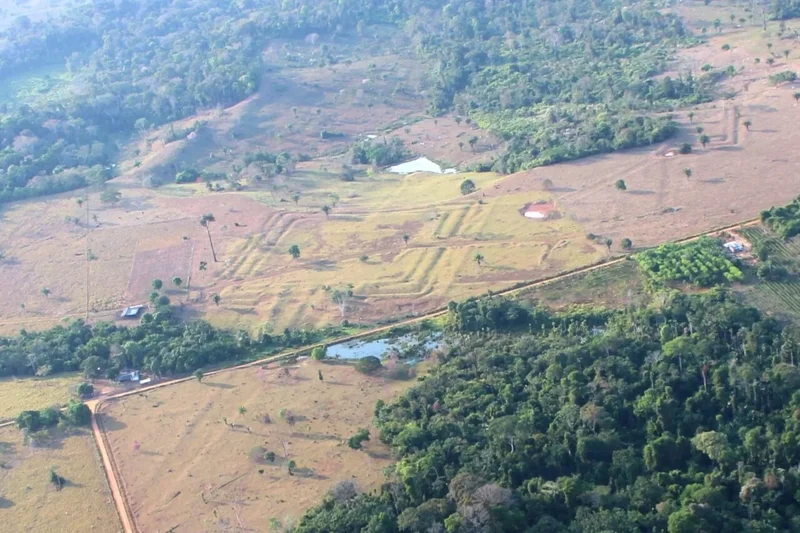
The scientific consensus up until just two decades ago was that there was no evidence any human civilization had ever occupied the Amazon before Spanish and Portuguese conquistadors forever altered life and politics across the South American continent. But now new airborne laser scans surveying over 1,737 square miles (about 4,500 square kilometers) of western Brazilâs rainforest have completely rewritten human history in the pre-Columbian Amazon.
Researchers led by archaeologist Martti Pärssinen at the University of Helsinki in Finland have uncovered more than 400 well-preserved earthwork monuments, ceremonial sites, and roads hidden beneath the dense overgrowth of the Brazilian rainforest. Incredibly, the researchers extrapolate the approximately 400 confirmed sites to an estimated 20,000 to 30,000 earthwworks across the region. Pärssinen and his colleagues believe these structures are evidence of an interconnected, multicultural civilization that thrived deep within the Amazon between 600 BCE and 850 CEâa population of millions who dramatically altered the rainforestâs ecosystem.
They call them the Aquiry, after the indigenous Iñapari name for the Acre River, an Amazon River tributary that runs alongside this groupâs hundreds of once-lost ancient sites.
âThe research shows that the human impact on the Amazonâs environment has been far greater than previously believed,â Pärssinen said in a press statement. âThis has direct implications for our understanding of the regionâs biocultural history.â
Laser tag
Pärssinen and his team used an aerial mapping tool known as lidar, short for âlaser imaging, detection, and ranging,â to map the Aquiryâs ancient structures. As its similarity to the older acronym radar might imply, lidar beams laser light against a surface and derive measurements from how that light bounces back. In recent years, safe and noninvasive lidar scans have helped archaeologists uncover sites from a jungle hiding Cambodiaâs early Khmer empire to a national preserve in Mexico that held a forgotten Mayan city.
âWe flew long, roughly [280-mile] 450-kilometer straight transects, mapping a strip about one kilometer wide every [6 miles] ten kilometers,â remote sensing and photogrammetry professor Juha Hyyppä of the Finnish Geospatial Research Institute explained in a statement.
âThis allowed us to cover as large a continuous area as possible,â according to Hyyppä, who executed this aspect of the new study, published Wednesday in the journal Nature.
The teamâs lidar mapping traced large geometric shapes, known as geoglyphs, as well as straight roads that sometimes connected them. These geoglyphs could be quite complexâincluding pentagrams and octagons as well as circles inscribed into precise squaresâaccording to study coauthor Alceu Ranzi, a geographer with the University of Acre.
âAt the same time that Pythagoras was in ancient Greece doing his theorem, we had people here in Amazônia doing geometry,â Ranzi told the journal Science.
A nation of millions
Trace amounts of charcoal found at some of these geoglyphs during early and more ground-based surveys helped archaeologists radiocarbon date the earthworks to roughly 2,500 years ago, according to Ranzi. That work also helped the team better estimate the Aquiry peopleâs population at something between 1.25 and 3 million people along a 3% patch of the Amazon spanning roughly 71,000 square miles (183,000 sq km).
Heiko Prümers, a researcher at the German Archaeological Institute who has also investigated ancient human settlements within the Amazon for his own work, expressed caution over these eye-popping population estimates. As Prümers told Scientific American, the recurrence of these geoglyphs across so many hundreds of sites could very likely be the consequence of âfrequent relocationsâ by the Aquiry instead of evidence of their sprawling population density. Indeed, it’ll be interesting to see what other archaeologists will have to say about the extraordinary claims made in the new paper in the coming months and years.
If correct, however, those calculations would imply that tens of millions of people inhabited rainforests once thought to be pristine wilderness. Pärssinen and his coauthors, instead, found compelling evidence that the Aquiry left a profound mark on the Amazonian ecosystem.
Aquiry horticulture and forest management cultivated a variety of protein-rich tree species specific to the region, including the Brazil nut and the peach palm, as well as various fruit-bearing palms, like the bacaba and uricuri. The researcherâs examination of microscopic mineral deposits left by plants, known as phytoliths, also suggests that the Aquiry were early farmers of maize and squash.
âOur findings overturn our understanding of the Amazon regionâs past,â according to Pärssinen, who added that these all-too-human changes in the ancient Amazon might force scientists to rethink how the rainforests have been impacted by more modern human activity.
âThe civilization also affected ancient Amazoniaâs carbon production and carbon balance,â he said, âwhich should be better accounted for in future climate models.â