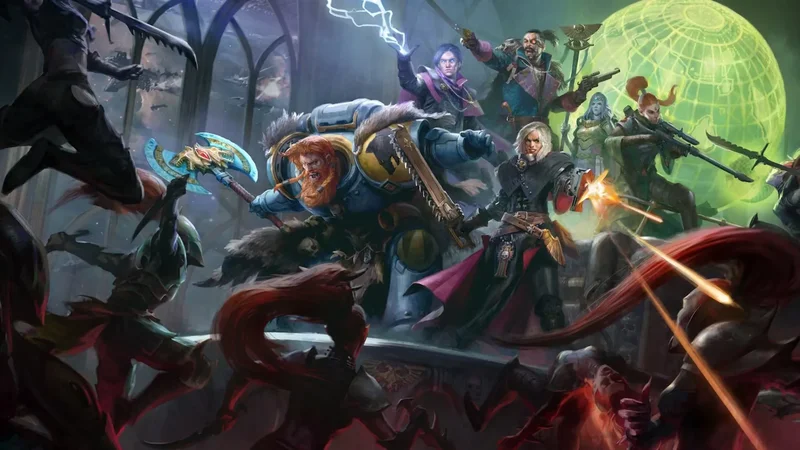
"Feeling confused" and "having fun" usually exist at opposite ends of the experience spectrum for me, but Owlcat's Warhammer 40K: Rogue Trader is bringing the two closer together than I would've thought possible. I've never warred a hammer before, and when Rogue Trader was released in 2023, Baldur's Gate 3 fully occupied my time and attention. But with Owlcat's big July 7 Switch 2 update for the game, I figured now was as good a time as any to give Rogue Trader a go. I'm glad I did. It's a fantastic spectacle of dark sci-fi fantasy and deep strategy, and despite a few hiccups, it runs surprisingly well on Nintendo's hybrid handheld.
Or it does now, anyway. The Switch 2 version launched in a dreadful state in December 2025, full of wildly variable frame rates, stutters, crashes, and game-breaking (even ending-blocking) bugs, but Owlcat's patch fixes most of the major issues and even bumps the resolution up a bit. The frame rate is capped at 30fps, and dips are much less common now. When they do happen, it tends to be in the occasionally choppy transition from gameplay to cutscene rather than during standard gameplay in, say, a crowded location (and that's usually in handheld mode, not when playing docked). Battles unfold smoothly, even when lightning and psychic blasts are competing for attention on the screen, and so far, I haven't encountered any crashes or quest-blocking bugs. And despite being designed for mouse and keyboard, the controls feel smooth and intuitive on Switch 2.
Load times are a bit longer than I'd like, though. It takes 30 seconds or so to go from the main menu to the game itself and about 15-20 seconds when changing areas in handheld mode, though much less in docked. Saving also takes several seconds, which is annoying when an autosave suddenly forces you to stop what you were doing until it's done. Hopefully, Owlcat can improve these in future updates. But annoying as the load times are, I'm just glad I can play a massive game like this without being chained to my computer. As an apology, Owlcat made Rogue Trader's expansions free on Switch 2, too, which is a nice and welcome bonus.
Though I admit, I'm not quite finished with the absolutely gargantuan base game yet. Owlcat tosses you into the deep end of the Warhammer pool, but it's a gentle landing that lets you float for a bit. Rogue Trader starts with you in attendance to a rogue trader, which is kind of Warhammer's version of what England's Elizabeth I did with her naval captains in the Age of Exploration. “Go forth and chart new lands for us! But also feel free to do bad things and wreck our rivals and act like a pirate.” The lands in question are "uncivilized" solar systems at the far edge of the galaxy, which are perfectly civilized on their own, thank you. They just don't necessarily follow the God-Emperor, humanity's political and religious leader. Religion is also a bit funky in Warhammer, as its boundaries with technology blur a lot. The God-Emperor's throne, for example, is a symbol of faith and a technological masterwork despite the obvious contradictions there.
You learn all this in roughly an hour, and while it's a lot to take in, Owlcat doles it out in easy-to-digest chunks wrapped in a pretty gripping tale of conspiracy. Your presence on the vessel of rogue trader Theodora von Valencius is part of a weird family reunion. She's looking for blood-heirs to share her empire with and pulled a bunch of distant cousins in to see who might be worthy. Then people start dying, and losing their minds, and exploding, and getting possessed by space demons, and dying some more. You're the captain now by virtue of not being dead, and you've got a psychic, a knight, and a murderous nun with a shotgun to help you run things. I don't think I've ever played a game with a prologue as wild as Rogue Trader's.
There's a handy glossary so you can look up stuff like "the warp" that's making people lose it (an interdimensional space ruled by chaos, but very handy for traveling fast), "God-Emperor," and the game's bizarre HP terminology. (It's not health, it's wounds!) During and after the prologue, Owlcat does an admirable job spacing out lore dumps and introducing more proper nouns so Warhammer newcomers like me never feel like they're falling into an unknowable abyss, even if they are standing on the edge of it.
Which is good, since Rogue Trader's story gets knotty, fast. The gist of it is you're dealing with the fallout of Theodora's highly questionable actions, and you're getting involved in a lot of other people's messes in the process, shaping the galaxy's uncharted corners with your special brand of ideological lunacy. Rogue Trader's version of morality alignment is less about good and evil and more to do with which ideology your character adheres to. There's room for several, but once you reach a certain level of entrenchment in one philosophy, it becomes your dominant trait and has greater influence over your conversation options and how likely you are to clash with everyone else.
They sure are some high-stakes clashes, too. Rogue Trader has all of Warhammer's extremes, so saying you follow the God-Emperor without question is kind of the same as saying "yes, I support colonization and mass murder." And not following them means you put yourself in a lot of dangerous situations by taking the "iconoclast" route and supporting all the people the emperor's followers oppress. Or you can toss it all to the wind and embrace chaos. Every path has its benefits — and unpredictable consequences. Even though you do eventually specialize in one type of morality, the option to mix and match as you go lets you take a more flexible, bespoke approach to problems rather than routinely picking the good, bad, or neutral option and pretty much knowing how that's going to pan out.
It's impressive just how effectively Owlcat manages to capture the unparalleled misery of living in a Warhammer world, making these large-scale political conflicts feel so personal and intimate. Grim as it is, though, it's never overwhelmingly horrible thanks in part to how well-written your companions are.
And it helps that you spend a lot of time in Rogue Trader's excellent turn-based combat, too. The bones of it are similar to Larian's Divinity: Original Sin games, though slightly more forgiving. Moving and using skills use points, but since Rogue Trader keeps the two separate, you have more room to maneuver before committing yourself to an action. It's just as dense as the story, but, mercifully, you can open a combat glossary mid-battle to make sure what you're doing won't backfire horribly.
It gets deep fast. Argenta, the nun-with-a-gun, starts with a skill that lets her take two actions, so you can have her zoom around the battlefield and fire her shotgun in a huge cone pattern that engulfs groups of enemies and then do it again. There's a penalty for it, but you can have her learn a skill that reduces that penalty too. I admit I had no idea what I was doing with my player character during the creation sequence, but even in the prologue, she ended up debuffing enemies and one-shotting lines of them with a sniper rifle's piercing bullet. That turned out nicely. That's not even getting into the distinctions between melee attacks and ranged attacks and the different stats that determine how and if they land. The skill ceiling for building combos is incredibly high, and Rogue Trader is one of the only RPGs I've ever wanted to replay just for a chance to do things differently with combat.
Even with its long load times and 30fps cap, Rogue Trader is a perfect fit for the Switch 2. It's the kind of game that rewards you for taking your time with it, chipping away at it in bits and pieces and exploring every dark corner and potential mystery. If, like me, you let it get lost in the shadow of Baldur's Gate 3, now's the perfect time to check it out.