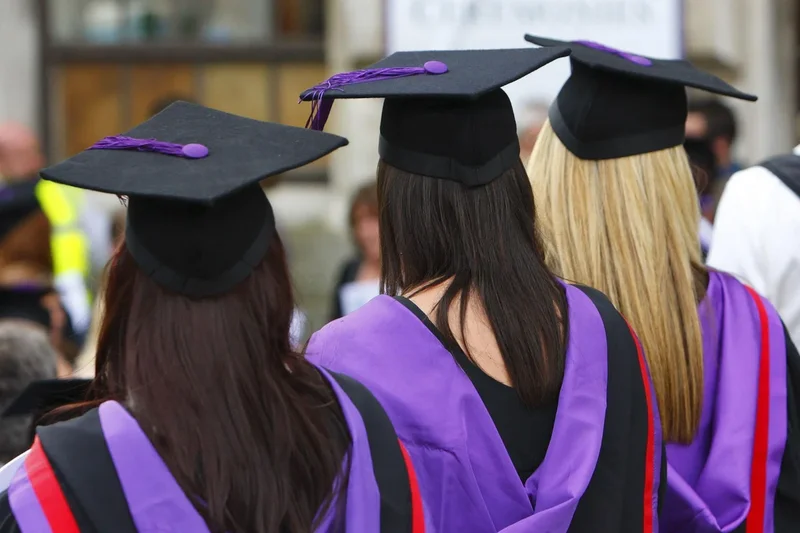
President Donald Trump is reportedly considering imposing a $100,000 fee on a visa used by foreign-born graduates to work in the United States.
In the latest attempt to restrict legal immigration pathways, the president and his Department of Homeland Security are considering the high fee on Optional Practical Training visas that are an extension of students on F-1 visas, the Wall Street Journal reported.
Optional Practical Training Visas allow recent graduates to work in the U.S. for one to three years so long as it's directly tied to their area of study.
Though the new policy has not been confirmed by the administration, if imposed, it would mirror the $100,000 fee imposed on H-1B visas by the Trump administration last year.
A spokesperson for the Department of Homeland Security said no policy should be considered final until it’s formally announced but that the department was “always having conversations” about how to “protect the integrity of our legal immigration system.”
“Under President Trump and Secretary (Markwayne) Mullin, our immigration system is being reformed to serve American citizens, American workers, and American families and to preserve our national identity—not to rapidly import foreigners who take American jobs, commit crimes, steal our intellectual property and engage in corporate espionage, and erode our cultural and social fabric,” the spokesperson added.
A White House official familiar with the matter told The Independent that the administration had no imminent policy announcements on Optional Practical Training visas.
The idea under consideration is another example of exorbitant fees to curtail the number of foreigners working in the U.S. – one of the president’s goals.
Already, the administration sought to add a $100K fee to H-1B visas for skilled foreign workers. However, its proposal was struck down by a federal judge last month, who ruled the fee was considered a tax – and only Congress could authorize such a change.
The president also created Trump Gold Cards, which offer permanent residency to wealthy foreigners who invest $1 million into the U.S. and pay a $15,000 processing fee.
While the administration sees the technique as a way to root out immigrants, experts warned that limiting H-1B visas could hurt tech industries that rely on talent from other countries to develop new technologies.
Similar consequences could occur if the administration chooses to introduce a new fee on Optional Practical Training visas. Universities and colleges could lose foreign-born students as sources of revenue, should fewer foreign-born students choose to come to the U.S. for school and early career opportunities.
It could also hurt tech companies, where recent grads utilize Optional Practical Training visas to work.
In 2024, roughly 418,000 students were authorized to work in the U.S. through an Optional Practical Training visa. That was roughly 26 percent of the 1.58 million foreign students on F-1 or M-1 visas.