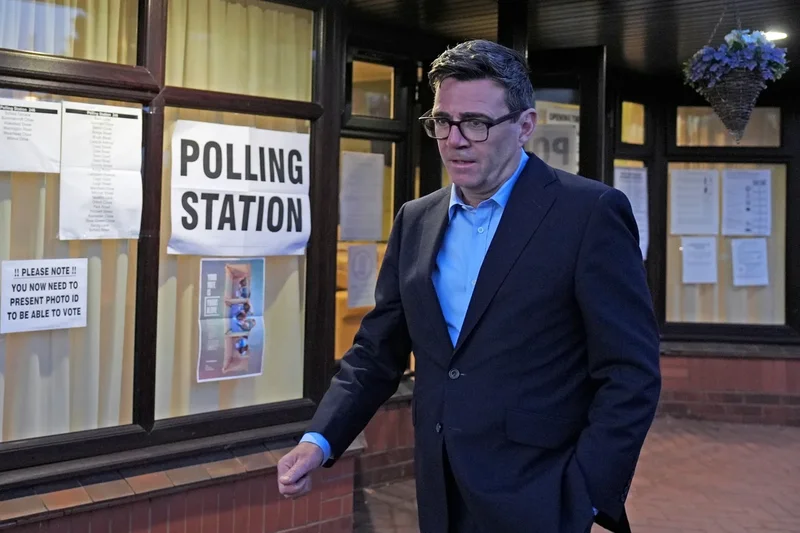
Polling stations have now closed across Greater Manchester in the historic by-election to determine the region’s next mayor.
This contest, necessitated by Andy Burnham’s recent election to Parliament, stands as the largest by-election in British history, with more than two million people eligible to cast their votes.
Ahead of Thursday’s ballot, projections indicated a comfortable victory for Labour candidate Bev Craig, who currently serves as the leader of Manchester City Council.
Her primary challengers were anticipated to be Reform UK’s Sian Astley and the Green Party’s Geraldine Coggins.
Other hopefuls included Phil Eckersley for the Conservatives, Richard Kilpatrick representing the Liberal Democrats, Marlon West of Restore Britain, and independent candidate Marcus Farmer.
Mr Burnham himself voted at a polling station in Golborne, near Wigan, late on Thursday, casting his ballot less than an hour before polls closed.
After voting finished on Thursday, Labour deputy leader Lucy Powell said her party had run “a really positive campaign” and been “on the front foot, setting out our stall, showing what Labour in power can do”.
She said: “Through our candidate Bev Craig and our new Prime Minister, Andy Burnham, we have heard from many people who are giving Labour another look. Labour is offering hope.
“If the voters of Greater Manchester put their trust in Labour, we will all work tirelessly to put Bev’s promises into action.”
Ms Coggins said her party had seen “former Labour voters move to the Greens in droves” and shown it could “challenge the larger parties”.
She said: “A new Prime Minister who is popular in this region meant that we were contesting this election in unusual circumstances. However, we found real discontent across Greater Manchester with how Labour have been running this place, and the people want a change of direction.
“This includes clear commitments on rent controls, affordable housing and to make sure people are put before profit.”
Votes will be counted on Friday, with the winner expected to be announced in the afternoon.
It is the first time a by-election has been necessary to fill a vacancy for one of England’s combined authority mayors.
The cost of the contest is expected run into the millions, with the 2024 mayoral election costing the taxpayer £4.7 million.
That contest saw Mr Burnham re-elected with 63% of the vote under the “first past the post” system, in which the candidate with the most votes is declared the winner.
He also received the most votes in each of Greater Manchester’s 10 local authority areas.
For Thursday’s by-election, voting changed back to the “supplementary vote” (SV) system used in the mayoral elections in 2017 and 2021.
If any candidate wins more than 50% of the first-choice votes, they are declared the winner.
If no candidate has more than 50% of first-choice votes, all but the top two candidates are eliminated and the count moves to a second round.
The ballot papers of the eliminated candidates are counted again and if there are any second-choice votes for the two remaining candidates, these are added to their first-choice totals.
The candidate with the highest overall total of first and second-choice votes is declared the winner.
In 2021, the last time Manchester was contested under the SV system, Mr Burnham won in the first round with 67% of first preference votes.