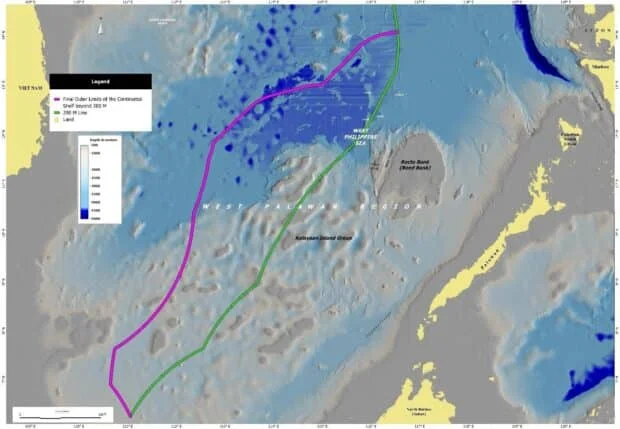
PH presents WPS seabed claim before UN panel
MANILA, Philippines — The Philippines has presented its claim to an extended continental shelf in the West Philippine Sea (WPS) before a United Nations commission, asking it to consider the landmark 2016 South China Sea arbitral ruling as it evaluates Manila’s bid, the Department of Foreign Affairs (DFA) said.
The presentation before the UN Commission on the Limits of the Continental Shelf (CLCS) on Wednesday marked the next step to the Philippines’ partial submission in June 2024 covering the West Palawan region, the DFA said.
Article continues after this advertisement
During the proceedings at the United Nations headquarters in New York on July 29, the Philippines urged the commission to consider rulings by tribunals constituted under the United Nations Convention on the Law of the Sea (Unclos), including the 2016 South China Sea arbitral award.
READ: Why the West Philippine Sea ruling still matters
Outer limits
The DFA said the arbitral ruling had authoritatively determined the maritime entitlements of coastal states in the South China Sea.
The Philippines filed its claim under Article 76 of the Unclos, which allows coastal states to establish the outer limits of their continental shelf beyond a 370-kilometer (200-nautical-mile) limit if they meet the convention’s scientific and legal requirements.
An extended continental shelf covers the seabed and subsoil beyond a country’s 370-km exclusive economic zone (EEZ). Under the Unclos, coastal states may establish their outer limits as far as 648 km (350 nautical miles) from their territorial seas if they satisfy the convention’s criteria.
Article continues after this advertisement
Article 77 grants coastal states sovereign rights over natural resources found on or beneath the continental shelf, including minerals and other nonliving matter, as well as organisms that are fixed to the seabed or subsoil.
Article continues after this advertisement
“The submission demonstrates the Philippines’ steadfast commitment to the United Nations Charter and the 1982 Unclos, reflecting the country’s trust in a rules-based order in the marine and maritime domain,” the DFA said in a statement.
The department said the submission also reflected the Philippines’ commitment to promoting peace in the South China Sea through the rule of law while protecting livelihoods, marine biodiversity and trade.
Manalo leads team
Ambassador Enrique Manalo, the Philippines’ permanent representative to the United Nations, led the Philippine delegation. It included the Extended Continental Shelf Technical Working Group headed by National Mapping and Resource Information Authority (Namria) Administrator Peter Tiangco, and officials from the DFA, the Department of Justice, Office of the Solicitor General and academic experts from the University of the Philippines.
The DFA said Namria spent 15 years preparing the scientific and technical submission prior to the Philippines’ partial submission with the CLCS in June 2024.
China protest
The 2024 submission was the Philippines’ second to the CLCS. In 2009, it filed a partial submission covering the Philippine Rise, formerly called Benham Rise. The underwater plateau is located in the Philippine Sea, east of Luzon in the western part of the Pacific Ocean.
The CLCS adopted its recommendations in 2012, allowing the Philippines to establish the outer limits of an additional 135,506 square kilometers of continental shelf.
China protested against the Philippines’ partial submission covering the South China Sea in note verbale on June 18, 2024.
It appealed to the CLCS “not to consider” Manila’s submission. It said that it had “indisputable sovereignty” over Nanhai Zhudao, its name for the South China Sea islands, and the adjacent waters, and that it “enjoys sovereign rights and jurisdiction over the relevant waters as well as the seabed and subsoil thereof.”
The Philippines’ extended continental shelf “seriously infringed” on China’s sovereignty, sovereign rights, and jurisdiction in the South China Sea.
Malaysia also protested against the claim on June 27, 2024, saying that the Philippines’ continental shelf was “projected from the baselines of the Malaysian state of Sabah” and Kuala Lumpur never recognized Manila’s claims to Sabah.
Vietnam rejection
On July 17, 2024, Hanoi, Vietnam filed its own extended continental shelf claim, its third submission.
The Philippines responded, saying it was “ready to engage” with Hanoi on “possible ways forward” to reach a “mutually beneficial solution to South China Sea issues” according to international law, particularly Unclos.
Vietnam said it “resolutely rejects” and “cannot accept” the Philippines’ claim, citing an overlap with Vietnam’s 370-km continental shelf. It said that this violated Vietnam’s “inherent sovereign rights and jurisdiction.”
Hanoi, however, said it was open to discussing and negotiating the matter with Manila under Unclos. But it requested the CLCS to “refrain from considering” the Philippines’ submission “until all the relevant issues have been resolved by Vietnam and the Philippines.”
The CLCS reviews the scientific and technical basis of submissions under Article 76 of the Unclos and issues recommendations on the outer limits of a state’s continental shelf.
It does not decide questions of sovereignty or maritime boundary disputes. —WITH A REPORT FROM INQUIRER RESEARCH