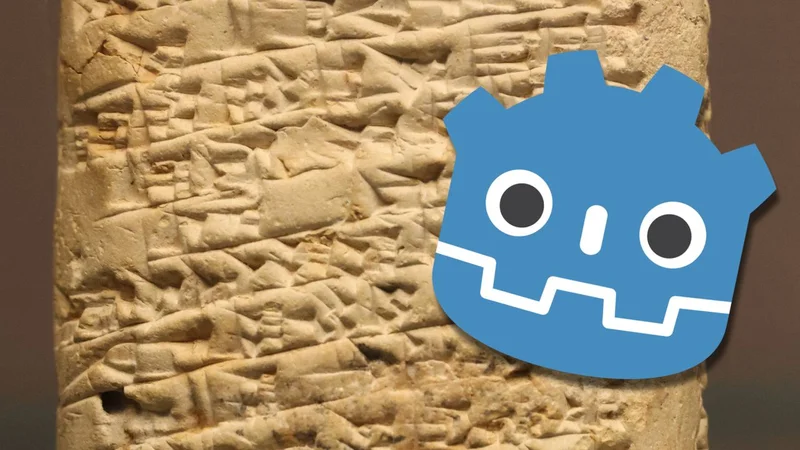
In a time when the dominant game engines are contorting themselves to accommodate generative AI toolsets and the resurrected specter of NFTs, game developers who might be investigating alternatives should be asking themselves one very important, yet all too often overlooked question:
Does this engine's built-in scripting language allow me to write code using the finest and most adaptive logo-syllabic writing system ever devised in ancient Mesopotamia?
Daily reminder that GDscript supports the Sumerian clay table alphabet, Akkadian cuneiform of ancient Mesopotamia. This is perfectly valid code you can write in your game:
— @steinmakesgames.bsky.social (@steinmakesgames.bsky.social.bsky.social) 2026-07-30T21:57:18.990Z
Well, if you're considering Godot for your next project, the answer is a resounding 𒀭𒈾. As noted on Bluesky earlier today by independent game developer SteinMakesGames, GDscript—Godot's built-in, Python-like scripting language—supports coding in Sumero-Akkadian Cuneiform, a feature that's sadly neglected by many of the standard languages used in software development.
"Daily reminder that GDscript supports the Sumerian clay tablet alphabet, Akkadian cuneiform of ancient Mesopotamia," SteinMakesGames said, before demonstrating with a screenshot of "perfectly valid" cuneiform code that I can definitely read and absolutely understand. I just don't want to show off. It's rude.
By supporting the world's earliest known writing system, GDscript is the perfect choice for developers who might want to comment their code with a dedication to divine and benevolent Enlil, from whom the princes and kings of the earth derive their authority, or ensure they're using a language truly capable of conveying their frustrations with being sold a shipment of sub-standard copper ingots despite earlier assurances of their quality.
It's worth noting that SteinMakesGames—whose strategic mining roguelike Dig Dig Boom is set to launch on Steam next year—seems genuinely invested in ensuring that other developers are aware of GDscript's cuneiform support. While it isn't exactly a daily reminder as claimed, the developer has previously posted on Reddit to give other Godot users a heads-up that they could be coding in Akkadian. Can you imagine? Not knowing you could be coding in Akkadian?
If you're wondering why GDscript supports cuneiform, it's because its parser accepts the use of most Unicode Standard Annex #31 characters in identifiers when some languages—like C#—do not. That means, in addition to cuneiform, Godot devs could also be coding with Futhark runes, Egyptian hieroglyphs, and Mycenaean Linear B. And GDscript isn't alone in that capability: Python, JavaScript ES6+, and Rust let you play Unicode jazz, too.
Keep up to date with the most important stories and the best deals, as picked by the PC Gamer team.
As history tells us, It's nice to have choices—both in writing systems, and in ingot providers.
Lincoln has been writing about games for 12 years—unless you include the essays about procedural storytelling in Dwarf Fortress he convinced his college professors to accept. Leveraging the brainworms from a youth spent in World of Warcraft to write for sites like Waypoint, Polygon, and Fanbyte, Lincoln spent three years freelancing for PC Gamer before joining on as a full-time News Writer in 2024, bringing an expertise in Caves of Qud bird diplomacy, getting sons killed in Crusader Kings, and hitting dinosaurs with hammers in Monster Hunter.