Galaxies in the infancy of the Universe are the building blocks of more modern galaxies. They began as small "shreds" of material that coalesced over time to form larger ones. That's why astronomers use observatories such as the James Webb Space Telescope (JWST) to study the young Universe. The light from those early objects appears in the infrared part of the spectrum, which JWST is tuned to see.
In recent years, JWST has also found massive, quiescent galaxies at a time when the cosmos was about 1-2 billion years old. This is a period when galaxy formation was kicking in, as well as the collisions that helped form larger galaxies over time. The quiescent galaxies aren't dead, and there's ample evidence that the galaxies experienced bouts of star formation before going quiet. So, the big question is: what is it that turns off the starburst activity, leaving behind galaxies with little activity after the first bursts of star formation? Astronomers have proposed several ideas about the causes, including early dark energy activity that caused some galaxies to grow fast and die young.
This image shows a small portion of the field observed by NASAâs James Webb Space Telescopeâs NIRCam (Near-Infrared Camera) for the Cosmic Evolution Early Release Science (CEERS) survey. It is filled with galaxies. Some galaxies appear to have grown so massive, so quickly, that simulations couldnât account for them. However, a new study finds that some of those early galaxies are in fact much less massive than they first appeared. Black holes in some of those galaxies make them appear much brighter and bigger than they really are. Galaxies such as CRISTAL-02 look remarkably quiet compared to their brighter and busier counterparts. Courtesy NASA, ESA, CSA, S. Finkelstein (University of Texas)
The Answer is Blowin' in the Winds
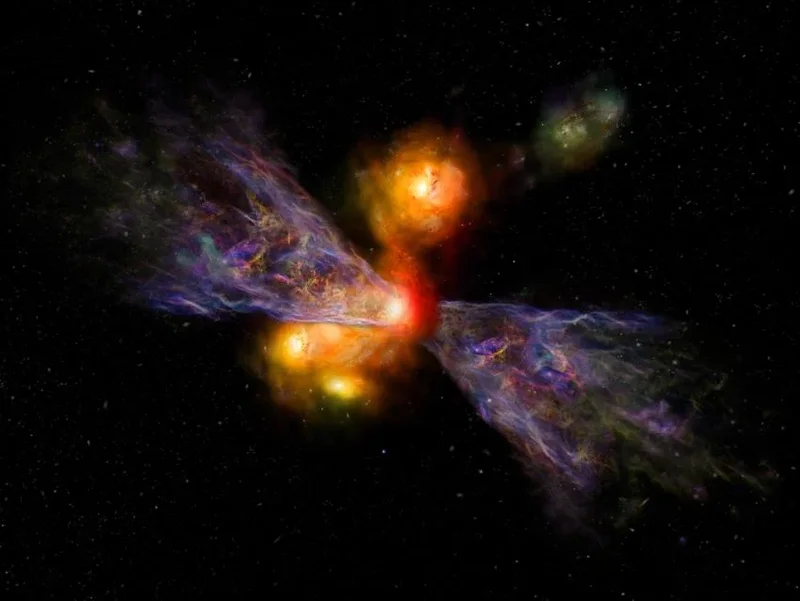
It turns out the culprit is a galaxy-quenching "wind" that occurs in some galaxies and explains why astronomers see many quiet and massive ones in the early Universe. The wind is thought to occur during galaxy collisions. As two or more galaxies mesh with each other, the cosmic dance triggers huge bursts of star formation. A team of astronomers from Swinburne University studied a galaxy called CRISTAL-02, using JWST and the Atacama Large Millimeter/submillimeter Array (ALMA) radio telescope.
The target galaxy appears as it existed one billion years after the Big Bang, and was experiencing a rapid growth spurt. There's actually more than one galaxy involved in this collision, which makes the scene all the more interesting. Usually, during galaxy encounters like this, gas flows toward the center of the action. That's what triggers the starburst activity seen in many of these collisions.
Based on its collisional history and the bursts of star formation, the team, led by Rebecca Davies, wrote a study proposing a simple process: the galaxy experiences a huge period of starbirth that triggers not only growth, but a galaxy-killing wind that shuts off further growth. "Dense regions of the universe are like very active cities," said Davies. "Galaxies collide and undergo frenzied bursts of star formation. But when the biggest stars burn out, they explode as supernovae, launching powerful winds that blast away the very gas galaxies need to keep forming stars."
About CRISTAL-02
The target galaxy appears to be forming stars twice as fast as other similar galaxies at comparable epochs of cosmic time. The clue to what was happening is a plume of cold gas flowing away from CRISTAL-02. That's the seed material for stars and a clue that something is driving the gas away from the galaxy. "The galaxy has a powerful wind that is ejecting material twice as fast as the galaxy forms stars," Davies added. "If this rapid blowout continues, the galaxy could be dead in less than 50 million years, explaining the origin of the mysterious massive dead galaxies in the early Universe."
An artist's conception of gas clouds feeding starburst regions in early galaxies. Massive stars that form in these areas live fast and die young, and their supernova winds can expel and destroy any other gas clouds nearby. That chokes off star formation. Courtesy NASA.
The CRISTAL-02 starbirth activity and eventual quenching of star birth offer a plausible explanation to the mystery of why many early galaxies lived fast lives and died young, according to Davies. "Almost half of early massive galaxies are interacting with other nearby galaxies, suggesting this isnât a quirk but a widespread cosmic phenomenon," she said. "If many early galaxies collide and experience rapid growth, then it may not be surprising that we see so many dead galaxies in the early Universe."
The CRISTAL-02 observations will lead to additional studies using JWST. For one thing, astronomers will want to look at the dusty regions of the galaxy, in additition to the gas plume. Those studies should shed new light on the gas-fueled star formation regions and how the mergers the galaxies are experiencing are affecting the participant galaxies. The discovery also underscores the importance of reevaluating simulations that previously underestimated the diversity and complexity of early galaxies. By integrating observations like CRISTAL-02's, astronomers can refine models to better align with the chaotic, dynamic reality of the early cosmos.
In their paper, the team suggests further deep observations of early galaxies to study their optical emissions and neutral gas content. They point to CRISTAL-02 as just the first step in identifying other galaxies being killed by starbirth winds. It was just barely detectable by JWST spectra. Along with deeper observations, astronomers should check out high-redshift star-forming regions in greater detail in these targets to see if the merger-driven outflow explanation is robust.