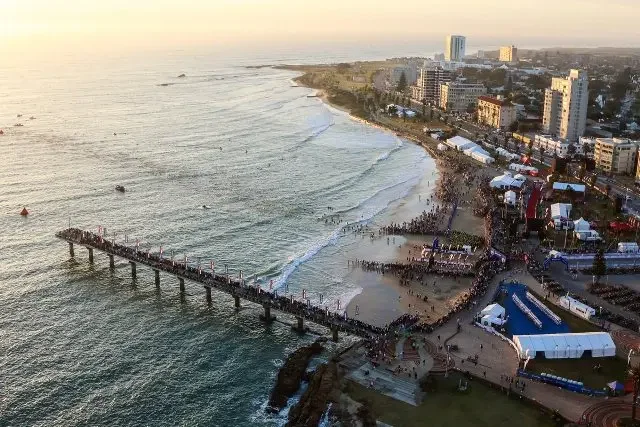
Gqeberha (formerly Port Elizabeth) has gone from having first-rate infrastructure and a thriving automotive industry-driven economy to reeling from mismanagement of public funds, potholes, malfunctioning street lights and more, signalling a service delivery collapse.
The deterioration has led to a veteran anti-apartheid activist this week calling for the intervention of national government.
As leader of the Abantu Integrity Movement (Aim), Mkhuseli Jack has set in motion a bid for the Nelson Mandela Bay Municipal Council to be dissolved.
The Aim has petitioned Minister of Cooperative Governance and Traditional Affairs (Cogta) Velen-kosini Hlabisa, requesting that he urgently replace the floundering council with an administrator under sections 139(1)(c) and 139(5) of the South African Constitution.
Frustrated with administrative dysfunction and poor governance by the ANC-led coalition government of executive mayor Babalwa Lobishe, Jack recently broke away from Nelson Mandela Bay as a member of the mayoral committee, saying that only Hlabisa’s urgent intervention could curb the collapse of the metro’s public infrastructure.
He said the deterioration bordered on violating the constitutional rights of ratepayers and the business community.
Reflecting on what he described as “the governing coalition in turmoil”, Jack said that while residents struggled with brown water coming out of their taps because of broken infrastructure and faced prolonged electricity outages, the mayor and her deputy, Gary van Niekerk, were “busy with their ugly public spat”.
“They are not on speaking terms with each other and are exchanging bitter recriminations in the media, blaming each other for the service delivery collapse.
“While the ship is sinking, they still have time for petty political battles.
“That is why we have requested Minister Hlabisa to put all the politicians in the governing coalition out of their misery.
“The only way to stem the infrastructure collapse is to install an administrator who will steady the ship,” Jack said.
While Lobishe could not respond to questions sent to her for comment, Van Niekerk told the Mail & Guardian that the coalition was not the cause of the municipality’s problem; rather, “ineffective leadership at the highest level” was.
“A coalition can function only when there is decisive leadership, open communication and a willingness to engage with partners and the broader community.
“One of the greatest concerns has been what I believe is a lack of responsiveness from the executive mayor. This is a clear indication of a dysfunction at its worst.
“Even those of us serving in the leadership of council, including myself as deputy executive mayor, speaker and the chief whip, have struggled to receive responses to matters requiring urgent attention.
“If the council leadership experiences these difficulties, it is understandable why many residents
have become frustrated and have, in many instances, given up trying to engage with the mayor’s office,” Van Niekerk said.
Over the past nine months, the council had taken part in five meetings with Cogta, aimed at addressing the challenges affecting the municipality, he said.
“Despite these engagements, I have observed very little, if any improvement in the mayor’s responsiveness or in the manner in which these concerns have been addressed.
“I am also deeply concerned by what I understand to be a directive issued by the executive mayor, instructing the executive directors responsible for service delivery not to take instructions from me — not even to take my telephone calls.
It reflects a troubling approach to governance. Service delivery should never become secondary to political considerations.
“Rather than preventing elected leaders from assisting residents with service delivery challenges, every effort should be made to ensure that communities receive the support and services they deserve.”
Van Niekerk said Lobishe had also taken the decision to reject his rapid turnaround strategy, “specifically designed to restore confidence in service delivery by prioritising the repair and maintenance of the
top 100 routes across Nelson Mandela Bay”.
“The strategy focused on addressing visible service delivery failures along the municipality’s busiest corridors to improve the daily lives of residents, rebuilding public confidence.
“Unfortunately, the proposal was rejected without an alternative plan being presented,” he said.
On Jack’s call for Cogta’s intervention, Van Niekerk said: “That is ultimately a matter for the minister of Cogta to consider after assessing all relevant facts and the municipality’s compliance with its constitutional obligations.”
Lobishe’s administration was recently lambasted by the Cogta portfolio committee in parliament. It had been summoned to appear before MPs to account for the poor governance of the largest municipality in the Eastern Cape.
In its petition to the minister, Aim has pointed out that the metro has racked up about R30 billion in irregular, unauthorised, wasteful and fruitless expenditure, the highest in the country.
National Treasury initially withheld the municipality’s equitable share grant of nearly R2 billion, citing “persistent and serious violations of the Municipal Finance Management Act”.
In an about-turn, Finance Minister Enoch Godongwana announced that the National Treasury would release R7.1bn in previously withheld Local Government Equitable Share funds to 49 struggling municipalities sfrom Friday, including the Nelson Mandela Bay metro.
The decision protects basic service delivery, although future allocations remainunder strict conditional review.
This is in contrast to Godongwana’s initial decision of temporarily withholding R13.5 billion from 69 non-compliant municipalities across all nine provinces
Local government expert Mpu-mezo Ralo said Jack’s call reflected a frustration that many residents were feeling.
“The municipality is floundering and constitutional mechanisms exist to deal with this kind of crisis.
“Regardless of the political motive, the facts on the ground remain — service delivery has collapsed. Minister Hlabisa must test the merits of the petition against the constitutional criteria, not the personalities involved.
“If an intervention is warranted, it must be about stabilising the city, not rewarding political players,” Ralo said.
He said Nelson Mandela Bay was “in a state of institutional fatigue”. “We have water and infrastructure failures, poor revenue collection and a council paralysed by coalition instability.
“Residents are tired of being used as collateral in political chess.
“Any intervention, whether political or administrative, must be judged on whether taps run, lights stay on and money is spent properly,” he added.