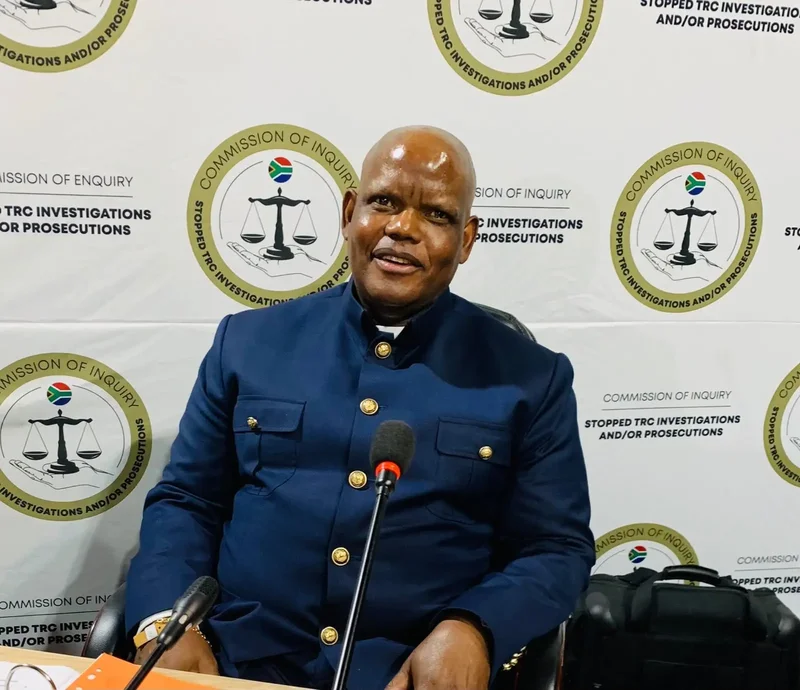
The former acting National Commissioner of the South African Police Service (SAPS), Lieutenant General Kgomotso Phahlane, distanced himself from any involvement in the Truth and Reconciliation Commission (TRC) cases when he testified before the TRC Cases Inquiry sitting at Newtown, Johannesburg.
Phahlane said he was aware of the TRC cases during his tenure as the head of SAPS forensic services, when his division assisted with the exhumation of the remains of executed anti-apartheid activists.
“I was not directly involved but I was the head of the forensic unit, which helped exhume bodies and took the remains to the laboratory for analysis,” he said.
Phahlane served as acting national commissioner from October 2015 to June 2017 after being appointed by then-president Jacob Zuma. He was suspended in 2017, appeared in court with his wife in 2018 and was dismissed in 2020 for dishonest conduct.
At the inquiry, Phahlane also used the opportunity to revisit his dismissal after advocate Andrea Gabriel SC questioned him about it. Gabriel asked whether, given that he had been appointed by Zuma, the minister of police had the authority to remove him and whether he had ever received a dismissal letter.
“There is no provision for the minister to fire a police commissioner. The authority came from nowhere. There is no legislation or policy that prescribes it. Since 2017, I have not received any letter informing me of my dismissal,” Phahlane said.
Phahlane’s testimony also touched on the disbandment of the Directorate of Special Operations (Scorpions) and the establishment of the Directorate for Priority Crime Investigation (Hawks) during the political transition following Thabo Mbeki’s resignation in 2008.
Referring to the Khampepe Commission and the Glenister judgments, he said the transition involved the transfer of personnel from the Scorpions, which operated under the National Prosecuting Authority, to the Hawks, which were established within SAPS.
According to Phahlane, the transition involved the transfer of staff from the disbanded Scorpions to the Hawks, with many former Scorpions investigators who had never been police officers becoming members of the new unit.
He maintained that the TRC cases remained a priority for the Hawks.
“It is the head of the DPCI who will provide the necessary information regarding the TRC cases. I believe the TRC cases were, and still are, regarded as priority crimes,” he said.
Phahlane joins a growing list of former senior police officials who have appeared before the commission, including former police minister and national commissioner Bheki Cele and former Gauteng police commissioner Eliezer Mothiba, both of whom denied direct involvement and said responsibility for the investigations rested with the Hawks.
Earlier this week, the commission shifted its focus from political office-bearers to senior administrators, hearing evidence from former directors-general Nonkululeko Sindane and Vusi Madonsela.
Both denied any involvement or interference in the TRC cases, saying the National Prosecuting Authority was the only independent body mandated to make prosecutorial decisions.