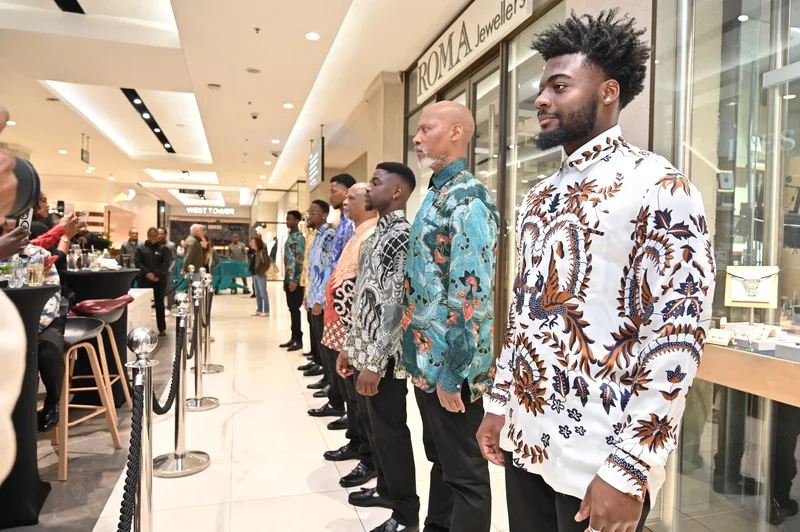
What does it feel like to dress like a free man?"
It is a deceptively simple question. One that sounds at home in a fashion interview until it is posed to John Kani, a man whose life has been shaped by the long journey from oppression to freedom.
Asked by actor and host Sthandiwe Kgoroge at the opening of Presidential Shirt's new flagship emporium in Sandton Square, just steps from the towering Nelson Mandela statue, Kani paused. Then he asked her to repeat it.
Perhaps because freedom is rarely spoken about in the language of fabric and buttons. We measure it in constitutions, elections and rights — not collars, cuffs and the quiet confidence of wearing clothes that finally feel like your own.
By the end of the evening, however, it was clear that this was never simply the launch of another luxury retail space. It was a conversation about identity, dignity and how something as ordinary as getting dressed can become an act of reclaiming oneself.
Standing before guests in a black silk Madiba shirt embroidered in white along the collar, chest and cuffs, Kani transformed what could have been a ceremonial speech into theatre.
“I have always known that being black is a continuous struggle to be respected, to be seen, to be acknowledged, to beg for your own self-worth," he said.
He returned to his initiation ceremony. Coming back from the mountain, he explained, he needed new clothes because he was no longer a boy. His community recognised that transformation. Apartheid South Africa did not.
“I kept struggling to identify who I am."
His words exposed one of apartheid's quieter violences: denying Black South Africans the right to define themselves. Clothing became another language of power. The European suit, wrapped in ideas of authority and professionalism, became the accepted uniform of legitimacy.
“It was so uncomfortable," Kani laughed. “I knew that this suit is not giving me the opportunity to be who I am."
The audience laughed with him, recognising the truth beneath the humour.
Then, he said, Nelson Mandela changed everything.
“Years went by and here was this man, Nelson Mandela, and he liberated us from this suit. Because now when we are invited to events we are asked to wear the Mandela shirt."
The applause was immediate.
The Madiba shirt has long outgrown its place in the wardrobe. It has become shorthand for a distinctly South African confidence, proof that elegance does not have to imitate Europe to command respect. Mandela's colourful silk shirts quietly rewrote the visual language of leadership, making African identity itself synonymous with formality and dignity.
For Kani, whether someone chooses a Madiba shirt or traditional attire, the principle remains unchanged.
“We are formal in the manner in which we choose to articulate our own culture."
It is a quiet revolution many South Africans barely notice anymore because it has become ordinary. Yet, as Kani reminded the audience, that ordinary freedom was hard won.
Former Constitutional Court judge Justice Albie Sachs, now 91, offered his own reflection with characteristic humour: “While some of my peers are heading commissions of inquiry," he joked, “I've become a male model."
Dressed in a blue Mandela replica shirt, Sachs reflected on how democracy transformed not only institutions but everyday rituals.
“Part of the revolution was how you dress," he said.
Like Kani, Sachs never cared much for suits and ties, though the judicial office demanded them.
Then he watched Mandela.
“One day I saw the president, President Nelson Mandela, looking so peaceful and relaxed. It was not what he was wearing but what he was not wearing."
He was not wearing a suit.
“Suddenly, I knew clothing could be fun. I knew I did not have to conform to another style of clothing that came from another country or continent."
For Sachs, the shirt became more than fashion.
“It was a symbol of our transformation and a symbol of our freedom."
That symbolism traces back to 1994, when Cape Town designer Desré Buirski presented Mandela with one of her handcrafted shirts just two days before his inauguration as South Africa's first democratically elected president.
He wore it.
Then another.
And another.
Those shirts would accompany him through defining moments of the young democracy. When he was signing the Constitution in 1996, welcoming the Fifa World Cup and meeting Queen Elizabeth II on a state visit to Britain. With every appearance, Mandela quietly demonstrated that the South African presidency no longer had to borrow its image from elsewhere.
Dr Naledi Pandor, chairperson of the Nelson Mandela Foundation's Board of Trustees, brought a thoughtful counterpoint.
As guests celebrated Mandela's relaxed elegance, she smiled and confessed she actually preferred him in a suit.
The audience laughed.
“But Madiba was a symbol of many things," she said. “A symbol of steadfastness, a symbol of hope and a symbol of knowing that triumph over adversity is possible."
The emporium, she argued, should preserve more than Mandela's wardrobe.
“While today we open this wonderful emporium, let us also appropriate those wonderful concepts and make them our own. Nelson Mandela would expect a great deal from every one of us."
It was the evening's most important reminder.
Memory is easy to merchandise. Legacy is far harder to live.
Rob Sims, chief executive of Presidential Group, traced the company's own story alongside South Africa's democratic journey, from opening its first airport store in 2010 to rescuing one of its suppliers from liquidation, protecting local jobs and expanding its manufacturing workforce to more than 100 employees. Its renewed partnership with the Nelson Mandela Foundation during Mandela's centenary in 2018 further rooted the brand in South African craftsmanship and heritage.
Closing the evening, Presidential Group executive director Geoff Mabote described the flagship store as more than a retail destination. It is a statement that South African design, craftsmanship and innovation belong on the global stage.
That ambition feels fitting.
The Madiba shirt has always occupied an unusual space. It is unmistakably South African, yet instantly recognised around the world. It carries history without becoming trapped by nostalgia.
Perhaps that is why Kgoroge's opening question lingered long after the speeches had ended.
What does it feel like to dress like a free man?
As guests wandered through the emporium, pausing before replicas of the shirts Mandela wore at defining moments in South African history, the garments felt less like museum pieces than living reminders.
South Africa's democracy did more than rewrite laws. It rewrote the country's image of itself. It loosened collars once tightened by colonial convention. It replaced borrowed symbols with homegrown confidence. Sometimes, freedom looks as simple as a man no longer needing to wear someone else's suit.