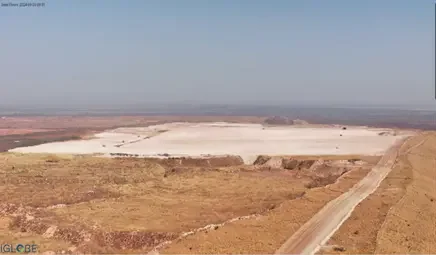
A rehabilitated waste rock dump at Kumba Iron Ore’s Sishen mine is offering a new vision for South Africa’s mining legacy, as the country’s first embedded solar photovoltaic (PV) project on rehabilitated mine waste reaches financial close.
Experts say the project represents a new chapter in mine rehabilitation, demonstrating how former mining land can continue generating value long after extraction ends.
The 63MW facility near Kathu in the Northern Cape will be built on the rehabilitated G80 waste rock dump, generating renewable electricity from land that would otherwise have limited productive use while avoiding pressure on undeveloped or agricultural areas.
The project is jointly owned by Envusa Energy and the Sishen Iron Ore Company Community Development Trust, which holds a 10% stake, with all electricity supplied to the Sishen mine.
Envusa Energy chief executive Nicole Mason described the project as a breakthrough that showed how renewable energy infrastructure could be integrated into previously disturbed mining land instead of competing with agricultural or residential land.
“This approach supports rehabilitation while avoiding the sterilisation of productive land for other uses,” she said, adding that it offered a practical model for other mining operations by demonstrating how legacy mining areas could be transformed into renewable energy assets.
Built atop a rehabilitated waste rock dump about 20-storeys high and covering roughly 100ha, the project required innovative engineering to accommodate long-term ground settlement, including adjustable solar mounting structures and a mobile substation.
It will generate about 150 000MWh of renewable electricity a year. Envusa Energy estimates this will reduce the mine’s carbon emissions by about 140 000 tonnes annually.
Mariette Liefferink, chief executive of the Federation for a Sustainable Environment, said the project represented a significant innovation in South Africa’s mining and renewable energy sectors.
She said the innovation lay not simply in installing solar panels but in repurposing previously disturbed mining land into productive infrastructure. “Instead of viewing rehabilitation as the end of mining, it integrates rehabilitation with future economic land use,” she said.
According to Liefferink, the project gives mining land a “second life” by supporting rehabilitation while improving energy security, reducing greenhouse gas emissions, avoiding competition with agricultural or community land uses and creating long-term economic value from previously disturbed land.
“It is a positive example of how mine closure planning and renewable energy development can be integrated from the outset.”
South Africa’s mining industry has left behind thousands of hectares of disturbed land, raising long-standing questions about how rehabilitated sites can be put to productive use once mining ends.
Renewable energy is increasingly being viewed as one possible answer, particularly where existing road and electricity infrastructure already exists.
Last year, researchers from the Global Energy Monitor (GEM), a US-based NGO identified 18 potential conversion sites, covering about 250km² of coal mines in Mpumalanga, that will be available for solar build-out.
Its report found that they could produce nearly 13 gigawatts of solar energy, offering a way to accelerate the country’s clean energy goals while repurposing land scarred by the extraction of coal.
Worldwide, coal mines that have been abandoned or will close by the end of this decade hold enough potential PV solar capacity to power a country the size of Germany for a year.
Liefferink said renewable energy had considerable potential to become one of the most valuable post-mining land uses in the country. She noted that there are thousands of hectares of disturbed mining land, particularly in the Northern Cape, Mpumalanga, Limpopo, Gauteng and North West.
Many of these sites already have existing transmission infrastructure, road access, industrial zoning, proximity to electricity demand and limited competing land-use pressures. These characteristics can make them attractive locations for solar or, in some cases, wind energy projects.
However, she cautioned that not every rehabilitated mine site would be suitable. Feasibility would depend on factors including long-term geotechnical stability, available surface area, proximity to grid infrastructure, environmental constraints and future land-use objectives identified in mine closure plans.
“While not every rehabilitated mine site will be technically or economically feasible, many large, stable waste rock dumps, tailings facilities and other disturbed mining areas could potentially support renewable energy developments,” she said.
“As mining companies increasingly pursue decarbonisation and closure planning aligned with sustainable development principles, such projects are likely to become more common.”
Liefferink added that projects of this nature required close collaboration between geotechnical engineers, rehabilitation specialists, environmental scientists and renewable energy designers to ensure rehabilitation outcomes were maintained over the long term.
Mason said South Africa’s long mining history meant there were likely to be many opportunities to repurpose rehabilitated mine waste dumps and other disturbed mining land for renewable energy projects, although not every site would be suitable.
Each site required detailed assessments of geotechnical stability, landform characteristics and proximity to electricity infrastructure. At Sishen, the biggest challenge was establishing confidence in the stability of the 80m-high rehabilitated waste rock dump, where differential settlement was an inherent consideration.
She said the project combined adjustable solar mounting structures with a mobile substation to accommodate any future ground movement — an approach that could be replicated on other rehabilitated mine sites with similar geotechnical conditions.
Mason said the biggest challenge was establishing confidence in the stability of the 80m-high rehabilitated waste rock dump, where differential settlement was an inherent consideration.
Although adjustable solar mounting structures and mobile substations have been used elsewhere, she said the innovation at Sishen lay in combining the technologies to address those conditions.
Through engineering design, specialised foundations and ongoing satellite-based monitoring, Envusa said it had demonstrated that the solar infrastructure could be safely deployed under these conditions.
Mason said the adjustable structures allowed the panels to be realigned if settlement occurred over time, while the mobile substation could be repositioned should ground movement require it.
“This integrated approach could certainly be applied to other rehabilitated mining sites with similar geotechnical conditions, provided each site is assessed and engineered based on its specific characteristics.”
Repurposing waste rock dumps for renewable energy reduced pressure on productive landscapes, supported responsible land stewardship and gave rehabilitated mining areas “a valuable second life” while they continued their long-term recovery.
“Every year, mining disturbs significant areas of land and it can take decades before rehabilitated sites regain the characteristics needed to support productive agricultural use,” she said.
Long-term monitoring formed a fundamental part of the project’s design, Mason said.
The rehabilitated waste rock dump would be continuously monitored using satellite technology capable of detecting ground movement, allowing engineers to identify settlement trends early.
She said the project’s environmental focus was on maintaining rehabilitation outcomes and ensuring compliance with environmental authorisations throughout the life of the facility.
Cheng-Cheng Wu, a co-author of the GEM report, said the Sishen project differed from those examined in GEM’s research because it involved a former iron ore mine rather than abandoned coal mines.
“Key differences in coal and iron ore mines, such as their geographical conditions, will lead to different scales of solar projects, while distinct pollution profiles mean restoration and reclamation standards are also different,” she said.
However, Wu said the underlying principle remained the same. “The core value behind these projects remains the same: converting abandoned mines into clean, renewable energy facilities.”
She said such conversions could create jobs, restore degraded land and improve access to clean electricity. “Also, South Africa has more coal mines and more renewable energy potential can be converted from there.”
Wu noted that the primary obstacle remains a lack of clear reclamation guidelines and standardised frameworks to lead this transition and safeguard benefits and rights for local communities.
Mason said projects like Sishen could become an increasingly important component of mine rehabilitation and closure planning, although they would not be suitable for every site.
“Developing a solar PV facility on a rehabilitated waste rock dump is certainly more complex than building on conventional ground.”
The main barriers to wider adoption included site-specific technical challenges, regulatory certainty and commercial viability.
“Where those challenges can be addressed, this model offers a compelling opportunity to integrate mine rehabilitation with South Africa’s energy transition,” she said.