I’ve been reading Peter Venison’s biography of Sol Kerzner, SOL: My Friend and Adversary. One chapter specifically made me go down a research rabbit hole.
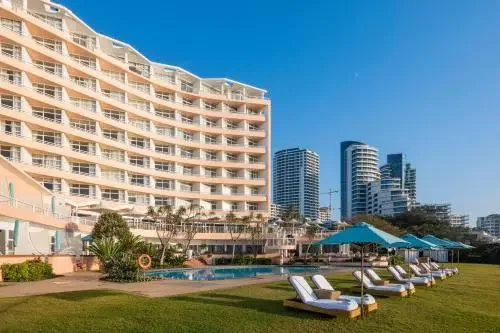
For those guessing Sun City or Atlantis — The Palm in Dubai, it’s neither. Rather, it was about South Africa’s first five-star graded hotel, which was also the first hotel Kerzner developed. The small peach-pink hotel on a cliff in uMhlanga,KwaZulu-Natal.
If you grew up anywhere near Durban, The Beverly Hills is part of the furniture. It’s the building between the pier and the lighthouse.
It started with a 26-year-old chartered accountant who had never built or run a hotel in his life, putting his entire savings of R25 000 into a project on the stretch of coast that wasn’t on the tourism industry’s
map yet.
I’m not going to retell the book — go buy it; it’s a good read. Almost everything that later made Kerzner into Kerzner is sitting there in this one small salmon building, in three decisions he made before a brick was laid. Where he built it (basically selecting this spot as a prime-time tourist destination way before its time), what he did before he built it and how he opened it.
In the early 1960s there was one obvious place to put a hotel in this part of the world — Durban’s Marine Parade. The elegant little Edward Hotel had been trading there for years and the boarding houses filled every time the Highveld emptied itself onto the beach.
uMhlanga, its name means “place of reeds”, in isiZulu, was 17km further up the coast and undeveloped.
Here’s the part I love, because it’s so much less romantic than the legend. Kerzner didn’t choose uMhlanga because he saw the future. He chose it because he couldn’t afford the Parade. But the book also emphasises that even if he’d had the money, it would have been one hotel too many on the Parade. In uMhlanga he was taking a risk on the location but he’d be one of the only ones taking it.
For context on how low-key uMhlanga was, the area became popular only after a track was cut through from Mount Edgecombe and farmers started leasing small plots on the shoreline for holiday cottages. The Oyster Box next door began life in 1863 as a navigational beacon and opened as a hotel in March 1954. The Borough of uMhlanga wasn’t even formed until 1972, when uMhlanga Rocks merged with La Lucia.
Kerzner, who had zero experience in the hospitality sector and hotel development, raised the money the way a good accountant would. His backers were the directors he’d impressed with his head for figures and the banks he knew through his audit firm.
Instead of handing the money straight to architects, he took much of his own stake and spent it on a plane ticket. I can only imagine what his backers made of that.
He ended up in Miami Beach, at the Fontainebleau on Collins Avenue. It was a huge curved building where every bedroom had a wall of glass facing the sea, so that no guest got a bad view. In one trip, Kerzner studied The Fontainebleau’s owner, Ben Novack and the blueprint for how to run this luxury resort hotel.
Construction started in 1962 and Kerzner took the term “hands-on” to another level.
He knew nothing about construction, so he counted the bricks laid each day and demanded an explanation when the number looked wrong. He kept bank notes in the back pocket of his jeans to incentivise a worker into finishing a task before knocking off, so the next crew weren’t left standing around the
next morning.
He would announce and plan the grand opening almost on the day construction began. Once the date was public, the travel trade could take bookings, which meant cash flowing in before the doors even opened. It also meant the staff had to be ready because there was no debate about the date.
The 72-room hotel came in under budget and opened on 6 December 1964 with the biggest fireworks display South Africa had seen at that point.
The biography says Kerzner wanted the Hollywood glamour association and named the hotel The Beverly Hills. He stopped short of calling it the Fontainebleau, which would have meant nothing to a Joburg family saving for a coastal holiday and settled on the one name everybody would recognise.
But the hotel’s 50th-anniversary coverage says it was named after his daughter, Beverley. I don’t think these cancel each other out. The best brand names usually have two
stories, one for the boardroom and one for the family.
The hotel’s real engine was the nightclub. The Copacabana was a celebrity, media magnet and sat on the lower floors, alongside the meeting rooms and the gym. Every other hotel chain of the era put its club on the top floor for the view. Kerzner’s response was that nobody needs a view in a nightclub, because people go down to clubs to look at other people.
More than 60 years on, the 10-floor building is there on the same clifftop, five-star graded, flying the Southern Sun flag as part of the Tsogo Sun stable. The 72 rooms have become 89.
The Fontainebleau principle has survived intact, which is impressive. Every one of the 89 rooms has a private balcony or terrace and an uninterrupted ocean view. At the top end there are two Presidential Suites and a one-off Studio spread over 109m2 with three balconies.
On the amenities side, you get 24-hour room service, 24-hour
fitness centre, heated outdoor pool, poolside massages, spa treatments at Mangwanani Boutique Spa, valet parking, a business centre, beach access and a small courtesy I don’t see often in South African hotels today: two garments pressed free on arrival. Dining is The Sugar Club, which does the Sunday lunch buffet and afternoon tea and Elements café bar for oysters and sundowners.
One of my fascinations with Kerzner is that every one of his clever moves was a response to not having enough. Not enough money for the Parade, not enough experience to trust the architects, not enough margin to allow a late opening.
Constraint made him inventive. With that, he went on to create some of the most iconic hospitality establishments that this world has seen. And it all started with this little peach-pink hotel on the cliff.
Source: The account of how The Beverly Hills was conceived, funded, built and opened in this column is drawn from Peter Venison’s biography of Sol Kerzner, SOL My friend and Adversary. Venison knew and worked alongside Kerzner.