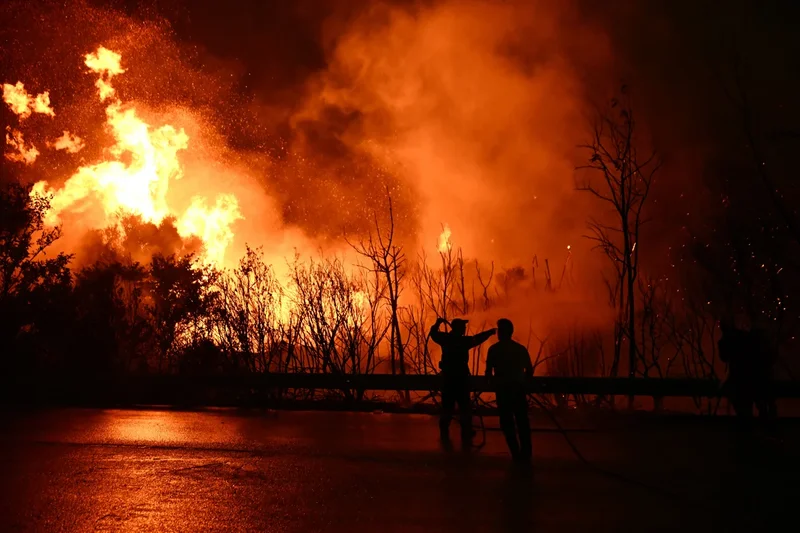
Climate change made the extreme conditions behind the wildfires burning across France and Spain far more likely, new analysis has found.
The study, released by the World Weather Attribution group on Friday, found that human-caused warming made the hot, dry and windy conditions that fuelled the fires at least twice as likely in south-western France and at least 20 times as likely in central Spain. The scientists described both figures as conservative estimates.
Fires have burned across the two countries since early July, destroying thousands of homes and displacing more than 250,000. They have been described as some of the worst on record in both countries, with 140,000 hectares burned in Spain and 115,000 in France since the start of the year, an area larger than the Isle of Wight in each case.
Some blazes grew so fierce they generated their own weather systems, making them very hard to contain, and further high temperatures are forecast in both countries in the coming days.
Researchers examined the seven-day period of most dangerous fire weather in the worst-hit areas, using a measure called the Daily Severity Rating, which combines heat, dryness, wind and landscape conditions to gauge how hard a fire would be to put out once it started. They compared this year's conditions with observations of past summers and with a simulated pre-industrial climate.
In today's climate, the analysis found, fire weather of this intensity can be expected roughly once every 20 years in south-western France and once every six years in central Spain, meaning the conditions have become a recurring hazard rather than a rare extreme.
The researchers also pointed to a pattern increasingly driving fire risk in the region: wet winters followed by dry springs and summers. The winter rain encourages plants to grow, and when the vegetation dries out in the heat it becomes fuel for the flames.
Clair Barnes, a researcher at the Centre for Environmental Policy at Imperial College London and one of the study's authors, said the findings were “extremely scary”.
"A wet winter, followed by this intensely dry summer and a succession of heatwaves, has left forests loaded with dry fuel, and relentless heat, fuelled by human-caused climate change, has created the conditions for sparks to take hold and become massive, dangerous wildfires," she said.
"What's unique about this case is that it's still early in the season, and with another heatwave looming, these findings are extremely scary."
“These aren’t fires burning in remote areas, they are happening in close proximity to where people live. Every fraction of a degree of warming pushes us into unknown territory, and these fires show exactly what that risk looks like.”
The smoke from the fires has also spread far beyond the fire lines. In the French city of Bordeaux, levels of fine particle pollution peaked at about 20 times the threshold considered fair air quality in Europe, and poor air was recorded up to 400km away.
In Spain, nearly 100,000 people were confined to their homes because of the air quality, and two towns west of Madrid were placed under lockdown for several days. In France, the national reserve of FFP2 masks was released to pharmacies for the first time during an air pollution episode.
“These extensive wildfires and subsequent air pollution outbursts will bear upon a population already hard hit by several weeks of heat waves,” said Augustin Colette, of the French National Institute for Industrial Environment and Risks.
"This summer 2026 sequence of compounding climate risks should be an eye-opener for the upcoming adaptation challenges and motivate ambitious climate action," he added.
Friederike Otto, a professor of climate science at Imperial College London and co-founder of WWA, which has been analysing all major disasters in recent years, said the pattern of such wildfires has been familiar.
"Our studies time and again show how Europe's climate is shifting faster than governments are adapting," she said. "Now we're seeing yet another disaster fuelled by the same driver: the burning of fossil fuels."
Europe is the fastest-warming continent, heating at roughly twice the global average. Scientists have repeatedly linked the rising frequency and intensity of its heatwaves, droughts and wildfires to greenhouse gas emissions.
Gareth Redmond-King, International analyst at the Energy and Climate Intelligence Unit (ECIU) said: “Climate change doesn’t light the spark for wildfires, but it certainly provides the fuel.”
“It's our burning of coal, oil and gas that has caused climate change, making fires much more likely, and much more dangerous - creating literal fire-storms in France and Spain. This gets worse and worse - more and more deadly - the longer we keep adding planet-heating emissions to the atmosphere.