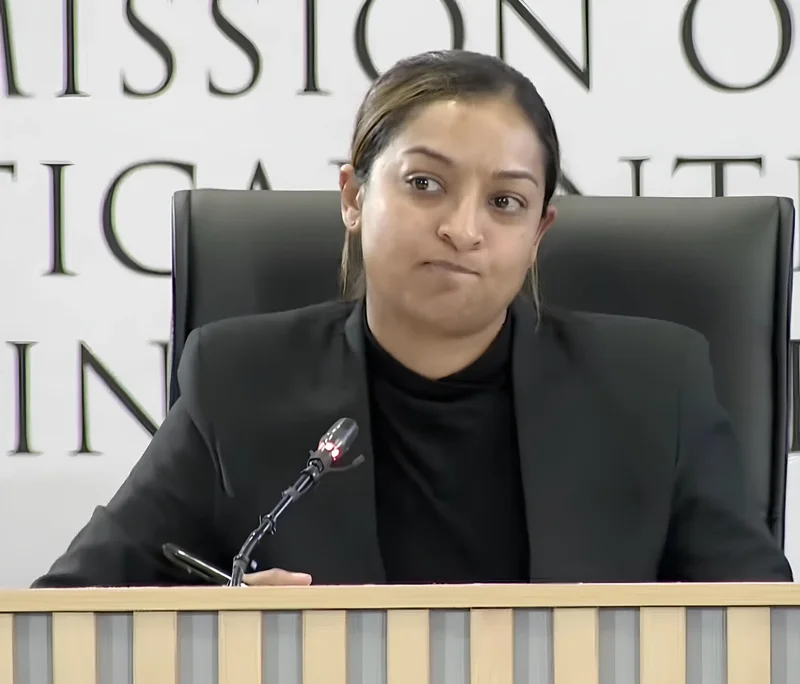
Investigating Directorate Against Corruption (Idac) prosecutor Drushanta Ramsamy told the Madlanga Commission on Thursday that former Idac head Andrea Johnson and senior investigator Dylan Perumal orchestrated investigations targeting crime intelligence head Dumisani Khumalo and national police commissioner Fannie Masemola.
Ramsamy accused Johnson and Perumal of having “launched an orchestrated attack on General Masemola and Lieutenant General Khumalo using Idac’s powerful investigation tools”.
Ramsamy said Johnson first launched Project Diversion, which targeted Khumalo and later opened an investigation into Masemola’s alleged involvement in the R360 million Medicare24 scandal, presenting it as part of the Tembisa Hospital corruption investigation.
Khumalo was arrested in October 2024 for the alleged irregular appointment of Brigadier Dineo Mokwele, a former BMW SA employee, as the head of the technical support service. The National Prosecuting Authority has since provincially withdrawn the charges against Khumalo, Mokwele and several members of crime intelligence.
KwaZulu-Natal police commissioner Lieutenant-General Nhlanhla Mkhwanazi has accused Johnson and Idac of arresting Khumalo to stop the Political Killings Task Team (PKTT) as it closed in on criminal cartels in Gauteng.
“I would be remiss if I did not dismiss the suggestion that Lieutenant-General Khumalo was arrested because he was the coordinator of the Political Killings Task Team,” Johnson stated during her earlier testimony.
Masemola was later added as the 16th co-accused in the R360 million Medicare24 case involving businessman and alleged kingpin Vusimuzi “Cat” Matlala. The case remains before the courts. Matlala was charged alongside three company directors and 12 police officials.
Johnson said a risk audit had alerted Masemola to the allegedly illegal Medicare24 contract and recommended that he stop payments.
“It took him a long time to do so. In not acting promptly and diligently as the accounting officer, monies in the approximate value of R50 million were paid out because of these unlawful corrupt activities before the contract was stopped,” she said.
Ramsamy’s testimony centred on what she described as discrepancies between affidavits submitted by National Coloured Congress MP Fadiel Adams in November
2024 and January 2025, which formed the basis of Idac’s investigation against Khumalo.
She alleged that Johnson presented the commission with a different version of Adams’ section 27 affidavit from the one used to obtain authorisation for the investigation that ultimately led to charges against Khumalo, Brigadier Mokwele and other crime intelligence officials.
Commission chair Mbuyiseli Madlanga said Johnson would have to be served with a rule 3 notice, allowing her to respond to Ramsamy’s allegations.
Ramsamy testified that when Johnson first handed her Adams’ section 27 affidavit on 6 December 2024, it contained allegations extending far beyond Mokwele’s appointment. Johnson has denied that there was an investigation into the political killings task team.
“I can honestly not recall asking them [to investigate] the PKTT,” Johnson told the commission on Tuesday.
However, Ramsamy said the original affidavit included claims relating to the PKTT, former police minister Bheki Cele, procurement irregularities and the alleged abuse of the Secret Service account to purchase vehicles, properties and a hotel building.
“The section 27 referral affidavit presented at the commission could not have been the affidavit I used to prepare the section 28 investigation application,” she said.
Ramsamy said the version presented to the commission omitted all references to the PKTT. Throughout the week, commissioners questioned Johnson about her basis to approve Khumalo and Mokwele arrests when the affidavit presented was sparse on facts.
“Allegations about the PKTT featured prominently in Mr Adams’ section 27 affidavit, yet the one presented makes no mention of the PKTT,” Ramsamy said. “The allegation concerning Brigadier Mokwele’s appointment was little more than a passing reference.”
Ramsamy told the commission that Johnson handed her the original affidavit accompanied by a list of names for her to prepare an authorisation to prosecute on the same day on 6 December 2024.
This was a few weeks before the PKTT was disbanded on 31 December 2024 by suspended police minister Senzo Mchunu.
“When I arrived at the office, [Johnson] had a grey document bag (with a zip) and she told me that it contained a highly sensitive section 27 referral affidavit. She told me, ‘They have decided’ that the matter will be investigated. She did not say who “they” were and I did not ask.”
Ramsamy said the document bag contained a notepad page with names of people in Johnson’s writing. The names included Khumalo, Mokwele, Nozipho Madondo, Phindile Ncube, Philani Lushaba, Josias Lekalakala alongside Mr Moyane, Mr Sebola, Mr Van Vuuren, Mr Duvhalo and an automotive engineer.
“A lot of these names didn’t correlate with that section 27,” Ramsamy said. “She told me that these are the suspects [the] ‘chief and I discussed are to be included’ in section 28. By chief she meant Perumal,” she said.
Ramsamy was instructed to prepare an application for authorisation of a section 28 criminal investigation and to include the names on the notepad as suspects.
Johnson allegedly ordered her not to show the Adams section 27 affidavit “to anyone due to the sensitivity of the matter”.
Ramsamy said she felt uncomfortable preparing an authorisation to prosecute that did not include a memo from the prosecutor as was the procedure after receiving a section 27 complaint. She said Johnson presented a different section 27 affidavit to the Madlanga commission than the one she gave her to prepare a prosecution authorisation application. Senior Idac investigator Mantsha Rapeshu confirmed that Johnson presented a different affidavit, she said.
Johnson gave the commission an affidavit that did not include allegations made against the PKTT, Cele and abuse of the secret service account to purchase cars and properties, including a hotel building.
“The section 27 referral affidavit flighted at the commission could not and is not the section 27 referral affidavit that I used to prepare the application for a section 28 (13) investigation,” said Ramsamy.
She accused Johnson of attempting to shift responsibility for irregularities onto her. During her six-day testimony at the commission, Johnson implicated her as the individual who came up with the names of crime intelligence officers to be prosecuted.
“Advocate Johnson told many untruths about me and my involvement in what is now known as the Mokwele case. She did not disclose that I raised concerns from the outset and repeatedly thereafter,” said Ramsamy. “Advocate Johnson was in charge of Project Diversion and, in particular, the Mokwele matter from the outset.”
Ramsamy said Johnson selected her to work on the matter because she assumed she would not question decisions made by senior officials.
“What she did not anticipate was that Mr Mantsha Rapeshu and I would question Project Diversion from the start.” Ramsamy testified that Johnson’s personal assistant later informed her that Perumal claimed the original section 27
affidavit had been lost. She rejected that explanation.
“I suspect advocate Johnson and/or Mr Perumal did not want to disclose the section 27 referral affidavit to the accused persons in the Mokwele matter and needed a reason why it could not be produced.”
She said she did not believe that it was a coincidence that the affidavit produced before the commission omitted references to the PKTT while the version she had seen in December 2024 had included them.
Ramsamy said that while consulting with its evidence team on
22 July, she received a phone call from Johnson, which she recorded.
Johnson suggested they should “figure out how you don’t go” to the commission.
“At the start of the recording, advocate Johnson made a startling remark that ‘We’ve gotta figure out how you don’t go’. In other words, find a way for me not to testify before the commission.
“They put me through the process of section 28 (13) on the Khumalo matter. Don’t worry, I think they’re gonna call you. I’m gonna tell you why and figure out how you don’t go,” says Johnson in the recording.
Johnson then told Ramsamy to answer the commission’s question step by step. She told Ramsamy to identify only Khumalo and Madondo as the names she received.
However, Ramsamy pushed back and told Johnson she received the full names from her to which Johnson replied that she could not recall.
She also disputed earlier evidence by senior investigator Brian Padayachee that he had never seen Adams’ affidavit.
Ramsamy said Padayachee and Perumal met Adams in November 2024 to obtain the affidavit and discuss the names of potential suspects.
“There was a lot of secrecy around this section 27 affidavit,” she added.