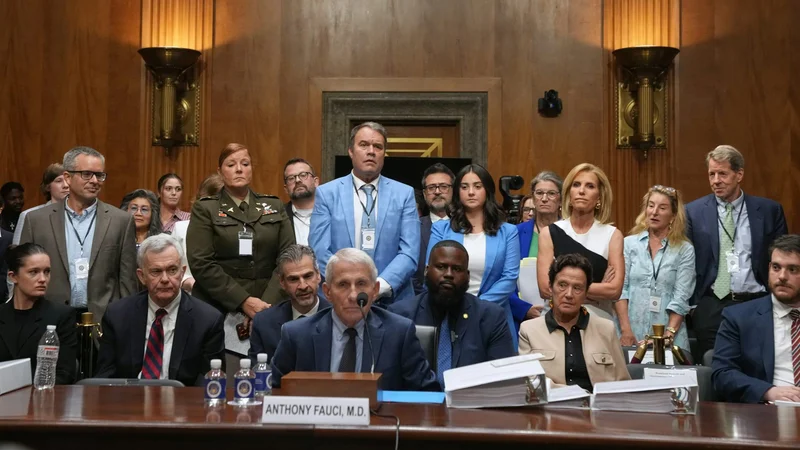
Dr. Anthony Fauci invoked the Fifth Amendment and declined to answer questions from a Senate committee more than 100 times on July 29, 2026.
The Republican-led hearing – convened to scrutinize Fauci’s management of the pandemic and the origins of COVID-19 – was the latest chapter in a political story that began in 2020, when uncertainty, fear and frustration with the government became entangled with conspiracy theories.
In the past six years, some of these theories have emerged from the margins of the internet and made their way into Republican politics, the MAGA movement, anti-vaccine communities and even white-nationalist extremist networks.
Conspiracy theories do not simply explain events, they identify villains – and Fauci has become one of the most popular in this particular story.
In the years since the pandemic, U.S. Sen. Rand Paul and others have accused Fauci of many things, but the central conspiracy accusation is that Fauci helped enable the COVID-19 pandemic through U.S.-funded research at a lab in Wuhan, China, and then participated in a coordinated government-scientific cover-up, misleading Congress to conceal that connection and suppress the laboratory-leak explanation. Paul, a Republican, has repeatedly called for Fauci’s prosecution.
In January 2025, President Joe Biden granted Fauci a preemptive pardon covering potential federal offenses related to his government service since 2014. Fauci had not been charged with a crime, but critics portrayed the pardon as evidence that he had something to hide. Fauci has denied claims of wrongdoing and has testified multiple times before Congress.
The Fauci conspiracy is much bigger than Rand Paul, though. Paul may be its most persistent congressional promoter, but it’s been amplified by a wider network of Republican lawmakers. Several Republican members of Congress, such as Rep. Steve Scalise, Rep. James Comer and former Rep. Brad Wenstrup, among others, have advanced versions of the Fauci/COVID-origin narrative. House Republicans formally investigated these claims for two years, while members repeatedly accused Fauci of suppressing the lab-leak theory and misleading the public.
That investigation ultimately endorsed a central claim of the conspiracy narrative: the House GOP’s COVID-19 investigation concluded the virus most likely leaked from a Wuhan lab, that Fauci helped shape a scientific paper dismissing that theory, and that he privately testified the “six feet apart” guidance “sort of just appeared” – though these are the conclusions of a partisan committee, not an independent inquiry, and Fauci and Democratic members have disputed them.
I’m an associate professor of sociology and criminology, and my scholarship focuses on far-right networks and digital radicalization – the exact ecosystem where these conspiracy theories have taken root and spread. My research on how these movements evolve online and intersect with political activists and extremist networks was directly relevant to tracing how COVID-origin claims moved from fringe communities into mainstream political discourse.
Fauci’s decision to invoke the Fifth Amendment, which he and his lawyer explained not only as a basic constitutional right but also a strategy to avoid the possibility that Paul might try to prosecute him for lying to Congress based on anything he might say, may be politically explosive and provide his opponents with another talking point. But, in my assessment, the spectacle says more about what happens when conspiracy theories become embedded in political institutions than it does about the origins of COVID-19.
From uncertainty to conspiracy
COVID-19 created the conditions in which conspiracy theories flourish: enormous uncertainty, frightening consequences, rapidly changing information and distrust of institutions.
People wanted explanations. Why did the virus appear in Wuhan? Why did recommendations about masks change? How were vaccines developed so quickly?
These questions were legitimate. Problems emerged when those questions became connected to a predetermined conclusion: Powerful people either created the pandemic or concealed the connection to the lab in Wuhan.
A 2021 survey by the Public Religion Research Institute illustrates how widespread one version of this thinking was. About 4 in 10 Americans – 39% – agreed that the coronavirus had been intentionally developed by scientists in a laboratory. Among QAnon believers – a sprawling conspiracy theory claiming that a cabal of powerful elites, often portrayed as child-trafficking Satanists, controls government and society and that Donald Trump was secretly fighting it – the figure was dramatically higher, at 85%. The same survey found that people who embraced anti-elite and anti-expert attitudes were more likely to accept coronavirus conspiracy theories.
Conspiracy thinking is rarely isolated. For example, a person who comes to believe that public health officials are secretly manipulating information may be more receptive to claims that vaccines contain hidden dangers. Someone who distrusts pharmaceutical companies may be more receptive to claims that the pandemic was engineered for profit. Someone who believes powerful elites routinely operate in secret may be more receptive to broader conspiracy narratives such as QAnon.
These beliefs can reinforce one another, creating a broader worldview in which institutions, experts and government officials are presumed to be acting deceptively.
The Fauci conspiracy
Because Fauci was highly visible during the pandemic, advising presidents and appearing on television, he quickly became associated with government efforts to control the spread of the virus.
For some Republicans and MAGA activists, and others who distrust the government and scientific institutions, Fauci came to represent lockdowns, masks, vaccines and government mandates.
Anti-vaccine activists incorporated him into broader narratives about pharmaceutical companies and public health agencies. Conspiracists took the story further, portraying Fauci as part of a secret effort to conceal the origins of COVID-19. Extremists connected these claims to older ideas about government tyranny, social control and corrupt elites.
The result was a feedback loop.
Claims were generated in online communities, repeated by political figures and amplified by media personalities, who injected these talking points back into supporters’ social media feeds. The repetition made the claims feel increasingly familiar – and familiarity can be mistaken for evidence.
The lab-leak question is not the same as a conspiracy theory
Asking whether SARS-CoV-2 emerged through either zoonotic spillover, which is when a virus jumps from animals to people, or through a laboratory-related incident is not inherently a conspiracy theory. Scientists and governments have legitimate reasons to investigate the origins of a pandemic.
The World Health Organization’s independent scientific advisory group reported in 2025 that much of the information needed to fully evaluate the competing hypotheses had not been provided by China. It concluded that the available evidence suggests spillover but maintained that the laboratory-leak hypothesis could not be ruled out.
There is, however, a distinction between investigating whether a laboratory accident might have occurred and claiming that scientists created a virus and intentionally released it. That distinction is important in returning to Fauci and the claims raised at the July 29 hearing: Were lawmakers investigating the possibility of an accidental laboratory release, or were they advancing the more conspiratorial idea that scientists deliberately created and released the virus?
The Republican-led House subcommittee argued that U.S. government–funded research may have contributed to the pandemic.
The investigation did not establish that the virus was intentionally manufactured or released.
Today, the scientific question of where SARS-CoV-2 originated remains unresolved. But conspiracy theories can transform the absence of evidence into evidence of concealment.
From fringe theory to political reality
The most consequential feature of conspiracy theories may be their ability to move from one group to another.
A claim can begin in an obscure online community and spread through social media to become a political weapon.
The Fauci hearing demonstrates the culmination of that process. These claims have moved into the formal machinery of government, where they are being amplified by elected officials and federal agencies. A theory’s credibility can increase simply because someone with greater institutional authority has repeated it.
That may be the most important question surrounding Fauci’s hearing: What happens when conspiracy theories acquire the authority of the government?