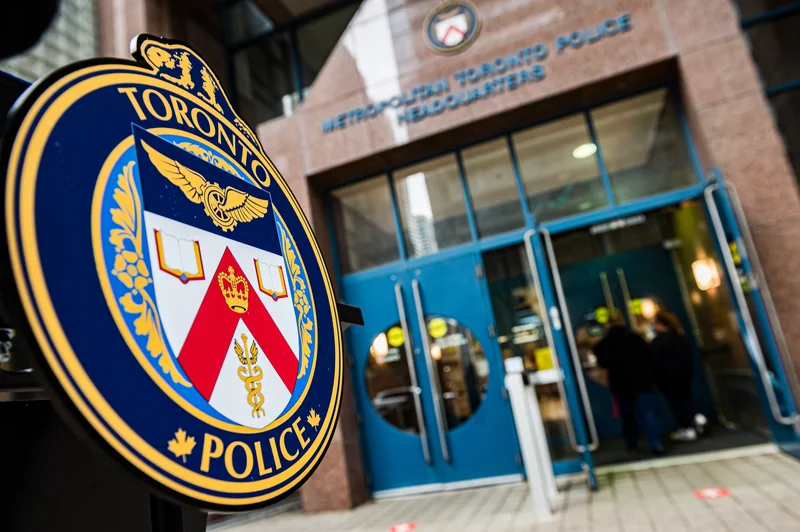
Toronto Police have laid a first-degree murder charge in a cold case that puzzled investigators for nearly two decades until officers used a technique known as forensic genetic genealogy to track down a suspect.
Patrick Santos’s father found the 21-year-old dead in the backyard on the morning of Sept. 17, 2006, when the father was letting the dog out.
Police said at the time Mr. Santos was ambushed on his way to the Scarborough home, had his hands bound, was stabbed multiple times and died from suffocation after his mouth was taped shut.
Investigators found DNA evidence they believed belonged to the suspected attacker but had been unable to make headway in the case for nearly two decades since Mr. Santos was found dead.
That changed this week, when police arrested Pierre O’Connor, 43, of Hamilton, and charged him with one count of first-degree murder. The allegations against him haven’t been tested in court.
Detective Sergeant Stephen Smith said at a news conference that investigators are still trying to understand the relationship between Mr. Santos and Mr. O’Connor that led to the alleged killing. Det. Sgt. Smith said it was likely a disagreement between two groups.
The investigation is still active because police believe other people were involved in Mr. Santos’s death, he said.
Det. Sgt. Smith said in an interview that the arrest wouldn’t have happened without the use of investigative genetic genealogy (IGG). The technique involves comparing DNA against genealogy databases used by members of the public. This allows police to identify suspects or potential relatives of suspects.
“You were looking for a needle in the haystack,” he said, referring to the latest cold case arrest. “IGG removes the haystack and provides the needle and then you’re able to confirm it through DNA.”
When investigators analyzed the scene after Mr. Santos’s death, they collected “a lot of DNA” left behind by another person, said Det. Sgt. Smith, though he declined to get into specific evidence while the case is before the courts.
But that DNA didn’t match any suspects at the time or anyone from the RCMP’s National DNA Data Bank, he said.
In 2019, Toronto Police began using IGG for cold-case investigations. A year later, officers and Houston-based forensic research company Othram Inc. used the evidence from the scene where Mr. Santos was found to create a suspect profile, police said.
The results didn’t immediately identify a suspect but instead highlighted other potential leads on a person of interest, Det. Sgt. Smith said. That person ultimately led police to the accused, he said.
The Santos case is the latest instance in which police in Toronto and elsewhere in Canada have used genetic genealogy to pinpoint a suspect.
Det. Sgt. Smith said Toronto police have used genetic genealogy to identify suspects in nearly 40 cases since 2019, which includes investigations across Ontario.
The technology has also been used to connect people to 89 unidentified human remains over the past four years, he said.
While the technology is instrumental in resolving cold cases, privacy watchdogs have raised concerns that its use can be invasive when identifying family connections unrelated to a case.
The Office of the Information and Privacy Commissioner of Ontario released a “guardrail” policy last year to address the increasing use of genetic genealogy, citing human-rights concerns and a lack of oversight.
Some of the proposed standards include improving data security and transparency on DNA use. At the time, Ontario’s Privacy Commissioner Patricia Kosseim said the technology risks broadening “the scope of state surveillance.”
Det. Sgt. Smith refuted the suggestion that the technology is invasive and said the Privacy Commissioner’s criticisms are based on “hypothetical situations.”
“They’re basically pie-in-the-sky ideas of if somebody went completely rogue and broke every possible rule and law that they could possibly do this,” he said.
“But, it would never be feasible, and the courts would shut it down long before that if we ventured that far.”