Philippe
French$$
It’s a fine line between pleasure and pain. I know the duck in front of me feels nothing, it’s been dry-ageing for two days and it has no head. Still, my own skeleton rattles with sympathy as the giant brass screw bores into its petite frame. I should be embarrassed by my eagerness to hear these bones break. Instead, I’m fizzing with curiosity as the carcass is crushed into the essence of an extraordinary sauce.
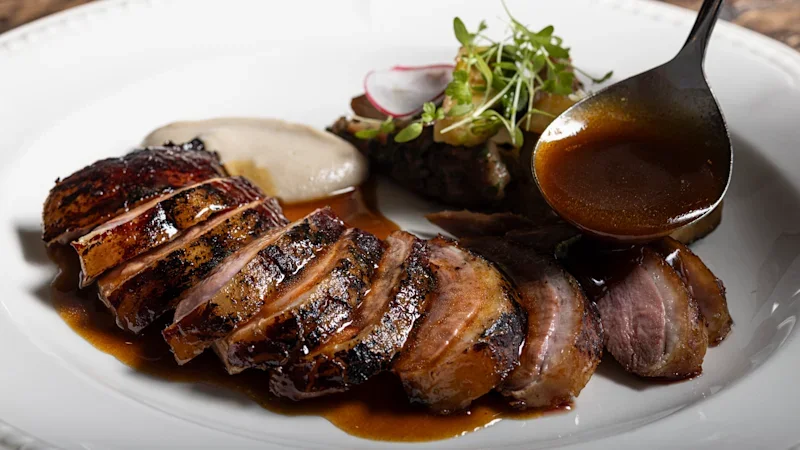
Canard a la presse is a uniquely visceral dish, and something I’ve wanted to order for a long time. Thankfully, it’s the subject of a signature ceremony at legendary chef Philippe Mouchel’s eponymous restaurant.
Conceived in the late 19th century, it’s considered one of the great theatrical dishes of France, and the most significant in the Norman capital of Rouen – chef Mouchel’s hometown.
Given its reliance on one very niche apparatus, these days canard a la presse is also exceptionally rare. Philippe, which celebrates 10 years of exemplary French cooking this year, is one of very few restaurants outside France that serves it.
Strikingly mechanical and festooned with duck motifs, 13 kilograms of antique brass arrives at your table alongside a par-cooked bird. The breasts are filleted and sent back to the kitchen to be flambéed, the carcass is placed inside the chamber. One pair of hands steadies the press, anchoring its feet – bronze and webbed – while another cranks the wheel.
The frame is juiced, its bones relieved of their marrow, and a sauce au sang, or blood sauce, is produced in front of you from a grocery list of life’s finest things: Armagnac, shiraz, shallots, fresh thyme, master duck stock, duck livers and, naturally, an unconscionable quantity of butter.
The breast returns accompanied by a quenelle of truffle pomme puree. The sauce, magnificently glossy, is poured over the top. Bloody. Delicious.
Restaurant manager Tim Sawyer has pressed more than 4000 ducks at Philippe. The history lesson he offers while calmly flambéing them takes some of the sting off the dish’s $210 price tag. It’s uncommonly good service – passionate, sensitive, invested – and extends, for the most part, to his team: he’s a hard act to follow.
Chef Mouchel patrols the pass as he has done in Melbourne since 1991. The menu can read like a time capsule from that era – the ageing fitout, too – but you’re not here for the cutting edge, and you wouldn’t begrudge this level of sincerity even if you were.
Take the devilled eggs, presented on a bed of shredded iceberg lettuce and improved with the sweetness of Queensland spanner crab.
And then there’s the chicken breast. Stuffed with brioche, black truffle, a little foie gras and plenty of butter, it makes plush luxury out of a maligned cut and is the only proof you need of this kitchen’s bona fides.
Ten years is an eternity in restaurants. Most don’t get nearly that far, and yet, Philippe feels like it’s been there for many more. That’s lore for you. Mouchel’s enduring influence on French food in Melbourne, his advocacy for his hometown cuisine – it’s all palpable at Philippe, a tender proposition anchored by a brutal dish and 13 kilograms of antique brass.
The low-down
Atmosphere: Basement bistro of carnal pleasures
Go-to dishes: Rotisserie chicken breast with brioche and truffle stuffing ($48); canard a la presse ($210); my father’s onion soup gratinee ($28)
Drinks: An all-Gallic and Australian list, with an icon indicating the best pairings for canard a la presse; locally produced house wines are also available to take home
Cost: About $160 for two, excluding drinks; more if you order the pressed duck
This review was originally published in Good Weekend magazine.
Good Food reviews are booked anonymously and paid independently. A restaurant can’t pay for a review or inclusion in the Good Food Guide.
More: