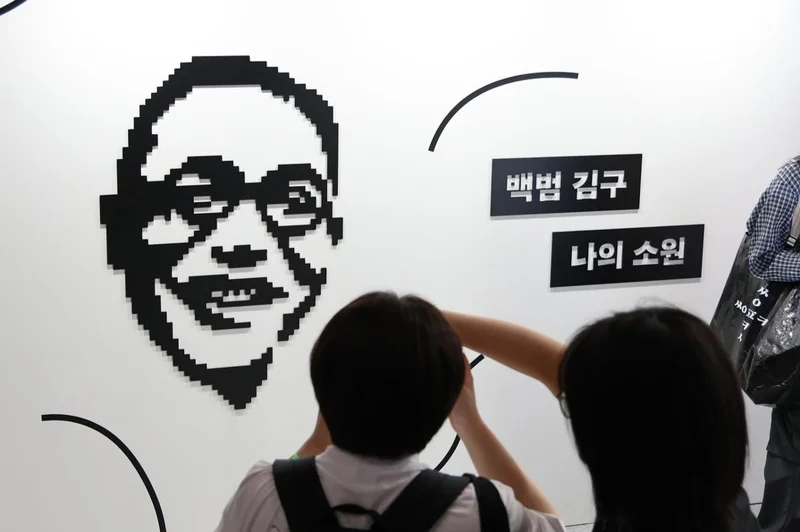
In the turbulent wake of World War II, as Korea struggled to forge a unified national identity out of the ashes of Japan's 1910-45 colonial occupation, a modest residence in downtown Seoul known as Gyeonggyojang became the nerve center of a fledgling democracy. There, Kim Koo — the revered leader of Korea’s provisional government — crafted a vision for his nation that reached far beyond mere political sovereignty.
Starting Tuesday, this historic site will serve as the backdrop for a special commemorative exhibition titled "Kim Koo: A Global Value," honoring the 150th anniversary of his birth in 1876. Co-hosted by the National Heritage Administration and the Seoul Museum of History, the exhibition runs through Aug. 30 — a month chosen to coincide with Kim’s birthday on Aug. 29, an occasion officially recognized on UNESCO's calendar of anniversaries this year.
Rather than presenting a standard chronological timeline, the curation zeroes in on the dramatic human events that unfolded inside Gyeonggyojang itself. After returning from exile in China in November 1945, Kim transformed the building into the final headquarters of the Provisional Government of the Republic of Korea. It was within these rooms that he debated statecraft with key independence figures and penned his famous essay, "My Wish" (Nae Ui Sowon), in which he famously argued that true national greatness lay not in military might or economic dominance, but in the power of culture to foster global peace.
"I desire that our nation become the most beautiful in the world," Kim wrote in the essay, envisioning a country defined by high culture rather than physical power, believing culture possessed the unique capacity to bring happiness both to oneself and to others.
The exhibition also chronicles Kim’s fateful 1948 journey from Gyeonggyojang to Pyongyang for inter-Korean talks — a last-ditch effort to prevent the permanent division of the Korean Peninsula before his assassination at the residence the following year.
Although intimate in scale, occupying 35 square meters of interior space, the exhibition offers visitors an immersive encounter with a decisive chapter in modern history. Admission is free, with daily commemorative book clips offered to the first 20 visitors each day, inviting a new generation to reflect on a statesman whose cultural and philosophical legacy continues to resonate worldwide.
This article was published with the assistance of generative AI and edited by The Korea Times.