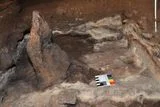
Across roughly 1,000 generations, GunaiKurnai Old Ancestors carried whole grass plants into the dark interior of Cloggs Cave and burned them across the floor. The resulting ash may have served a purpose described in GunaiKurnai traditional knowledge, helping practitioners perform magic and track the footsteps of anyone who entered, including spirit-Beings.
Reaching the main chamber meant passing through a curving corridor less than 3 feet wide. It continued for approximately 16 feet before ending in a nearly 4-foot drop to the cave floor. Through it, people transported grasses with their roots, stems, leaves, and flower heads still attached.
GunaiKurnai knowledge and 19th-century accounts identify caves in the region as secluded places where mulla-mullung, powerful learned women and men, and other spiritual practitioners performed magic, healing, and cursing rituals.
A new study published in Frontiers in Environmental Archaeology identified microscopic remains of whole grasses deliberately burned inside Cloggs Cave across a span of 25,000 years.
“Here we show that the Old Ancestors selected whole grasses from the wider landscape and carried them into Cloggs Cave to spread out in thin layers and burn. Over time, sediments covered these burnt layers, preserving each layer on top of another over thousands of years,” said Elle Grono, co-author of the study, in a press release.
Read More: Chamber in Manot Cave May Be The Earliest Ancient Ritual Site in Southwest Asia
Cloggs Cave Phytoliths Help Distinguish Human Activity From Possum Activity
GunaiKurnai Elder Uncle Russell Mullett at the entrance of Cloggs Cave
(Image Credit: Jess Shapiro, courtesy of GunaiKurnai Land and Waters Corporation)
Cloggs Cave lies on the Country of the GunaiKurnai, the Aboriginal Traditional Custodians of Gippsland and the southern Victorian Alps in Australia. Their Land and Waters Aboriginal Corporation requested the excavations, and community representatives helped design the research, conduct fieldwork, interpret the evidence, and share the findings. Following guidance from Elders, the study refers to past generations as “Old Ancestors.”
Phytoliths are tiny silica structures that can remain after plants decay or burn. This makes them useful in ash layers where heat may have destroyed the pollen.
No plants grow in the cave’s main chamber, so every phytolith had to arrive from outside. People were one possible carrier. Common brushtail possums, whose droppings appeared throughout the deposits, were another.
Researchers compared the cave sediment with 13 preserved possum droppings. Individual droppings were often dominated by one phytolith shape, perhaps reflecting a single night’s meal. The unburned particles could have come from either source, but none of the droppings contained burned or melted phytoliths. The scorched particles in the sediment therefore provided a clear record of human activity.
Why Researchers Link the Grass Fires to Ritual
The phytoliths show what people burned, but they cannot reveal why on their own. Researchers drew that interpretation from how the fires burned and the cultural evidence surrounding them.
Most phytoliths were neither blackened nor melted, and the ash layers contained little charcoal. That pattern points to relatively cool surface fires made with soft vegetation. The study connects these fires with GunaiKurnai traditions of using ash in magic and producing smoke for ceremonial and medicinal practices.
Nineteenth-century accounts also describe ash, charcoal, and grass used together in GunaiKurnai rituals. Men conducting initiation ceremonies were smeared with ash and charcoal powder and wore tufts of grass.
Four Centuries of Fires Surrounded a Standing Stone
One part of the cave contained 73 thin ash layers deposited between approximately 4,400 and 1,600 years ago. Among them stood an 11-inch (28-centimeter) stone erected approximately 2,000 years ago. Old Ancestors repeatedly burned vegetation around it for roughly 400 years.
Deeper deposits held two miniature fireplaces dating to approximately 11,000 and 12,000 years ago. Each contained a trimmed Casuarina stick smeared with animal or human fat.
The meaning of each fire remains beyond reach, but every ash layer records a return. Generation after generation, Old Ancestors moved through the narrow corridor, carried plants into the dark chamber, and added to a history already thousands of years old.
Read More: Ancient Dingo Burial Site Reveals a Strong Bond with Indigenous Peoples in Australia
Article Sources
Our writers at Discovermagazine.com use peer-reviewed studies and high-quality sources for our articles, and our editors review for scientific accuracy and editorial standards. Review the sources used below for this article: