New higher-capacity Bus Rapid Transit system to be studied in Tuas South, could be rolled out islandwide
LTA is evaluating BRT systems used in cities such as Shanghai, Seoul and Curitiba to decide which model could work for Tuas South.
SINGAPORE: A new Bus Rapid Transit (BRT) system using higher-capacity two-section and three-section buses is being studied for Tuas South, with an islandwide rollout possible if it proves feasible.
The Land Transport Authority (LTA) said on Friday (Jul 31) that a BRT system in Tuas South could give workers faster and more reliable connections from their workplaces to existing and future MRT stations.
BRT is a "medium-capacity transport mode" that offers higher passenger capacity than conventional bus services, though less than the MRT, LTA said.
Such systems typically run on dedicated road lanes or corridors with traffic signal priority, allowing BRT vehicles to travel faster and more reliably than conventional buses.
“This also results in higher capacity, especially at peak periods, while requiring less dedicated infrastructure and greater flexibility in route adjustments compared to MRT or LRT systems,” said LTA.
“This makes BRT a potentially cost-effective and scalable solution for suitable medium-density corridors like in Tuas South.”
Minister for Transport Jeffrey Siow said on Friday during a visit to the Singapore Rail Test Centre that if the BRT system proves feasible in Tuas, it could be a "promising and cost-effective mode of transport not just for Tuas but for the rest of Singapore, and it sits between buses and trains as a mid-mode".
He added that while BRT systems usually require their own dedicated infrastructure such as rails, power and signalling, cities like Shanghai and Seoul run such systems without it.
"These variants are more flexible, they are cheaper and more quickly deployable," he said.
HOW OTHER COUNTRIES DO IT
LTA said it is studying various BRT systems around the world to decide which one to roll out for Tuas South.
Some systems use buses of varying lengths, from single buses to longer articulated two-section and bi-articulated three-section vehicles. Examples include BRT systems in Shanghai, Seoul, Curitiba in Brazil, Istanbul and Brisbane.
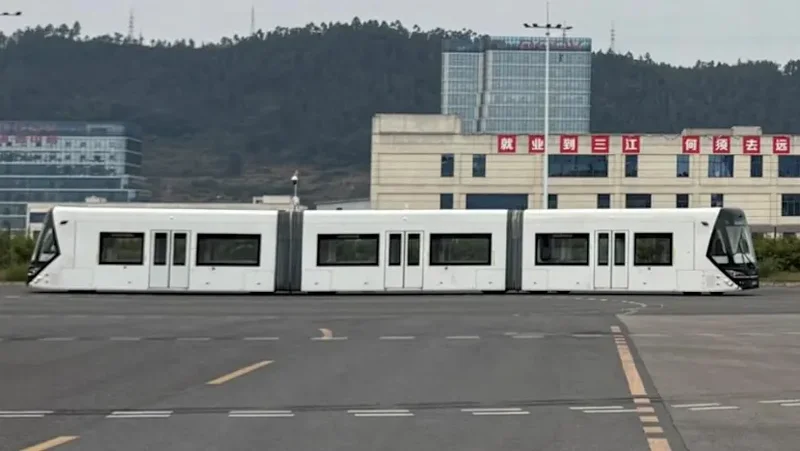
A separate tram-like BRT variant uses longer vehicles with driver's cabins at both ends, and may include virtual guidance and automation systems for navigation. Examples of such systems can be found in Zhuzhou and Yibin, both cities in China.
Both types typically run on dedicated lanes with traffic signal priority. Some also feature fare payment at stations rather than onboard the vehicle, and platforms flush with the vehicle floor, to speed up boarding, cut dwell time and improve the commuting experience.
LTA said it will study the benefits and costs of the range of BRT options for Tuas South, and assess whether the system would be suitable for long-term implementation.