What to know about the conflict in Mali and the world’s most terrorized region
What to know about the conflict in Mali and the world’s most terrorized region
LAGOS, Nigeria (AP) — Mali is facing its most serious security crisis in years as al-Qaida-linked militants and separatist rebels join forces to intensify attacks against its military.
The partnership between the JNIM jihadi rebels and the Azawad Liberation Front (FLA) is the latest twist in a decades-long conflict in what is already the world’s most terrorized region.
It has resulted in some of the largest attacks Malian security forces and their partners have seen in years, analysts say.
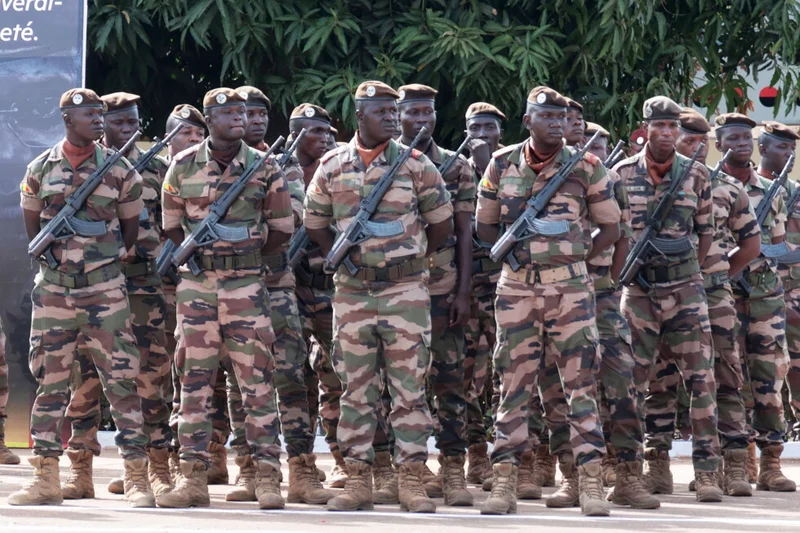
The rebels and separatists launched massive simultaneous attacks across the country in April for the first time in a decade. Earlier this month, they partnered to ambush a Malian military convoy, capturing or killing dozens of soldiers, and mounting pressure on the ruling junta.
Fatalities from militant attacks increased by 35% to 3,435 in the first seven months of this year, compared with 2,546 in the same period in 2024, according to data from the Armed Conflict Location and Event Data (ACLED), an independent conflict monitor.
“The JNIM and FLA see the benefit of working with each other because they function as force multipliers for each other,” said Heni Nsaibia, a senior analyst for West Africa at ACLED.
Both groups, Nsaibia said, have the same goal of “finishing the common enemy,” which they see as being the Malian armed forces and its partner, Russia’s Africa Corps paramilitary group.
The relationship between the groups is “a form of tactical coordination” focusing on military operations, FLA spokesperson Mohamed Elmaouloud Ramadane told The Associated Press.
He said the groups had agreed that after securing independence of the northern region of Mali the communities would decide what version of sharia is applied.
The latest dimension to the Mali conflict began in 2012 with the northern Tuareg rebellion, which opened the field for jihadis, setting the country and the wider Sahel — a vast strip of semi-arid desert stretching from North Africa to West Africa — on a violent path.
Soldiers took over Mali’s civilian government in 2020, citing the security crisis, setting off a series of coups across the Sahel, which is considered the deadliest region in the world with a record of up to half of all terror-related deaths globally, according to the Institute for Economics and Peace.
The period of military rule has fared worse than previous civilian governments, analysts say, with armed groups increasing their footprint across the country and the Sahel.
Here is a guide to the groups fighting in Mali and their goals:
Jama’at Nusrat al-Islam wal-Muslimin (JNIM)
JNIM is the most potent of the armed groups in the Sahel region and one of the deadliest local affiliates of al-Qaida globally, according to researchers.
It was formed in 2017 after the merger of four separate al-Qaida-affiliated groups in Mali, creating one bigger entity. One of its stated goals was to drive out French forces which, at the time, were helping Malian forces to fight the jihadis.
The group is led by Iyad Ag Ghaly, a veteran of the Tuareg rebel group and a former Malian diplomat. It operates across much of Mali in the north, south, west and central axis. Last year, it imposed a blockade on fuel imports into the country, disrupting fuel supplies to the capital Bamako to date.
JNIM is also active in neighboring Niger and Burkina Faso, and has been expanding its presence to coastal West Africa.
Analysts say JNIM has forced the Malian military to disperse across wider territories, stretching its operational capacity on multiple fronts. Recently, it has been presenting itself as an alternative legitimate authority to the government.
“JNIM has progressively expanded its influence, becoming an increasingly unavoidable interlocutor for some local communities and exercising de facto authority in certain areas where state institutions have only a limited presence,” said Beatrice Bianchi, an adviser for the Sahel-Sahara Security Strategies Centre.
Azawad Liberation Front (FLA)
The FLA, which was formed in 2024, is fighting for the independence of northern Mali. It is the latest iteration of the complex formations of several Tuareg separatist rebel groups that have emerged in the north.
Its roots date back to the 1960s following Mali’s independence from France, when it claimed that the central government marginalized the northern region politically and economically.
In April 2012, a coalition of Tuareg rebel groups under the Coordination of Azawad Movements declared independence and sparked a rebellion alongside Islamic militants.
A 2015 accord signed in Algeria between the Malian government and the rebels led to a cessation of fighting between the group and government forces. In 2024, however, the Malian junta exited the accords as tensions flared between the junta and the rebels, leading to renewed hostilities.
Several officials of multiple rebel groups then came together to form the FLA.
Islamic State Sahel Province (ISSP)
The Sahel-based arm of the Islamic State group, the ISSP was formed by defectors from al-Mourabitoun, one of the four al-Qaida affiliates that came together to form the JNIM.
In Mali, it is considerably less prominent compared to JNIM, and most of its operations are in the Menaka region, which borders Niger.
The Islamic State group acknowledged the ISSP’s allegiance in 2022. Unlike JNIM, which tries to present itself as a better alternative to the government, ISSP’s stated goal is to build an Islamic caliphate in the region, and it’s considered more coercive in its relationship with civilians.
“Both organizations are responsible for significant violence against civilians, but JNIM has generally sought to combine coercion with efforts to build local acceptance, while the Islamic State has relied more heavily on overt violence and intimidation,” Bianchi said.
Both groups are also often at loggerheads as they violently compete for territories and differ on jihadi philosophies, reflecting the global rivalry between al-Qaida and the Islamic State.
Africa Corps
The Africa Corps is a Russian paramilitary group that succeeded the disbanded Wagner Group. After coming into power, the Malian military junta expelled French forces from the country in 2022, citing protection of national sovereignty and a worsening security crisis.
Mali then turned away from its traditional Western partners to Russia — first to the Wagner Group, a private organization that acted as Russia’s diplomatic proxy.
Russia has since replaced Wagner with the Africa Corps, answerable to the Russian Ministry of Defense. The Africa Corps fights alongside the Malian army and has been accused of gross human rights violations.
Other pro-government forces
Other smaller ethnic auxiliary groups support the government.
They include the Dozo militias, former hunters that have become militarized, and some Tuareg groups, such as the Imghad Tuareg Self-Defense Group and Allies (GATIA) and the Movement for the Salvation of Azawad (MSA), in the Menaka region.
The support can also be fluid. Dan Na Ambassagou, a militia group that fights against Fulanis, accusing them of harboring Islamist groups, was once embraced by the government but has now been denounced.