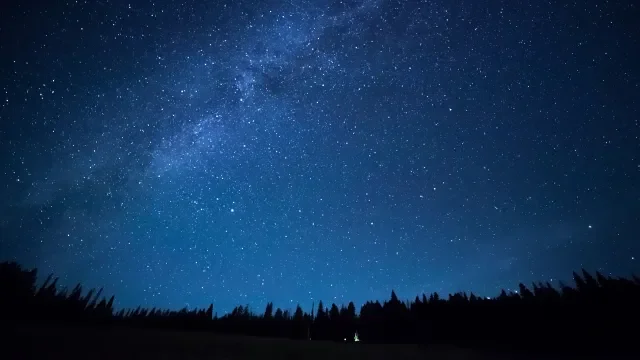
We see our Universe as it is today: 13.8 billion years after the Big Bang. Because of how quickly and how long it’s been expanding and cooling, the Universe is now sparse, possessing less than 1 proton per cubic meter of normal matter on average. Dark matter and dark energy, not normal matter, dominate our Universe’s contents today, and the expansion rate is much lower, around 70 km/s/Mpc, than it was at earlier times. The cosmic microwave background, or the Big Bang’s leftover glow, is a mere 2.7 K, and although galaxies clump together in groups and clusters, the distance between various galactic groups and clusters is enormous: tens of millions of light-years, on average. While most of what our naked eyes can see are stars and nebulae within our massive, heavily evolved Milky Way, with telescopes, we can see incredibly far into deep space. What would someone who came along long before humans did have seen? That’s the question of Sayan Banerjee, who wants to know what the earliest form of intelligent life to arise in the Universe would have seen, and how it would have been different from what we see today. “In a hypothetical scenario where an intelligent being existed shortly after the Big Bang—perhaps on a planet, though I understand planets may not have formed for the first 1-2 billion years—how would their view of the night sky differ and evolve from what we see today?” To understand that, let’s first try to understand when the Universe could have first made life, and then, if it grew to become intelligent, what it would see when it peered out at the cosmos. This conceptual image shows meteoroids delivering all five of the nucleobases found in life processes to ancient Earth. All the nucleobases used in life processes, A, C, G, T, and U, have now been found in meteorites, along with more than 80 species of amino acids as well: far more than the 22 that are known to be used in life processes here on Earth. Similar processes no doubt happened in stellar systems all throughout most galaxies over the course of cosmic history, bringing the raw ingredients for life to all sorts of young worlds. Credit: NASA Goddard/CI Lab/Dan Gallagher In order to have life — or life as we know and understand it — you need a few ingredients. You need a star to provide a source of energy: one that’s stable enough over time and won’t vary in temperature too much or flare too excessively. You need a planet that has a solid, rocky surface, along with a sufficient amount of liquid water on that surface: something that requires a thin-but-substantial atmosphere. And you need a sufficient quantity of heavy elements in order to create a variety of complex molecules capable of binding together to create organic compounds that can metabolize nutrients and reproduce: generally understood as the bare minimum for life. The Universe wasn’t born with those conditions, however. In the immediate aftermath of the hot Big Bang, there were no stars. There was also no carbon, no oxygen, no nitrogen, no phosphorus and more: none of the heavy elements needed to make rocky planets, liquid water, or complex molecules in general. In order for them to be created, we need stars to be born, live, and die in cataclysmic explosions: returning the heavy elements made inside to the greater Universe, where future generations of stars and star systems can form. An artist’s conception of what the Universe might look like as it forms stars for the first time. As they shine and merge, radiation will be emitted, both electromagnetic and gravitational. The neutral atoms surrounding it get ionized, and get blown off, quenching (or ending) star formation and growth in that region. These stars will be short-lived, but their deaths will enrich the Universe with heavy elements, enabling the creation of more evolved, lower-mass, and eventually, planet-possessing star systems in their wake. Credit: NASA/ESA/ESO/W. Freudling et al. (STECF) One generation of stars that live-and-die is probably insufficient, however. In today’s exoplanet-rich Universe, we still only find rocky planets around stars with at least 1% of the heavy elements found in the Sun, and only typically find them when they have somewhere between 10%-25% of the Sun’s heavy elements. A single generation of stars that live-and-die might be sufficient to get the interstellar medium up to near 0.01% of the current value, but many generations — building up the fraction of heavy elements located in the interstellar medium — are required in order to enable the formation of rocky worlds. In the densest environments in the young Universe, however, this process can occur very rapidly. The very first stars of all might form when the Universe is merely 30-100 million years old, and the earliest galaxies we can see, some 280 million years after the Big Bang, are already heavily evolved and enriched. By the time it’s around 800 million-1.1 billion years after the Big Bang, the interstellar medium in the most enriched galaxies has enough heavy elements that rocky planets can form around newborn stars. If conditions are right, life can arise almost immediately on those worlds. This color-coded map shows the heavy element abundances of more than 6 million stars within the Milky Way. Stars in red, orange, and yellow are all rich enough in heavy elements that they should have planets; green and cyan-coded stars should only rarely have planets, and stars coded blue or violet should have absolutely no planets at all around them. Just 1 billion years after the Big Bang, a significant number of stars with the right abundance of heavy elements to possess rocky planets around them should begin forming. Credit: ESA/Gaia/DPAC; CC BY-SA 3.0 IGO We can estimate, then, that the earliest forms of life can come into existence just 1 billion years after the hot Big Bang begins: a time where the Universe was just 7% of its present age. In order for intelligent life to arise, a significantly longer amount of time must pass: an amount of time that we cannot estimate just yet, as we only have one example — the example of our own planet — to draw from as far as information concerning “how long it takes, given the existence of life, for intelligent life to arise.” On our world, it took between 3.8 and 4.5 billion years for that process to occur; elsewhere in the Universe, it could have perhaps happened more swiftly. Without even a second example of life, much less intelligent life, in the Universe, all we can do is speculate about how long that process is likely to take. If evolution proceeded more quickly and more efficiently on other worlds, perhaps it might even be possible for life to go from its simplest forms to the complex, differentiated, intelligent, and even tool-using macroscopic life we’re familiar with today in as little as 1-2 billion years. In the grand cosmic lottery of life, we don’t know: what the other prizes are, what the odds of winning each prize are, or whether humanity is even the grand prize. Nevertheless, even with our profound ignorance, we can start from the assumption that life first arises 1 billion years after the Big Bang, and that intelligent life first arises 2 billion years after the Big Bang. Then from that assumption, we can begin considering the main question: what would those early life forms see in their night sky? Under ideal dark sky conditions, the unaided human eye can see up to 6000 stars at once, and up to 9000 stars total if they could see the full sky at once, unblocked by the Earth itself. Much longer ago, when the star-formation rate was far greater and galaxies were much closer together, the night sky might have looked akin to what you see above: with many more stars, as well as some prominent spiral, elliptical, and irregular galaxies, illuminating the night sky on a moonless night. Credit: callisto / Adobe Stock Being a rocky planet that orbits around a luminous star, they’re very likely to have a night side to their world: a night that gets comparably dark to what Earth experiences on a moonless night. That star system is likely, like ours, to be located within a galaxy, but the galaxy is likely to be different than ours in several important ways. That galaxy should be: smaller in size, lower in mass, with — on average — bluer, hotter stars than we have in our own backyard, with far fewer stars within it (from tens of millions to perhaps ten billion, but unlikely to have hundreds of billions like our own does), but with a much greater star-forming rate than we have today. Just 1 billion years after the Big Bang began, the star-formation rate was still increasing rapidly, and was perhaps only around 2-3 times as great as it is today. So there would be about 2-3 times as many bright, blue, newly-formed stars that shine in the sky (the easiest and most common ones for us to see with our naked eyes) as we have today at the time the first forms of life begin to emerge. But 2 billion years after the Big Bang, the star-formation rate has continued to rise and intensify, and is more like 8-10 times as great as the star-formation rate is today. (In another 1-2 billion years, it will reach its peak: about 20-30 times the current rate.) That means the density of the brightest stars in the night sky will be roughly an order of magnitude greater than what we have in the Milky Way today. The Fermi-LAT collaboration’s reconstructed star-formation history of the Universe, compared with other data points from alternative methods elsewhere in the literature. We are arriving at a consistent set of results across many different methods of measurement, with the greatest uncertainties persisting at the highest redshifts and earliest times. These uncertainties represent less than a 1% uncertainty in the total number of stars formed throughout cosmic history. An age of 1 billion years corresponds to a redshift (x-axis) of 5.6, while an age of 2 billion years corresponds to a redshift of 3.2: with significantly greater star-formation rates than at present. Credit: Fermi-LAT collaboration & M. Ajello et al., Science, 2018 A few of the brightest stars in the night sky — like Alpha Centauri and Sirius — appear bright not because they’re intrinsically extremely luminous, but rather because they’re extremely close to us. Intrinsically, they range from around the Sun’s brightness to about 20-25 times the Sun’s brightness, but the bright stars that aren’t intrinsically extremely blue are all relatively nearby: within about 50 light-years, tops. However, over 60% of the brightest stars in our sky are 100 light-years away or more, as: they’re either main sequence O-class or B-class stars, representing just 1-in-800 stars overall, but are the brightest, bluest, and shortest-lived of all stars, or because they’re stars that have already evolved into red giants or supergiants, and have become far more luminous than they were during the main sequence (hydrogen-fusing, alone) stage of their lives. Whereas, in our galaxy, under ideally dark skies, a typical human eye can pick out about 2000-3000 stars at once, and approximately 6000 total stars over the course of a full night, someone born 1 billion years after the Big Bang would be able to see more like 5000-8000 stars at once and around 10,000-15,000 stars over the course of a full night, while someone looking at their sky 2 billion years after the Big Bang would see more like 15,000-30,000 stars at once and 30,000-60,000 stars over the course of a full night. It would be like replacing the power of your unaided eyes with the power of a pair of binoculars, but with the same wide-field viewing capabilities. This is basically the same as replacing your naked-eye views with a long-exposure astrophoto that can see far more details than your unaided eye can. This glorious photo, entitled “Milky Way Over Quiver Tree,” was taken in South Africa with a mobile device by astrophotographer Jilanfeng Dai, and won 2nd place in the Mobile Astrophotography category of DarkSky International’s latest photo contest: Capture the Dark 2025. Only a few thousand stars are visible to the naked eye, but through a long-exposure photograph such as this, hundreds of thousands of stars can be seen: comparable to what you’d see if you replaced your pupils with pupils the size of binoculars. Credit: Jilanfeng Dai Beyond the stars, however, there’s so much more that an observer who came along much earlier in cosmic history would see. First off, there would be the nebulae within their home galaxy. Most of the nebulae that we see today in our Milky Way — the Orion Nebula, the Eagle Nebula, or the Trifid Nebula, for some examples — appear like faint, fuzzy smudges in the sky: low in surface brightness, extended over a small region of sky, and quite far away. That’s because: our galaxy is huge, measuring over 100,000 light-years in diameter, even the closest major star-forming region, the Orion Nebula, is over 1000 light-years away, and star-forming regions, in a late-time galaxy like our own, typically only span around 50-ish light-years across. However, earlier on, galaxies were smaller and more compact, with larger and more impressive star-forming regions that tended, on average, to be closer to a typical star than our Milky Way is to the star-forming regions nearest us. It’s possible — perhaps even probable — that there would be larger, closer, brighter, and overall more prominent star-forming regions visible in the night sky, along with potentially large, close, newborn star clusters visible within them as well. This color-composite photo of the stars and nebulosity of the Orion Nebula show it as it would appear if it were much closer, and if our vision extended into the infrared. The large population of stars seen within this field-of-view, representing about 1000 stars, is from a star-forming region that gave rise to them within a timespan of about the most recent 1 million years. In the early Universe, star-forming regions like this were much more abundant, and were closer, on average, to a random star than the Sun is to the Orion Nebula. Credit: ESO/M.McCaughrean et al. (AIP) Beyond the home galaxy that long-ago alien species called home, there would be a vastly different Universe to explore. Today, our observable Universe is 13.8 billion years old, we can see out to 46.1 billion light-years in radius, and has a density of approximately one galaxy inside each box that’s 1.7 million light-years on a side. But back at the two epochs we’re considering, when either first life or the first intelligent life could possibly have arisen, it was: either 1 billion or 2 billion years old, observable out to 7 billion or 11 billion light-years away, and possessing 1 galaxy inside each box that’s either 100,000 light-years or 250,000 light-years on a side. The Universe was not just smaller and denser in the past, it had larger numbers of smaller-sized (and lower-mass) galaxies, as galactic mergers between those early, small galaxies are very common during the first several hundred million years of cosmic history. These galaxies would have been compact, blue in color, and more luminous-per-unit-mass than today’s galaxies. If human astronomers had come around with the same types of skies that would have been visible just 1 billion or 2 billion years after the Big Bang, we could have discovered the extragalactic nature of these nebulous objects in the sky not with 1920s-level technology, as we actually did here on Earth, but with the type of technology that was available decades earlier: between the 1850s and the 1880s. Galaxies comparable to the present-day Milky Way are numerous, but younger galaxies that are Milky Way-like are inherently smaller, bluer, and richer in gas in general than the galaxies we see today. Fewer galaxies have disks and spiral shapes as we look farther back in time. Over time, many smaller galaxies become gravitationally bound together, resulting in mergers, but also in groups and clusters containing large numbers of galaxies overall. Credit: NASA, ESA, P. van Dokkum (Yale U.), S. Patel (Leiden U.), and the 3-D-HST Team When it comes to cosmology — the study of the Universe on the largest scales of all — we would have discovered a much more primitive set of conditions, revealing a Universe that was significantly different than the properties we observe it to have today. Major differences include: the expansion rate of the Universe, which today is around 70 km/s/Mpc, but at an age of 1 billion or 2 billion years, was 650 km/s/Mpc or 320 km/s/Mpc, the temperature of the Big Bang’s leftover radiation bath, the CMB, which today is at 2.7 K, at an age of 1 billion or 2 billion years, was 18.1 K or 11.4 K, and instead of being 70% dark energy, 25% dark matter, and 5% normal matter, was at an age of 1 billion or 2 billion years, either 1% dark energy, 84% dark matter, and 15% normal matter or 3% dark energy, 82% dark matter, and 15% normal matter. Because of the difference in these properties, the patterns of fluctuations that appear in what today we observe as the CMB would have been somewhat different: revealing the same Universe, but with different temperature fluctuation and polarization patterns appearing on those same angular scales. (Because the distance scales that correspond to “1 degree” when the Universe was younger, smaller, and hotter are different than those distance scales are today.) At any epoch in our cosmic history, any observer will experience a uniform “bath” of omnidirectional radiation that originated back at the Big Bang. Note that the CMB isn’t just a surface that comes from one point, but rather is a bath of radiation that exists everywhere at once. As each new year passes, the CMB cools down further by about 0.2 nanokelvin, and in several billion years, will become so redshifted that it will possess radio, rather than microwave, frequencies. The farther away we look, the younger of a Universe, and the hotter of a CMB temperature at that location, we increasingly find. Credit: Earth: NASA/BlueEarth; Milky Way: ESO/S. Brunier; CMB: NASA/WMAP If we had been born much earlier on, and had a much more primitive Universe to look at, some aspects of our cosmos would have been much easier to discover, while others would have posed a much greater challenge. It would have been easier to discover the expanding Universe and the extragalactic nature of spiral, elliptical, and irregular galaxies, but more difficult to detect galaxy clusters and galaxy groups, as they’re still in the early stages of formation. It would have been easier to measure the leftover glow from the Big Bang, since photon densities and energies would both have been higher, but harder to isolate it from the foregrounds created by the heated gas and dust in the galaxy, which would also have been greater. It would have been easier to detect dark matter and infer the hot Big Bang, but harder to detect dark energy, or to learn what the ultimate fate of the Universe would have been. And it would have been easier to detect black holes, including active supermassive black holes, than it is today, but more difficult to find other instances of rocky exoplanets, and particularly rocky exoplanets with life or intelligent life upon them. Intelligent aliens, if they exist in the galaxy or the Universe, might be detectable from a variety of signals: electromagnetic, from planet modification, or because they’re spacefaring. But we haven’t found any evidence for an inhabited alien planet so far. It’s also possible that aliens have traveled here and are watching us, and are responsible for some UAP/UFO sightings, although no credible evidence exists for it. The lack of any such detections can only lead us to place upper limits on the abundance and longevity of such civilizations, not estimates for our own civilization’s longevity. Credit: Ryan Somma/flickr Another remarkable difference is that since the distances between galaxies would have been so much shorter, it means that if a long-ago civilization were to gain the capability of conducting interstellar travel, they could much more easily upscale that to intergalactic travel as well. If the goal of an early civilization was to extend the life from their world to other planets, star systems, and galaxies, coming along as early as possible is the optimal scenario. Still, it’s remarkable to think about how fortunate we are that we came along when we did. Too early, and there’s no one else to find, and it’s much more difficult and subtle to learn the Universe’s fate. Too late, and there’s also no one else to find, and we wouldn’t be able to discover the CMB or galaxies beyond our own Local Group: our cosmic origins would be hidden from us. But because we’re in the here-and-now, 13.8 billion years after the hot Big Bang began, we can do it all, and have excellent chances to find not just inhabited worlds and planets, but potentially intelligent life as well. It’s up to us to make the most of those opportunities! Send in your Ask Ethan questions to startswithabang at gmail dot com! This article Ask Ethan: What would “first life” see in their night sky? is featured on Big Think.
Ask Ethan: What would “first life” see in their night sky?