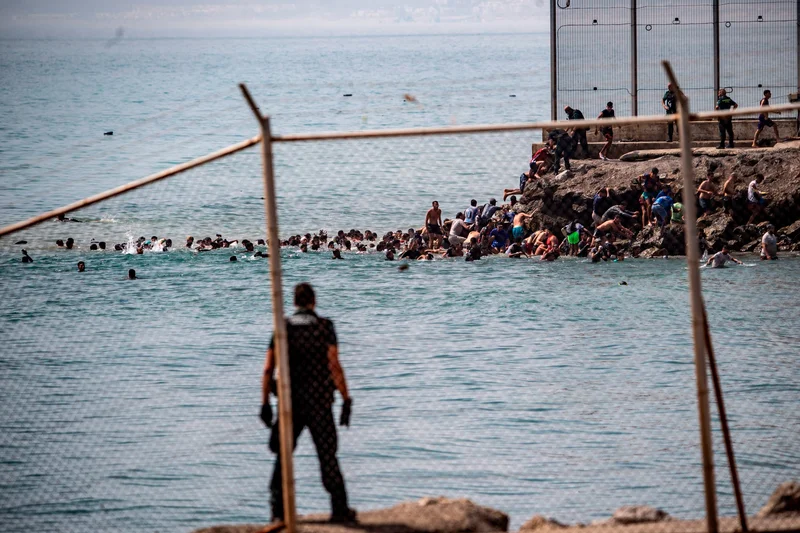
In the short span of a few hours, from noon to 4 p.m., the Spanish exclave city of Ceuta has been transformed: quiet streets have filled with barefoot young people, the lazy shade of public parks turned into massive open-air sleeping quarters; beaches once dotted with umbrellas and bikinis became crowded with migrants cooling off in the water. Ceuta was no longer the same city.
In a single day, thousands of migrants crossed from Morocco, either by swimming in open waters or by making their way around the breakwater that marks Spain’s border. The sudden influx has turned the city upside down and created an urgent management challenge just two days before the start of its summer fair. Taxi drivers called it an invasion; NGOs described it as a humanitarian crisis; local politicians faced with handling the situation labeled it a national emergency. All had a point.
The city of about 84,000 residents, led by Mayor Juan Jesús Vivas from the conservative Popular Party (PP), is used to receiving migrants. Along with the exclave city of Melilla, it shares a border with Morocco. But what happened on Thursday was so extraordinary that residents found themselves unable to look away from their television screens.
Thousands of people, as if an entire soccer stadium had emptied onto the field in celebration, reached the shore dripping with seawater, shouting and cheering for Spain. They then dispersed in every direction, hurrying along roads without regard for traffic, climbing ravines and losing their flip-flops, hugging one another and kissing the first stretch of Spanish pavement they encountered. The Spanish Civil Guard officers stationed at the border had little choice but to step aside and allow the human tide to pass.
Young men and women made up much of the crowd, but there were also families with children, all taking advantage of favorable circumstances to cross the border. The recovery of at least 18 bodies from the sea told the darker side of the story. Spanish Prime Minister Pedro Sánchez was due to travel to Ceuta on Friday.
Before the surge, the early morning had followed the familiar pattern of recent days. Lone young men or small groups arrived at the beaches floating on inflatable inner tubes until their numbers swelled into the hundreds. As they neared the shore, the distant heads bobbing in the water gradually took shape until they stepped onto the sand, where Civil Guard officers were waiting.
“Morocco, no. Morocco, no, please!” they pleaded with the officers.
“Not Morocco, don’t worry. Nothing about Morocco. Come in, come,” the officers replied.
But many had been through this before, having previously been sent back. The sight of a uniform was enough to make them bolt. Some resorted to theatrics worthy of a soccer match: collapsing on the sand in apparent exhaustion or dropping to their knees in supplication. “Work, work. No father, no mother,” they cried.
Once again, the officers, appealing to their more humanitarian instincts, tried to reassure them that they had nothing to fear. But they did not have interpreters to make themselves understood. Several volunteers stepped in to help translate and also provided the new arrivals with water and sandwiches. The sun continued to rise through the milky haze of the easterly wind, known locally in Ceuta as taró.
No sooner had they reached the sand than they pulled their cellphones from the waterproof plastic pouches that had kept them dry during the crossing. Most had concealed their plans from their families, saying nothing about spending hours adrift on an inner tube in the middle of the night. When they finally called home to say they had made it, that “God had been with them,” surprised relatives received the news with tears.
Among the most fearless, and certainly one of the most cheerful, was Hamsa Sliman, 12, who arrived on Tarajal Beach. There was no need to ask whether he was a minor. He hugged the friends who had made the crossing with him and called his father, who had known nothing of the journey. The man was crying on the phone screen.
Still shivering from the cold, the boy asked anyone who spoke Arabic when he would be able to travel to mainland Spain. He had come, he explained, to help his mother from Spain. More hugs followed.
“Look at the young people who are arriving. What a disgrace for a country to drive out its youth like this,” shouted a man from a balcony overlooking the beach, tossing down his dry T-shirt so the newcomers could wipe the seawater from their cellphones.
Hadiya is 16. She emerged from the water still wearing her earrings and gold chain, with mascara running down her face, as if she were coming home from a party. She spent three hours paddling with an inner tube, but she is in good shape. She plays soccer and wants to keep doing so in Spain.
“I told my mother I was just going out for a walk at night with a friend,” she says, shivering. Now she is looking for a phone to tell her that she will not be home for dinner tonight, that her daughter is not coming back.
The officers throw up their hands at these children, unsure how to help them, while sanitation crews struggle to clear away the inner tubes and flippers strewn along the shoreline. In Ceuta, thousands of young people speak Arabic and communicate easily with the new arrivals. To Spanish society, they are little more than children. But that does not move the roughly hundred people who, wrapped in Spanish flags, will later march down the city’s main avenue chanting fascist slogans and hurling insults at Prime Minister Pedro Sánchez’s mother. Police step up their efforts to keep watch over the demonstrators.
Meanwhile, at the Temporary Migrant Holding Center (CETI), the laughter gradually quiets as the hours pass. The young migrants begin to show signs of fatigue. They sprawl among the fallen leaves in search of shade, doze off along the roadside, wash up and display wounds on their legs. Some say Moroccan security forces beat them; others say the injuries came while climbing the rocky breakwater, with the help of Spanish officers.
At the CETI, there are only questions: when will they be allowed through those gates, now closed because the facility is full? Where will they be taken? Will they be allowed to go down into town to buy food and be free to return?
Up there on Mount Jaral, they are beginning to realize that the game has only just begun, and there is no telling whether they will win it. The CETI has one face in midmorning and another after the thousands who arrived in a midday surge have spread through the city. Many head straight for the reception center, and hours later police block the road leading up to it. By then, dozens of sub-Saharan Africans sitting in the sun have joined the Moroccan contingent. Waiting.
Like so many people in Ceuta, Yusra speaks to them in her native Arabic. She is 18, lives in the city’s well-known Príncipe neighborhood, and dreams of becoming a police officer. “I like the adrenaline,” she says. Since 3 a.m., she has been at Tarajal Beach, handing out sandwiches and water while watching the arrivals come ashore.
She shouts herself hoarse to tell them they will not be sent back to Morocco, that they can trust the officers and should wait patiently at the border facilities. But she is not always successful. She asks whether they crossed into Spain because they knew that a recent Supreme Court ruling now prevents migrants who arrive by sea in Ceuta and Melilla from being summarily returned to Morocco. No, they all reply, they knew nothing about it. But they greet this “new Spanish law” with enthusiastic applause.
“Morocco, zero. World Cup, no,” one young man, fresh out of the water, tries to explain. Morocco does not deserve to host the World Cup, he says. They were told it would improve their lives, but it has not, he adds in Arabic, while Yusra translates.
She is not the only one wandering around the area. Three other teenagers, barely out of middle school, greet the new arrivals with the fascination of spectators at a live spectacle. But they also say they have seen a dead body and helped rescue a boy who was drowning. Rayyan, Sufian, and Ashraf are about 16 years old and never miss a dawn.
Ceuta is once again reeling from scenes reminiscent of the mass arrivals of 2021. Shops have closed, as have the stalls preparing for the city’s summer fair. The government has deployed the military to assist the Civil Guard with security operations. The noise on the streets never lets up, and everyone is making rough calculations about how many thousands of soaking-wet migrants have, in just a matter of hours, transformed the face of the city.