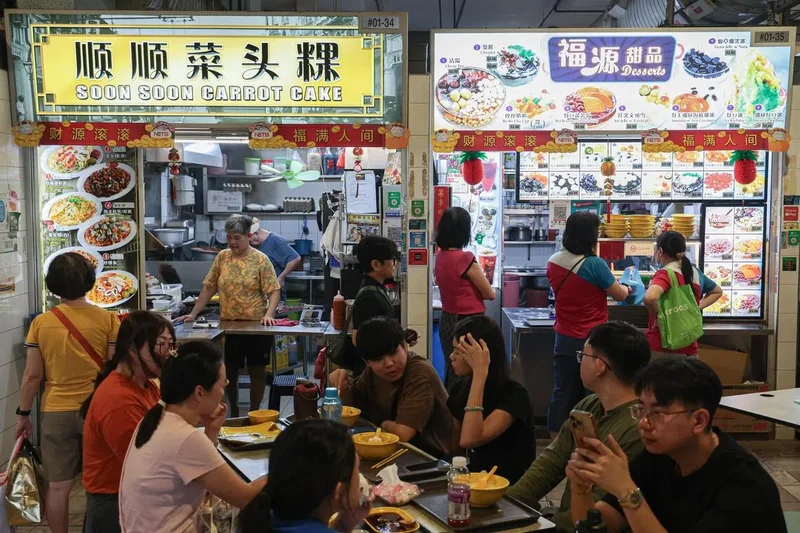
Hawkers, market stallholders welcome rent support, hope for more long-term help
AI generated
SINGAPORE – The rising costs of keeping her Indian Muslim food stall running in Ci Yuan Hawker Centre in Hougang led Ameer Amsha Jasmine Banu to axe her rojak offerings.
Jasmine said that delivery and ingredient costs driven higher by the situation in the Middle East, along with a shortage of people buying rojak, have made her rethink the menu.
The owner of Muhammad Jazeel Indian Muslim Food said: “Our operational costs such as deliveries and ingredients increased by about 20 per cent from February to July. Although rojak makes a profit when it is sold, we had to get rid of it because the cost is too high (and demand is low).”
Jasmine, 33, added that the $1,200 rent support the Government will give hawker stallholders over six months from September will cushion her spendings on ingredients – for now.
Hawkers and market stallholders in Ci Yuan Hawker Centre, Serangoon Garden Market, Tanglin Halt Market and Holland Village Market & Food Centre who spoke to The Straits Times on July 30 and 31 welcomed the rent support.
But they said it would not cover the rising costs of staying in business. On average, their operational costs have increased by about 20 per cent to 30 per cent.
The stallholders added that long-term support, including improving infrastructure, would be helpful.
The latest rent support is part of the latest $900 million support package announced by the Government on July 29 to help households and businesses manage cost pressures arising from the outbreak of conflict in the Middle East on Feb 28.
Some 6,900 cooked-food stalls will each receive $1,200 and about 8,300 market stalls will each receive $600, spread out over six months from September to February.
The payouts will be given to stallholders in markets and hawker centres managed by the Government and government-appointed operators.
The cash is meant to offset the rising costs of raw materials, packaging and utilities, said Senior Minister of State for Trade and Industry Low Yen Ling on July 29.
In Tanglin Halt Market, Chinese food stall owner Derrick Ng said his operational costs increased because of the Iran war. Petrol and diesel prices were driven up due to the blockage of the Strait of Hormuz, through which a fifth of global oil and gas flows.
He used to purchase chicken at $4.10 per kg in February. It now costs $5 per kg. As for eletricity and gas, he paid about $700 to $800 in February, compared with almost $1,000 in July.
While he acknowledged that the rent support is better than receiving no aid, he hopes the Government can lower rentals and offer discounts on water and electricity.
Ng, 50, said that the economic stressor from the war comes as residential areas near the hawker centre have been vacated because of the Tanglin Halt Selective En bloc Redevelopment Scheme, which was announced in 2014.
In Serangoon Garden Market, Ah Tas Muffins owner David Lim said that his operational costs have been rising since the Ukraine war broke out in 2022, with costs going up further recently because of the Iran war.
Lim, 36, estimated that the delivery costs for his ingredients increased by about 40 per cent from February to July. The cost of his raw ingredients rose by about 15 per cent.
“There has been a general increase in the price of all ingredients because of rising petrol costs. Butter and chocolate are mainly flown in from Europe or other countries,” said Lim, who has been running the stall for three years.
Catherine Zhng, who has run Chinese food stall Tong Xin Gu Wei in the same market for more than four decades, said that while the payouts will be helpful, more can be done to address underlying revenue concerns.
The 61-year-old said increasing footfall to the hawker centre can help hawkers earn more.
She suggested building more shelter so that rain does not fall near the diners’ seating area.
The Government could also look into heat management strategies for the hawker centre because it gets very hot in the afternoons, she added.
Ng, the Tanglin Halt Market hawker, said that building a carpark nearby will bring more diners.
Koh Keng Meng, who has been selling seafood at Serangoon Garden Market for 13 years, suggested that the Government give out more CDC vouchers to households, which will help drive up business for hawkers and market stallholders.
He said about 30 per cent of his customers use CDC vouchers.
On July 29, the Government announced that every Singaporean household will receive another $300 worth of CDC vouchers in January 2027.
Koh, 52, drives his van to Jurong Fishery Port every morning to source for seafood. His monthly diesel cost in February was $200, which ballooned to almost $400 in July.
In Holland Village Market & Food Centre, drink and dessert stall owner Ng Bee Leng, 62, said she was grateful for the payouts, especially because her monthly rent is $300 as a second-generation hawker stall owner.
To mitigate the rising petrol costs, she buys ingredients in a higher quantity each time. She now makes two trips every month to her wholesale retailer, instead of four.
In a Facebook post on July 29, Minister for Sustainability and the Environment Grace Fu said the National Environment Agency (NEA) will continue strengthening the sustainability and resilience of the hawker trade.
Past instances of rental support for hawkers and market stallholders include a one-time sum of $600 given out in 2025 in celebration of Singapore’s 60th year of independence.
The median successful tender price for cooked-food stalls across hawker centres managed by NEA was about $1,800 in 2023.
Between 2015 and 2023, the median monthly rent for all non-subsidised cooked food stalls in NEA-managed hawker centres was about $1,250.
The median assessed market rent for non-subsidised market stalls has remained at about $320 per month since 2019, the NEA said in 2024.