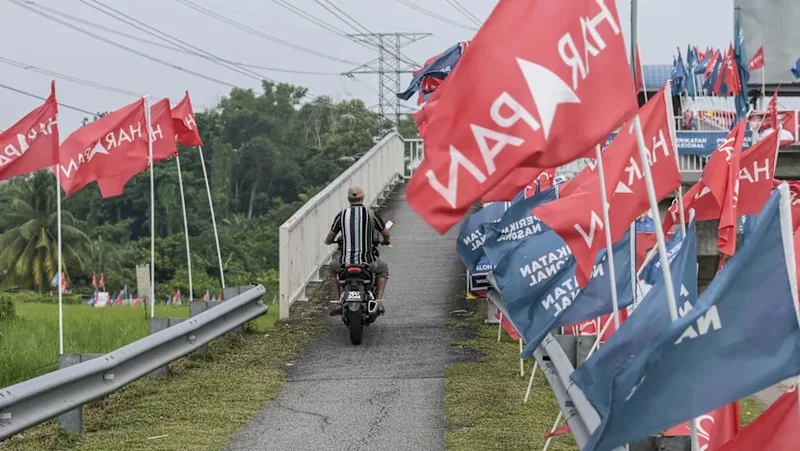
Malaysia's youth vote in focus as Negeri Sembilan heads to the polls
Parties have tailored their campaigns to younger Malaysians, promising better jobs, affordable housing, education opportunities and improved public transport in a bid to win over the state's largest voting bloc.
KAMPUNG TOHOR, Negeri Sembilan: Young voters are expected to play kingmaker in Malaysia's Negeri Sembilan state election, with nearly half the electorate under the age of 40 and several seats likely to be decided by narrow margins.
As voters head to the polls on Saturday (Aug 1), parties have tailored their campaigns to younger Malaysians, promising better jobs, affordable housing, education opportunities and improved public transport in a bid to win over the state's largest voting bloc.
The contest has become one of the country's most closely watched state races, with Pakatan Harapan (PH) fighting to defend one of its key strongholds against a coordinated challenge from former ally Barisan Nasional (BN) and opposition coalition Perikatan Nasional (PN).
Political analysts say younger voters are less driven by traditional party loyalties than previous generations, and are instead focused on bread-and-butter concerns such as the cost of living and employment prospects.
YOUTH VOTES IN THE SPOTLIGHT
Campaigning has also shifted online, with parties increasingly using TikTok, Instagram and Threads alongside traditional ceramah, or rallies, to reach first-time and Gen Z voters.
About 47 per cent of Negeri Sembilan's electorate is below the age of 40. Voters aged between 30 and 39 make up the single largest age group, while Gen Z voters under 30 account for about a quarter of all registered voters.
Prime Minister Anwar Ibrahim's PH coalition unveiled a manifesto centred on good governance, inclusive economic growth, affordable housing, and creating quality jobs and business opportunities.
Incumbent Chief Minister Aminuddin Harun has also pledged higher cash assistance, particularly for students, in a bid to retain support among younger voters.
One youth voter told CNA that education remains the top priority.
"I'm voting for a better education, for students to get into good universities, hopefully the universities that they desire," he said.
Another said improving public transport would make the biggest difference.
“Public transportation is important to me because I travel frequently by bus, plane and the KTM (train). We also need more scholarships,” she said.
ORANG ASLI VOTES ALSO IN PLAY
BN, meanwhile, has promised to boost economic growth through better public services and youth-focused incentives.
The coalition has also sought to court the Orang Asli community by proposing the appointment of a special officer within the Negeri Sembilan Chief Minister's Office to represent indigenous interests.
Although the Orang Asli make up only about two per cent of the state's electorate, parties acknowledge that every vote matters in a tightly contested election.
Both BN and PH have intensified engagement with indigenous communities in recent weeks, promising better roads, improved transport links and greater access to healthcare and education.
One Orang Asli voter said land rights remain their biggest concern.
"All we’re asking for is land for our homes, our ancestral lands. Life isn't easy for us. We depend on the land and live off what it provides,” he told CNA.
PN has also rolled out proposals to complement BN's manifesto after both parties agreed not to contest against each other to avoid splitting the Malay vote.
PN chairman Ahmad Samsuri Mokhtar, of Islamist party PAS, said the cooperation could reshape Malaysia's political landscape.
HIGH STAKES FOR ANWAR
Political observers say that despite the competing policy promises, the campaign has largely been driven by public sentiment.
"A lot of young people struggle. The dissatisfaction with the government, the distrust in institutions and officialdom is very, very high," said Ibrahim Suffian, co-founder of the Merdeka Center for Opinion Research.
"This is not a campaign that's based on policies (or) leadership. It's a campaign run purely on sentiment … against the DAP, against Anwar – because Anwar has overpromised and hasn't delivered."
On the campaign trail, bigwigs from the opposing camp have been targeting the Democratic Action Party (DAP), a key component of the PH coalition. They have portrayed the Chinese-majority party as anti-Malay and anti-Islam, allegations the DAP has consistently denied.
DAP secretary-general Anthony Loke is seeking to retain his seat in the rural mixed constituency of Chennah, where Malays make up about 48 per cent of the electorate, Chinese voters 42 per cent and the Orang Asli community around 7 per cent.
Race and religion have featured prominently throughout the two-week campaign, even as parties compete to convince younger Malaysians that they can deliver on issues affecting their daily lives.
Another factor that could shape the outcome is turnout among Negeri Sembilan's sizable "mobile electorate" – voters who work or study outside the state and must return home to vote. Analysts say their participation could prove decisive in several marginal constituencies.
For Anwar, retaining Negeri Sembilan would strengthen confidence in his unity government. For the BN-PN alliance, wresting control of the state would signal growing momentum behind their cooperation and potentially alter the country's political dynamics.