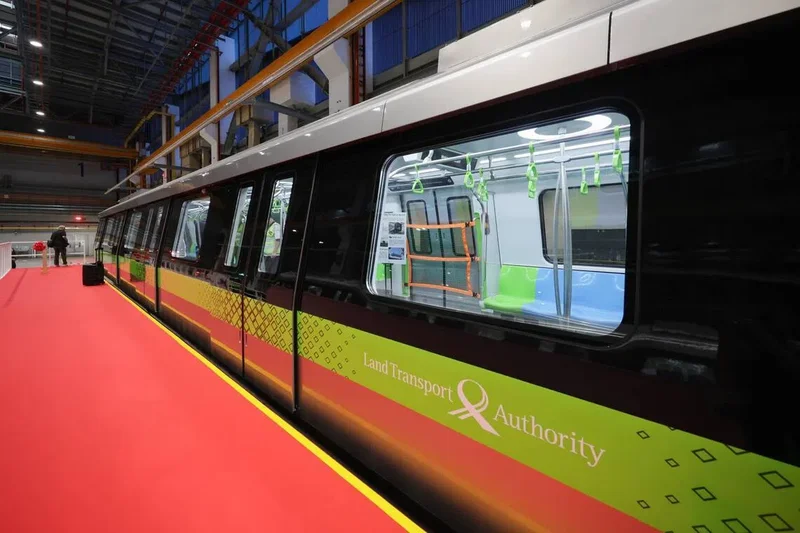
What to know about the new Cross Island Line trains
AI generated
SINGAPORE – Commuters can look forward to riding on a new batch of six-car trains when the first phase of the Cross Island Line (CRL) opens in 2030.
There will be 44 of the fully automated trains plying the line, and the Land Transport Authority (LTA) has the option to add another 11 in the future, when commuter numbers grow.
The first CRL train arrived ahead of time on May 31, and the rest of the China-made trains will be delivered in stages to Singapore from 2027.
Sporting a dash of lime green on its exterior, the first train is undergoing testing at the Singapore Rail Test Centre in Tuas, where it will be put through the paces to ensure it meets safety and performance standards. There will be further tests later, on the Cross Island Line track.
Once tests are completed, the train will then be returned to the manufacturer – the consortium of CRRC Qingdao Siffang Company and Singapore CRRC Sifang Railway Vehicles Service – for final touches, before coming back to Singapore.
LTA on July 31 said the trains have features that “improve commuter comfort, accessibility, operational reliability and maintenance efficiency.”
These include:
Five doors on each side
Like the Thomson-East Coast Line, the CRL trains will have five doors on each side, unlike most trains on existing train lines, which have four doors on each side.
More doors mean more commuters can get in and out of trains faster.
The new CRL trains also have something called micro sliding plug doors, which help shore up noise insulation.
Greater energy efficiency
The new trains will use a 1,500-volt direct-current overhead conductor rail system, which is more energy efficient than a typical 750-volt direct-current third rail system.
Only the North East Line employs an overhead system, with other lines using a third rail, which means the trains derive power from the train tracks.
LTA said an overhead system suits the demands of a long, high-capacity underground line like the CRL, which will be Singapore’s longest fully underground MRT line when completed.
Automated systems and smart monitoring
To enable a fully automated and driverless operation, the trains will use a communications-based train control signalling system.
This means they can exchange real-time location and speed data with trackside systems that monitor train locations, calculate safe distances, and signal them to speed up or slow down.
Built into the CRL trains are monitoring and diagnostic systems that can detect any equipment fault early.
There will also be new built-in functions, such as axle box and gearbox monitoring.
Some of the trains will also come with an automated track inspection system, which enables them to monitor the conditions of the running rail and the overhead conductor rail in real time.