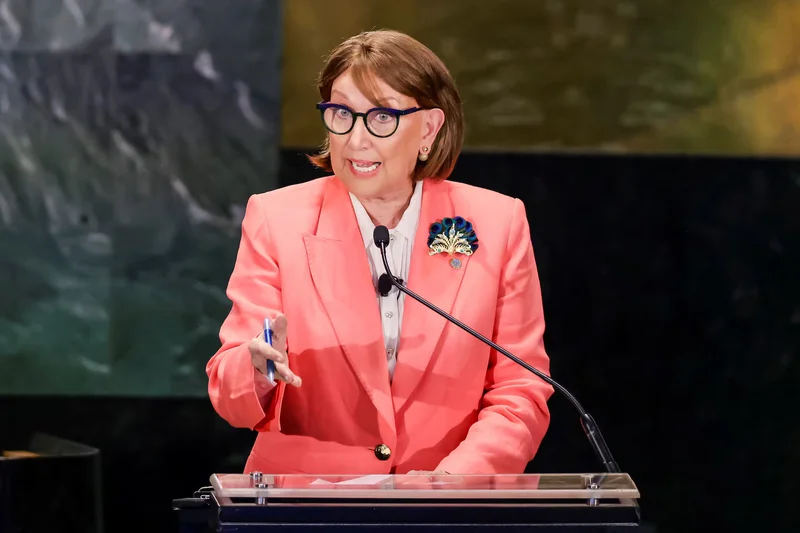
Grynspan UN Secretary-General Bid Leads First Straw Poll
Latin America · Politics
Grynspan UN Secretary-General candidate Rebeca Grynspan of Costa Rica led the first informal straw poll conducted by the United Nations Security Council on July 30, 2026, placing a Latin American woman as the early front-runner to succeed António Guterres.
The First Test of Viability
The UN Security Council held its first secret straw poll to gauge the viability of seven declared candidates vying to become the world’s top diplomat.
The process aims to replace Portugal’s António Guterres, who steps down at the end of 2026 after serving two five-year terms.
In this initial test, Grynspan secured 10 “encourage” votes against just 1 “discourage” and 4 “no opinion” ballots.
The result signals strong initial support inside the 15-member Council, though it does not guarantee final selection.
Who Is Rebeca Grynspan?
Rebeca Grynspan is a Costa Rican economist and former vice-president of her country, currently serving as the head of the UN Conference on Trade and Development (UNCTAD).
She is a familiar face in global diplomacy, having previously held senior roles at the Ibero-American General Secretariat and the UN Development Programme.
If successful, Grynspan would make history as both the first woman and the first Jewish person to hold the post of UN Secretary-General.
Her candidacy benefits from a broad consensus that the next Secretary-General should come from the Latin American and Caribbean Group (GRULAC).
The Competition and Regional Dynamics
Grynspan did not run unopposed. Carolyn Rodrigues-Birkett, a former foreign minister of Guyana, placed second with 9 “encourage” votes, 2 “discourage,” and 4 “no opinion.”
Argentina’s Rafael Grossi, the director-general of the International Atomic Energy Agency (IAEA), came third with 7 “encourage” votes, 2 “discourage,” and 6 “no opinion.”
The full field of seven candidates includes Michelle Bachelet of Chile, Maria Fernanda Espinosa of Ecuador, Macky Sall of Senegal, and Olara Otunnu of Uganda.
Five of the seven contenders hail from Latin America and the Caribbean, a region that has never held the post and argues its turn has come.
Why the Straw Poll Is Not a Final Result
It is critical for foreign observers and investors to understand that the straw poll is an informal, non-binding exercise.
The secret ballot simply tests the temperature of the Security Council, allowing candidates to gauge their support without a formal nomination.
The Council will eventually hold multiple straw polls before formally recommending a single nominee to the 193-member General Assembly.
Any of the five permanent members – the United States, China, Russia, France, or the United Kingdom – can veto a candidate at any stage.
A front-runner in the first poll has historically not always become the final Secretary-General.
What Comes Next
The Security Council is expected to hold additional straw polls in the coming months, potentially introducing color-coded ballots to distinguish votes from permanent and non-permanent members.
This mechanism reveals whether a leading candidate faces a veto threat from a major power, which can instantly sink a candidacy.
The selection process remains highly opaque by design, balancing regional rotation with geopolitical strategy.
For the international community watching from Latin America, Grynspan’s early lead is a significant diplomatic signal, even if the race is far from over.
Frequently Asked Questions
Is Rebeca Grynspan now the UN Secretary-General?
No. The July 30 straw poll is an informal and non-binding test of viability. The Security Council must still hold further polls and formally recommend a single candidate to the General Assembly.
Why are there so many candidates from Latin America?
Many UN member states argue it is the turn of the Latin American and Caribbean Group (GRULAC) to hold the post, as the region has never produced a Secretary-General.
Can a permanent member block Grynspan’s candidacy?
Yes. The United States, China, Russia, France, and the United Kingdom each hold veto power and can block any candidate during the formal recommendation process.
Sources & Further Reading
PassBlue · Reuters · The Globe and Mail