Negeri Sembilan polls: Can BN-PN pact to target Malay vote defeat PM Anwar’s coalition?
Negeri Sembilan heads to the polls on Aug 1, with Prime Minister Anwar Ibrahim’s Pakatan Harapan pact battling to retain power in the face of a Malay-Muslim unity narrative spun by Barisan Nasional and Perikatan Nasional.
SEREMBAN, Negeri Sembilan: For United Malays National Organisation (UMNO) member Mohd Wan Riduan, 65, slipping on his Barisan Nasional (BN) vest and cap no longer carries the awkward sting it once did.
Gone are the days he had to defend BN’s alliance with traditional rival Pakatan Harapan (PH) in the state of Negeri Sembilan to others.
Today, the retiree firmly backs BN’s new electoral pact with Perikatan Nasional (PN). UMNO is BN’s lynchpin party.
While party loyalty had compelled him to back PH in the 2023 Negeri Sembilan state election, the political landscape has shifted ahead of Saturday’s (Aug 1) state polls.
“I think BN going with PN is a much better fit compared to PH. There is unity among the Malay parties,” said the hardcore UMNO supporter, who is voting in Sikamat constituency.
PN is Malaysia’s largest opposition coalition at the national level, whose cooperation with BN to unite the Malay vote has been a major theme in the Negeri Sembilan hustings.
Mohd Wan said many of his close friends who were fellow UMNO members had chosen to sit out the last election in protest against the pact with PH, but things will look different at the ballot box this time.
“When BN was with PH, I was teased and labelled 'UMDAP' until it rang in my ears,” he told CNA at a PN campaign event on Jul 29.
“UMDAP” is a blend of “UMNO” and “DAP” or Democratic Action Party, which is part of Prime Minister Anwar Ibrahim’s PH pact and has traditionally drawn support from non-Malay voters.
“People were really angry, and even within my family, there were so many disagreements over this. I am relieved they have now chosen to go with PN. Today, I can wear my vest and cap proudly,” said Mohd Wan.
Mohd Wan's sentiments capture a broader mood shift that could spell trouble for PH in Saturday’s polls, said political analysts and observers.
PH won 17 out of 36 state seats in Negeri Sembilan in 2023 while BN won 14 and PN, five.
Hisommudin Bakar, executive director of the research firm Ilham Centre, told CNA that during the 2023 Negeri Sembilan election, PH had to rely heavily on votes from BN supporters to secure victory and ultimately form the state government, he said.
"The political alignment has completely changed with BN and PN joining forces. This alignment looks like it is enough to ensure their victory,” he said.
PH had collaborated with BN in Negeri Sembilan in 2023 after both coalitions formed the federal unity government following a hung parliament in the wake of the 2022 general election.
While they remain partners at the federal level, the dynamic on the ground at the state level has fractured. PH and BN are now taking each other head-on - a friction first seen in the Johor polls last month, where BN swept 48 of the 56 contested seats.
In Negeri Sembilan, BN has forged a strategic pact with component parties of PN, especially Parti Islam Se-Malaysia (PAS).
This time, BN is contesting 25 seats, while PN component parties will contest the remaining 11, ostensibly so that they will not split the Malay vote.
However, the Malay-centric Parti Pribumi Bersatu Malaysia (Bersatu), whose ties with its PN partner PAS have soured, is notably running under its own logo and will be contesting 24 seats.
A party or coalition needs to win at least 19 seats to form the government in the state legislative assembly.
In a report on Friday, Ilham Centre said the PN-BN pact was on track to win at least 22 seats, while PH is projected to win at least nine seats. The remaining five seats however were difficult to predict, it said.
“The issue of Malay vote consolidation, political stability, and the need to prevent a PH victory were themes consistently repeated until they successfully influenced a large portion of Malay voters, including fence-sitters.
“The direct impact of this is that BN successfully strengthened its grip on almost all of its traditional strongholds, while PN reaped the benefits in the areas they contest through the spillover of votes from BN supporters,” said the centre.
It added that PH faces a deficit among the non-Malay voters, who have traditionally supported the coalition.
“Aside from a deficit in Malay support, they also failed to maintain maximum support among their own core voters,” said Ilham Centre.
Its prediction was based on fieldwork from Jul 18 to Jul 30, combining quantitative and qualitative methods such as face-to-face questionnaires, focus group discussions, and in-depth interviews.
The study involved 1,002 respondents, six focus groups, and 38 in-depth interviews, and had a 3.1 per cent sampling error, it said.
SECURING THE MALAY VOTE
BN and PN leaders told CNA their core objective is capturing the Malay vote to secure a decisive victory over PH.
Of Negeri Sembilan’s 23 Malay-majority seats, Malays make up over three-quarters of voters in 11 seats.
“Because of our pact with PN, I believe the Malay votes will not be split and the chances of winning are much better compared to last time,” said Mustapha Nagoor, who is the Negeri Sembilan UMNO secretary-general.
Mustapha will be defending his Palong seat, which he had won with a slim majority of 564 votes against a Bersatu candidate in 2023.
In 2018, he had won with a majority of more than 6,000 votes.
Mustapha said Malay voters could not accept the ideology of PH, especially that of DAP.
“I personally don’t have any problems working with any party but many of the UMNO voters did not come out to vote in 2023. And many of those who came out to vote gave their votes to PN at the time,” he said.
“In the Malay belt, voters want to see BN and PN work together,” he added. “Theoretically, the pact between PN and BN is more harmonious for the state.”
In 2023, BN scraped through with narrow majorities across multiple seats, while PAS made history by capturing its first-ever seats in the state on the back of rising Malay-majority support.
PAS information chief Ahmad Fadhli Shaari told CNA that BN and PN needed to collaborate to defeat PH, which he claimed was afraid of unity among Malays and Muslims.
“We can work with BN and I think they have realised that. They have learned from what they went through in the last three years (with PH in Negeri Sembilan). I am confident that there will be vote transferability for both sides,” Ahmad Fadhli said.
Wawasan secretary-general Saifuddin Abdullah is cautiously optimistic that the partners will win at least 20 seats. Wawasan is also a PN component party.
“As far as the campaign is concerned. I think it is very clear that BN leaders are openly saying to vote for PN candidates and vice versa. So I'm very hopeful that there will be a transfer of votes between the two blocs,” he said.
Analysts, too, expect PN-BN to sweep the Malay seats, although they said voter transferability between both sides was not equal.
The cooperation works more with PAS voters as they are known to be more likely to follow the direction of its president Abdul Hadi Awang, said political scientist Syaza Shukri of the International Islamic University Malaysia (IIUM).
Younger voters may also be more transferable than older ones, she said. This is because older voters may remember the intense rivalry between UMNO and PAS in the more distant past.
“I don’t think the younger voters are aware of the takfir movement,” said Syaza, referring to rival party members accusing each other of apostasy (takfir) due to differing views on Islamic governance that went back as far as the 1980s.
Hisomuddin estimated a 30 per cent shortfall in vote transferability - noting that PN voters were more inclined to back BN candidates than the other way around - yet maintained that the margin was still comfortable enough to secure the Malay-majority seats for the two blocs.
He also estimated that PH currently commands only 18 per cent support among the state's Malay population, highlighting a significant support deficit compared to the BN-PN coalition.
Ong Kian Ming, an adjunct professor at Taylor's University, also predicted that BN-PN is likely to take control of Negeri Sembilan by winning between 23 and 25 seats.
“With the electoral pact between PN and BN, it is very likely that Malay support for both of these coalitions will exceed 70 per cent and allow candidates from both coalitions to avoid splitting the Malay vote – which allowed PH to win a number of seats in the state election in 2018,” he wrote in a commentary published by several local media outlets on Jul 27.
In the 2018 election, PH had contested in three-cornered fights against BN and PAS in the majority of seats.
DAP THE TARGET OF ATTACKS
On the campaign trail, both BN and PN leaders have predictably targeted DAP to stoke Malay voter sentiment, analysts observed.
Hisommudin noted that BN and PN have synchronised to make DAP the focus of their attacks.
“This element is very effective because identity politics easily triggers voter emotions compared to other factors. PN is most clear in campaigning by using racial elements and indirectly framing DAP as a threat to the Malays,” he said.
UMNO secretary-general Asyraf Wajidi Dusuki has, for example, openly asked voters whether they wanted DAP secretary-general Anthony Loke to become the state’s chief minister – despite the state constitution requiring a Malay-Muslim occupant.
Leaders from BN and PN have also pushed claims that DAP exerts total control over PH.
A Rembau UMNO leader went as far as to claim DAP controlled the Negeri Sembilan palace.
Syaza said the BN-PN rhetoric centres entirely on removing DAP's influence, regardless of incumbent chief minister Aminuddin Harun's administrative performance.
“It’s been played up so much over the years, especially since 2018 … The whole ‘Malay-Muslim threatened’ narrative is very effective, especially in a competitive state like Negeri Sembilan where it can go either way,” she said.
PN election director Muhammad Sanusi Md Nor also created a stir on the campaign trail by asserting that Malays “have no other homeland”.
Claiming that Malaysia’s ethnic minorities retain ancestral ties elsewhere, he asserted “Malays only have this land”.
BN distanced itself from the remarks, with UMNO president Ahmad Zahid Hamidi warning Kedah chief minister Sanusi against stoking racial tensions in a multiracial society.
“If you want to be friends, be sincere or else just stay put in Kedah and focus on governing the state,” Zahid was quoted as saying by The Star.
As for the royal impasse that triggered the premature snap election, Syaza observed that it has largely taken a back seat, carrying limited weight in influencing voter decisions.
Hisommudin, however, noted that for voters practising adat perpatih, the customary matrilineal system unique to the state, chief minister Aminuddin’s actions of appearing to take sides breached protocol, as political actors are traditionally expected to remain neutral in customary matters.
“But overall this crisis is not a major issue being discussed by the majority of voters,” he said.
WHAT IS PH'S RESPONSE?
Observers say PH has tried to showcase its manifesto and achievements as the incumbent, but its efforts seem to be drowned out by the Malay-unity rhetoric.
PH component party Amanah’s communications director Khalid Samad admitted that the Malay-unity narrative of PN and BN was making it difficult for PH to woo the Malay electorate in Negeri Sembilan.
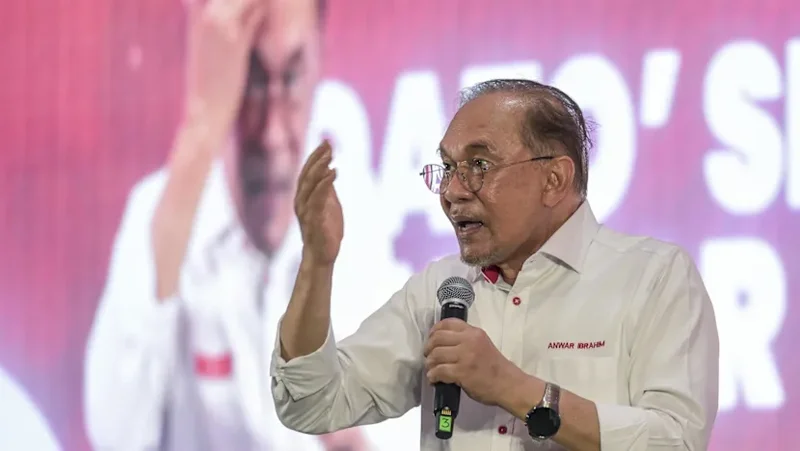
PM Anwar also addressed the narrative that the position of the Malays would be threatened.
"Whichever party (is in power), the kings will be Malay....The Prime Minister must be Malay," he said, adding that top institutional roles such as the leadership of the military and the central bank are likewise held by Malays.
"Find a good Malay to look after the country. Take a Chinese who is honest and hardworking. Anthony Loke is the Transport Minister. It's the same with Indian (leaders)," he said. ** **
DAP chief Loke, who is defending his Chennah seat, has been on the defensive against multiple personal attacks despite telling CNA in a recent interview that he wanted to run a “positive campaign” that included what PH could do for the people.
He said in an interview with The Edge Malaysia published this week that a PH defeat in Negeri Sembilan would have “quite big” implications for the survival of the federal unity government.
He also said political survival ultimately comes down to electoral strength.
“Politicians will only speak the language of strength. If you do not have electoral strength and political strength, then we are, of course, on the chopping board,” he was quoted as saying.
Meanwhile, Aminuddin’s decision to contest in the UMNO stronghold seat of Linggi – shifting away from Sikamat after four terms – has raised eyebrows, but he has expressed confidence in PH’s footprint in the state.
Amanah candidate Bakri Sawir, who will be defending his Klawang seat, said he was not perturbed by the PN-BN pact. The constituency is made up of 65 per cent Malays, but Bakri said he did not receive many votes from UMNO voters in 2023.
He won by a slim majority of 577 votes in 2023, compared to 976 votes in 2018.
Bakri believes he has an advantage in a three-way contest against PN’s Danni Rais and Bersatu’s Mohd Adib Musa.
“If it was a one-to-one, then it would have been tough for me but if it is a three-cornered fight, I believe I have a better chance,” he said, adding that he was also optimistic that the Malay voters would give him their vote.
Some analysts believe that Bersatu may pull support from BN or PN in the 24 seats it is contesting, even if it does not win any seats.
Syaza viewed Bersatu’s decision to enter the race as driven primarily by political survival and the need to remain relevant.
She said it could still pose a challenge to the BN-PN alliance in specific constituencies like Labu, and this could inadvertently give PH the upper hand.
Bersatu has denied it is contesting simply to split the Malay vote, with its information chief Tun Faisal Ismail Aziz saying that PN's leadership had excluded the party from seat negotiations.
"If anyone is truly responsible for splitting votes, it is not Bersatu. The three-cornered fights happened because of PN's decision to sideline Bersatu during the seat negotiation process. If unity was genuinely desired, why was Bersatu not invited to negotiate?" he said in a Facebook post on Jul 29.
Amid these political calculations, some voters like lorry driver Hisham Zainal, 54, said they were uncomfortable with the increasingly "racist" narratives and identity politics of BN and PN during the campaign.
This, the Ampangan constituent said, would determine his vote on Aug 1.
“I admit that PH isn’t perfect and hasn’t delivered on all its promises, but they are doing their best. The other side just likes to provoke,” Hisham said.